Categories
Uncategorized

 Lesbian Ponies with Ambiguous Representation: Rarijack and Appledash

NOTICE

I want to start off by saying that there is a canon lesbian relationship in My Little Pony Friendship is Magic. Background ponies, Lyra and BonBon (LyraBon). They propose to each other. They get married. It’s cute. 

Contentious Lesbian Ponies

This post is about the more contested lesbian ships in My Little Pony (MLP). That being Rarijack (Rarity and Applejack) and Appledash (Applejack and Rainbow Dash). These ships aren’t just contested because they share a member, Applejack, which does spark some healthy debate within MLP fan spaces. The biggest reason they are still talked about to this day is because these ships were very ambiguously yet directly acknowledged within the franchise. 

Though these characters are shipped across the entire MLP franchise. The Appledash ship is more commonly associated with the classic Friendship is Magic television show (the one where they’re horses) and the Rarijack ship is associated with the Equestria Girls movies series (the one where they’re humans).

Rarijack (Rarity & Applejack)
Rarijack reconciling

Throughout the Equestria Girls franchise there are multiple places where fans impose queer readings of interactions between Rarity and Applejack. This is very common within fandom spaces, especially ones with a large queer audience. Because of the history of Hays Codes–a set of self-censorship guidelines imposed by Hollywood that often targeted explicit depictions of queerness–queer audiences are more prepared to read coded messages within their media in order to find the representation they are looking for. By this point in the greater MLP franchise the creators weren’t strangers to the fan shipping culture. And their response to the Rarijack ship was. . . Raggamuffin. . . and Dirk Thistleweed.
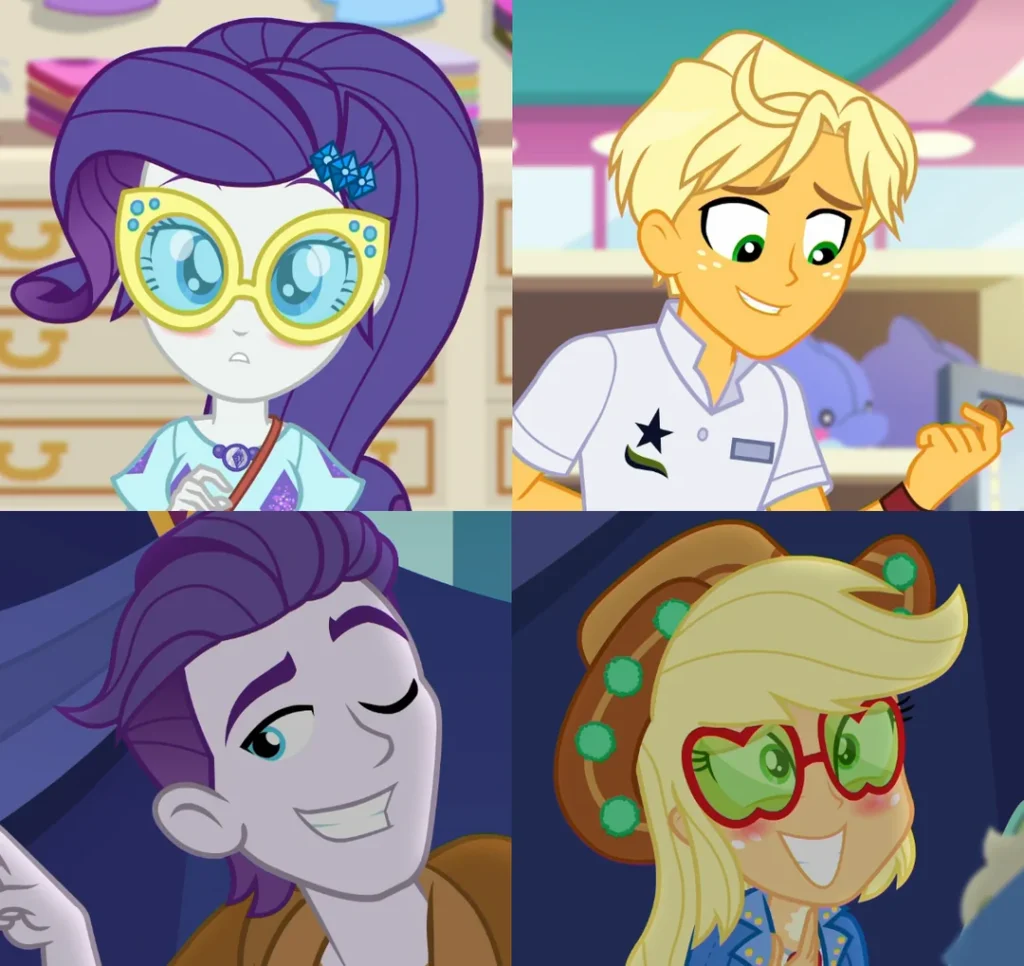
Top Left: Rarity, Top Right: Raggamuffin, Bottom Left: Dirk Thistleweed, Bottom Right: Applejack, https://www.reddit.com/r/mylittlepony/comments/ny9kdz/youre_trying_to_tell_me_this_wasnt_intentional/

Immediate reaction: 1) This was most definitely on purpose. 2) If they knew people were shipping Rarity and Applejack why create new characters that look like each other to pair together? 3) Why not just pair the girls together?

I understand that queer coding is sometimes a present and necessary part of how shows are able to include queer representation without receiving backlash from higher ups or unaccepting audiences. This hinting is sometimes the only tool available to creators when writing towards a mass (not specifically queer) audience. But that’s part of what confuses me about this approach. Everyone queer or not can see that Dirk is meant to be a stand-in for Rarity and Raggamuffin is meant to be a stand-in for Applejack, so it’s not properly “coded”. At the same time this queer ship is heavily popular within the queer parts of this fandom, so when catering to the people who enjoy this ship why would they opt for this kind of “coding” rather than explicitly depicting it. It feels very deliberate, like offering audiences a heteronormative alternative that simultaneously rejects queer readings of text, but acknowledges that there are queer readings of this relationship. It’s like that thing that hegemony does where it incorporates the subversion of itself within itself in order to gain more credibility and re-assert itself as correct and normal (Berlant & Warner, “Sex in Public”). 

Appledash
Appledash fist bump Season 9, Episode 6

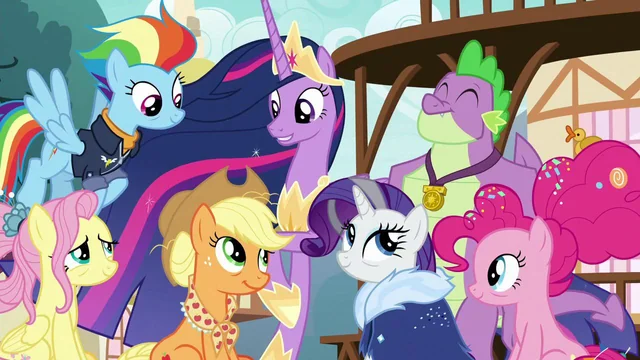
Appledash in the classic MLP television series is a little less problematic, but they have a lot less on-screen chemistry than Rarity and Applejack in Equestria Girls. In the series finale, The Last Problem (Season 9, Episode 26), when all of the mane six meet back up again, Applejack and Rainbow Dash enter princess Twilight’s throne room together, talking about doing chores like an old married couple. This for a lot of people was confirmation of the Appledash ship in classic MLP, but in all honesty outside of Fall Weather Friends (Season 1, Episode 13) Applejack and Rainbow Dash don’t really have a lot of episodes or even moments together. This depiction is closer to a more traditionally coded queer relationship, being ambiguous about the relationship, yet keeping the characters close. Even then the Appledash ship failed at communicating that sense of closeness throughout the previous 9 seasons, so this implied relationship, though welcomed, doesn’t feel earned.

Final Question

Is any of this representation? Especially if fans were gonna ship the ponies/girls anyway. What purpose does it serve to not fully engage with the audience? The creators are aware of the ships and seem to want to acknowledge them to give something to the fans, but these gestures feel empty and hollow (Warner, “In the Time of Plastic Representation”). Like despite trying to engage with queer readings of the characters, they don’t want to have explicitly queer characters. I do think that coding is a useful tool in art and not all queer relationships must be explicitly stated (Clark, “More Than Sex…”). Still I question what is the purpose of this specific kind of representation, that is disingenuous and heteronormative in essence? Would it have been better for the creators to leave the shipping content to the fans?

Bonus: Can you guess which ship is my favorite? Rarijack? Appledash? or a secret third option?

Categories
Uncategorized

“Nothing Ever Ends”: ‘400 Boys’ & the Flexible Bodies of Oppression

The Plot

“400 Boys” takes place in the post-apocalyptic Fun City, inhabited by Teams  led by Slickers. All the residents of Fun City have a psychic connection to the earth and each other, manifested in electric-styled telekinetic powers. In this story we follow the Brothers, a team that has survived the violent arrival of the 400 Boys. Guided by the unwritten, psychically understood, code of ethics of Fun City the remaining Teams band together to run the 400 Boys off their turf and avenge the fallen Teams.

Video & Short Story

My analysis looks at both the 1983 original short story by Marc Laidlaw, published in the popular OMNI science fiction magazine and the 2025 “Love Death & Robots” adaptation, published by Netflix. It’ll incorporate quotes, depictions, and characterizations built from both renditions and I highly recommend reading/watching both. *It’s liked through the images.*

400 Boys (2025) – 15 minute watch

angular silhouettes of five people walking through the burning rubble of a post-apocalyptic city
400 Boys Love Death & Robot’s Netflix Poster

400 Boys (1983) – 20-ish minute read

Cover of the November 1983 Issue of OMNI science fiction magazine

Since I am going to be looking at both versions of the story, there are some key differences between the  1983 version and the 2025 version that should be acknowledged in order to better understand my analysis. The 1983 rendition gives us more insight into the history of the characters and their world, this is primarily because this version is told through the perspective of one of the Brothers, Croak. There are additional characters, teams, and locations present in the 1983 original short story. Another major difference is in the depiction of the actual 400 Boys. In the 1983 story there are actually four hundred giant boys about the ages of seven or eight, while in the 2025 adaptation there are three giant babies. The effects of the Fun City inhabitants’ psychic powers also impact the 400 Boys differently. They shrink the 400 Boys down to double average height in the 1983 story, but only temporarily deform the 400 Boys in the 2025 version.  Much of the lore of the world remains the same, but the exact phrasing of things and who says them changes slightly.

The 400 Boys
the 400 boys from the 2025 Netflix adaptation, depicted as 3 giant towering babies
400 Boys towering over inhabitants of Fun City.

The 400 Boys. Let’s start by just breaking down their name. “400” can be interpreted as a reference to the Forbes 400 List of richest people in the world, creating a direct connection between the 400 Boys and capitalistic pursuits. “Boys” is in reference to their masculinity, which must be understood through a liberal (and neoliberal) perspective that “values individual agency as the ultimate goal of organized politics and recognizes the rights of individuals on the basis of their universal humanity” (Fawaz, pg.7). This is reflected in their descriptions in the 1983 short story as, having eyes with . . . “a vicious shine like boys that age get when they are pulling the legs off a bug — laughing wild but freaked and frightened by what they see their own hands doing” (Laidlaw).

Kids at the ages of seven and eight can still be very egocentric, functioning solely off of their own perception of the world around them. Oftentimes crafting it into their own imaginings as they see fit.

This kind of ego-centrism parallels the individualism that characterizes liberal philosophies. Additionally the reckless abandonment of the 400 Boys as they move through Fun City function similarly to that of capital owners, like the Forbes 400, in late capitalism. 

Another important aspect to the 400 Boys that connects them to ideas of neoliberalism is illustrated in their youth and regenerative abilities from the 2025 Netflix adaptation. These powers make the 400 Boys much stronger than the people of Fun City and act as a visual representation of their flexibility, the kind of flexibility that McRuer describes as necessary to the function of neoliberalism. It requires flexibility in order to capture niche and individualized audiences in both the labor and consumer markets, expand and contract. This flexibility acknowledges differences in order to reaffirm its own normalcy/supremacy. 

Finally, when the 400 Boys enter Fun City, they arrive violently. In the 2025 Netflix adaptation, Old Mother, matriarch of the Galrogs, proclaims that they are here to smash (i.e. battle, fight, war). Narratively the 400 Boys are acting as physically an oppressive force to the people of Fun City, similar to late capitalism and its other hierarchical manifestations of racism, misogyny, ableism, homophobia, transphobia, etc.

It was the end of the world.
There were wars in the south.
Bonfire made out of cities.
Bombs going off like fireworks.
The world was broken.
And beings from the outside
oozed through the cracks.
And now they want to smash.
---
Nothing ever ends.
Fun City

It is important to acknowledge the alternative depiction of masculinity provided by the inhabitants of Fun City. Similar to how Fawaz describes the new mutant generation of superheroes, the Teams of Fun City are like superhero teams and found families. They’re known by their Team names and have individual nicknames as well, often in reference to their abilities. 

When HiLo is first introduced he initially denounces the title of Slicker, because he understands that he can’t be a leader without a team. It is in this fallen state that Slash sets aside his aims of revenge to help HiLo fight off the 400 Boys and avenge the Soooooots. This is the first example of the “fluxability” Fawaz defines in “From American Marvels to the Mutant Generation”. There is the traditional masculine-aligned value of revenge—particularly for Slash—that is set aside due to empathy, which can be interpreted as vulnerability. The kind of “masculinity” developed in Fun City in order to survive is constantly being balanced with the vulnerability of the individuals and the Teams. Again they are all psychically connected at some level. For Fun City masculinity functions differently than it does for the 400 Boys, which is why they are able to come together in the end as  Fun City to smash against the 400 Boys.

Love, Death & Robots: Volume 4 | 400 Boys | Netflix
https://www.facebook.com/watch/?v=1207764200800638

HiLo’s rallying cry in this video gives you a better understanding of how the 400 Boys act as oppressive forces and why the Teams of Fun City felt it necessary to fight back.

There’s probably more I could say about symbolism of the Teams and the individual members and dynamics, and all with more nuanced references to Fawaz and McRuer, but I’ve decided that I’ve written enough.

Categories
Uncategorized

“She wasn’t like this with Ralphy”: Gestures in Black Mirror’s “Hotel Reverie”

Main Plot

In this episode of Black Mirror we follow the actor Brandy Friday (Issa Rae) as she’s looking for her next big role, not one where she’s playing the sidekick or love interest, but the main lead. She finally finds the opportunity in the role of Dr. Alex Palmer from the in universe 1940’s classic “Hotel Reverie” by Keyworth Studios. Utilizing “Redream” technology, Brandy Friday is transported into the movie. “Redream” uses technology to build an entire simulated universe based on the final copy of the movie. Then actor(s) are able to upload their likeness(es) and consciousness(es) into the simulated movie universe as already present in-movie characters and play the role. Everyone in the movie only understands themselves as really being the characters they portray and everything they do and experience feels real and authentic to them. To remaster this classic film, Friday’s full likeness and consciousness is put into a simulated movie universe, and even though the original Dr. Alex Palmer was played by a white man—Ralph Redwell—while Brandy Friday is a black woman, everyone in the simulated movie knows her as Dr. Palmer. That is to say the simulated characters do not discriminate against her based on her race or gender, they treat her like Dr. Alex Palmer, but one simulated character does take notice of this difference in gender especially. Clara Ryce-Lechere—in universe played by Dorthy Chambers (Emma Corrin)—is the unhappily wedded heiress to the Ryce-Lechere fortune, target of her husband’s multiple murder plots (to inherit her fortune), and the love interest of Dr. Alex Palmer. Dr. Palmer is meant to fall in love with Clara and save her, but the boundaries between Brandy Friday – Dr. Palmer and Clara Ryce-Lechere – Dorthy Chambers begin to blur, complicating their relationship and possibly raising ethical questions about the use of “Redream” technology within the film industry.

“Seduction Scene”
“Seduction Scene – Hotel Reverie.” Black Mirror, created by Charlie Brooker, season 7, episode 3, Brooke & Bones, 10 Apr. 2025. Netflix, https://www.netflix.com/watch/81716299?trackId=14170286

The scene starts at about 34 minutes into the episode. After Clara sprains her ankle on the stairs outside of the hotel, Dr. Palmer brings her up to her room. Clara sits in a chair and takes her heels off while Dr. Palmer kneels and asks to check her swollen ankle. Clara raises her foot to Dr. Palmer’s chest as she holds her foot in one hand. Soft and gentle orchestral music begins to play in the background. As Clara goes to pull down her stocking, she looks up to see Dr. Palmer looking down with an empty stare. As Dr. Palmer looks up at her with glittering eyes Clara stops for a moment. She looks off to the side with a contemplative look on her face before blinking herself back into reality. Once her stocking is completely off of her leg, Dr. Palmer begins to conduct the examination. Clara says that Dr. Palmer’s touch “doesn’t hurt at all”.  At her ankle they joke about her being able to join the Bolshoi (a prestigious ballet academy in Moscow Russia). Still she asks Dr. Palmer to “try a little bit higher” to “make certain” of the diagnosis.  Friday moves further up. Now at her calf, Friday asks if she’s in the correct spot. With a small gasp Clara tells Friday, “that’s good”. Friday moves further up and asks again. Finally at her knee, Clara gasps again, repositioning herself in her chair. Friday asks “Is that tender?” Clara quickly responds, almost sighing “Ever so tender.” In the real world the license holder/script supervisor, Judith Keyworth (Harriet Walter) comments. . .

There is a knock on the door. The tune changes to something more sinister and suspenseful. It’s the ice that Dr. Palmer requested for the swelling, but it came with champagne that wasn’t ordered. While the second murder plot is set into motion—a scorpion is released from underneath the bedskirt—Clara invites Dr.Palmer to stay for a drink. Friday knows of the scorpion and saves Clara by trapping it beneath a coup glass. Clara shoots up from her chair, placing her hand on Dr. Palmer’s chest and thanks her for saving her life. Once the danger is thwarted their eyes lock and they passionately kiss, pulling each other closer, as romantic music swells in the background. Keyworth comments again. . .

Analysis
Dr. Alex Palmer/Brandy Friday (Issa Rae) on the left, Clara Ryce-Lechere/Dorothy Chambers (Emma Corrin) on the right.

I think it’s in this scene that Clara’s character moves from object to subject, especially as she begins to embody more of Dorthy Chambers’ characteristics. She gains a greater sense of agency in her gestures that express a desire for more contact with Brandy Friday’s Palmer. Brandy has already entered this role with agency and self-consciousness that surpass Clara’s digitally generated consciousness, i.e. Brandy knows she’s in a movie and Clara doesn’t. Yet Brandy is still in love with both the real life Dorthy Chambers and the character of Clara who embodies her. 
Gesture is used throughout the scene to indicate an attraction between Clara/Dorthy and Brandy/Dr. Palmer that goes beyond the characters that they are playing. In this scene Brandy’s eyes are glittering as she looks at Clara with a mesmerized look on her face. Throughout the entire episode Brandy’s eyes linger on Clara even past the moments where the original movie scene would’ve ended. When Clara takes a little bit longer—looking off to the side, thinking about whether or not to pull her stocking further down for Brandy to check for swelling before eventually doing so; every one of Clara’s gasps and  Brandy moved her hand further up Clara’s leg are evidence of their mutual understanding and attraction between them. These gestures allow them to speak in this language of potentialities, “out of sound’s reach” (Rodriguez, Queer Futures).

Brandy and Clara looking out of a door.
Brandy and Clara looking out of her hotel door. Occurs shortly after the scene I talk about, “Seduction Scene”.

There is so much more that I could talk about when it comes to “Hotel Reverie”, but I’ll stick with gestures because I’d be writing too much and it’s my birthday. Here’s the link to the rest of the episode on Netflix, so you can watch it for yourself. <3

Categories
Uncategorized

Working Class Song

About a month ago the song Hard For (2016) by Kevin Gates made a resurgence on TikTok, or at least on my For You page. The official sound has over 86.1 thousand posts, most being James Charles memes –ugh, i know– and people making generally –subjectively– uninspired and unassuming TikToks. The few videos that are entertaining –again subjectively– are the edits of fictional characters and car commercials that utilise the song. One of the most popular edits, with over 2.2 million views, is one of a Ford F-150 commercial, Forward March (2015). They fit very well together, somehow finding a way to perfectly compliment each other’s energy. This edit, shown below, was posted by @editnicole2323 (Nick) on TikTok.

DISCLAIMER: This song, especially the chorus, is kinda silly. I realise that. Though that doesn’t mean it’s not deep and you can’t read into its message. I’d recommend taking the extra 4 minutes to listen to the full song. 

It is difficult to analyze Nick’s TikTok in isolation because it exists within an ecosystem of comments, reposts, and other TikToks that help build a collective understanding of its meaning and why the song being visualised by this Ford F-150 commercial makes so much sense. I’ll. Try. Anyway.

The Song

Gates offers a narrative of a man, particularly a black American man, who has invested his time and energy in the ways in which American society has ascribed to black men. Within this narrative you hear Gates describe drug related gang violence, which he compares to the mafia, “Luca Brasi” is in reference to The Godfather, and the hyper-sexuality of black men and their objectification by women, highlighted in the chorus.

Mistakin' it for trust, starin' right in the eyes
Women say they love, but never more than the eyes
You the only one that my dick could get hard for
I'm confused, what the fuck you want my heart for?
You the only one that my dick could get hard for
I've been misused, what the fuck you want my heart for?

At the same time Gates understands that the life he’s describing is one that’s unfulfilling and constantly puts him and his loved ones at risk of being harmed. His emotional detachment in his romantic relationships, seeing his only value as his sexual availability, is related to the necessity of emotional detachment required to pursue a dangerous and violent line of work. Gates speaks towards a kind of masculinity that does privilege his male identity; tough, virile, aggressive, emotionless, financial prowess, etc. But in recognizing his identity as a black man in America these qualities not only reproduce stereotypical images of black masculinity, but reproduce the conditions in which this form of masculinity is required to survive. Think of the role that organized crime plays in the prison industrial complex, which targets black men. 

The Ad

The March Forward ad offers a more commercial image of masculinity. It is important to note that the only bodies visually represented in the commercial are the bodies of white men (and trucks). This ad isn’t selling the trucks as much as it’s selling access to this “more desirable” kind of masculinity that has white men as the face of it. Similar qualities of masculinity are exemplified in Gates song and Ford ad; toughness, hard labor, heavy machinery, dangerous work environments, etc. The original audio of the ad is a man with a deep voice narrating all of the benefits and perks of the new Ford F-150 on top of an industrial electric guitar instrumental. They take care to show the shiny new trucks in contrast to the hard working men, who have mud and dust and dirt all over their bodies. These men are also wearing protective equipment appropriate to their job sites. It sets up this image of rural masculinity with the depiction of blue collar men and country-type guitar based music, and then it says “this brand new truck is for you, working class American man”. Ford is an American company. This is a white kind of masculinity. It’s hard working and rural identity serves as a benefit not a hindrance, allowing it to be associated with the new shiny, most likely expensive, trucks that the all-American Ford company sells.

An Intersectional Analysis of a TikTok Edit

In the edit the deep voice of the ad’s narrator is replaced by Gates’ gravelly singing voice. The guitar remains a musical staple, but the genre moves away from rock and roll and towards a hip-hop sound with a much stronger beat, both genres of music pioneered by black Americans. This elevates the image of masculinity that’s depicted by the ad, but specifically feeds into the conception of masculinity as aggressive and tough. All together it becomes a working class song to sell a working class car to a working class man. Which is a service to the Ford ad, but a disservice to black American men entrapped by this stereotype. Still the reason why so many people in the comments of this edit recognize it as being “so blue collar” -@jaydalashae or “so American” -@Serena127/7 is because of its emphasis on this hard working class kind of masculinity, that relies heavily on black American influence, whether it be the rock and roll sound of the original ad or the new energy provided by the Kevin Gates song. Again this builds a concept of masculinity that isn’t a real material benefit to anyone. Gates recognizes the unfulfilling aspects of these masculine stereotypes for black American men in Hard For, while the ad is able to bolster and sell this ideal version of masculinity through its American trucks and white men. American men need to buy it, their manhood, because they don’t already posses it, the truck.

I’ve come to the end of this blog post to realise, I don’t fully have a point. I just wanted to share this observation. I don’t think Nick was purposefully making any commentary when putting together this edit, but the conversation is in why this song and this ad fit so well together. Why are they so complementary to each other? Why is this even a relevant conversation to have? It’s probably along the lines of it being important to recognise that there isn’t just one type of man, and masculinity (and its expectations and stereotypes) impact men differently based on other relevant identity factors. . . or something like that.