This bollywood movie is about girl who is still living in a very patriarchal household and society in Delhi, India. There is a contrast between her ideals, and the city bustling around her. A day before her wedding, she gets broken up with. Having been looking forward to her honeymoon trip, she decides to go on the trip alone since she already had the tickets.
The movie shows a very interesting journey of this girl who had no exposure in her life, taking such a massive step and going on this literal/physical journey alone, suddenly in a new world unfamiliar to her after heartbreak. We see her go to places she wanted to with her fiancé alone, but surprisingly she starts to find her own confidence and journey because of this. As the audience we expect her to find love or go back to her ex, but she never does. She makes friends, gets more confident, changes her wardrobe. Instead of a big overnight transition, her journey happens slowly. She still wears traditional prints, now mixed with modern cuts – the movie uses fashion to portray her emotional journey, which is a treat to watch.
We see her react and act within her inbuilt patriarchal notions, and when her ex finally does come back, we see what it looks like for a self-confident and now ‘modern’ woman to respect herself while still living in the same society.
The film works because it is an accurate portrayal of modern patriarchy. A kind of heteronormativity that exists in connection with now old ideas. Without giving too many spoilers, this movie was an amazing watch. And the transition Rani (‘Queen’ in Hindi) has is so refreshing – no sudden transitions or disrespect, but the story of a woman slowly finding herself without losing her core values.
I see a lot of intersectionality play out in fan fictions, particularly ones where the media does not have any inbuilt. Harry Potter has had a cult following around the world, while its author has faced several allegations of being racist, homophobic and transphobic. As a result, the fandom which has loved the work for decades, decided to take matter into their own hands.
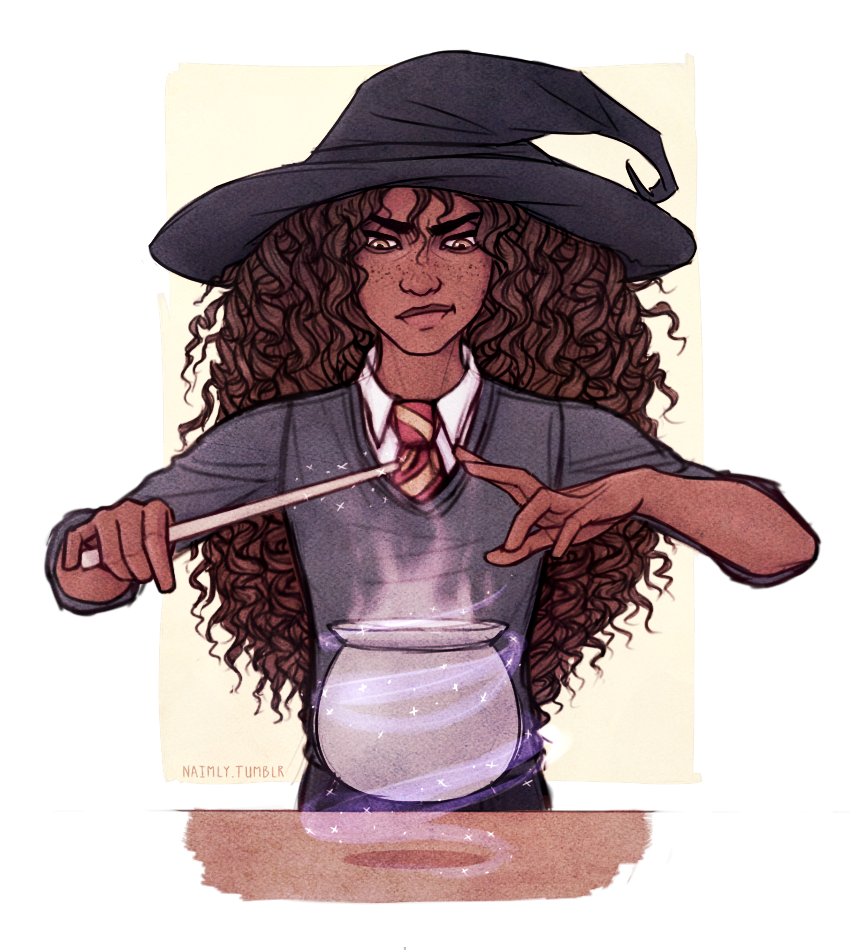
Not only are characters read as queer or gay, but also perceived to be different races. One of the main characters is Hermione Granger, who grew up in London and is characterised to have frizzy long hair. People decided to portray her as a Black character, as her roots and characterisation would fit this character image. Additionally, it was not specified in the books that she wasn’t, and that made it easier to see her in this light.
This fandom and queer reading has really spread. Multiple queer readings of characters in the series are seen in the top 10 of fanfics on AO3. Wide acceptance of intersectional readings spread into more canon depictions as well. When Cursed Child came out, the first Broadway production of this show even cast a black actress as Hermione.
There is a relationships fans have with such works, where a fandom pressure can bring representation to original works and how they are perceived.
Although having original representations is important, there is something to be said about reading queerness into such well known works, and then having them being made canon!
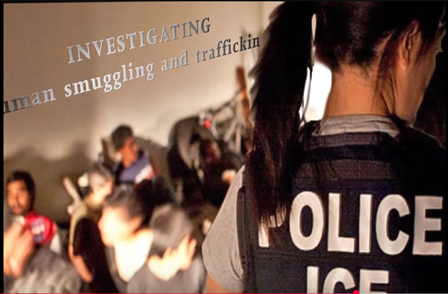
With the ongoing hostilities and terror immigrant communities are facing, I thought it timely to investigate the self-image of US Immigration and Customs Enforcement (or as artist Ricardo Levins Morales names them US Intimidation and Community Eradication). Turns out that three years ago, the office ICE.gov YouTube channel published a recruitment video showcasing just what exactly ICE is about.
It is an excruciating two-minute watch full of antiquated edits of floating texts and unbelievable naïve presentations of the actual “work” they do. When not explicitly calling out what is happening on screen, there is a near 100% chance that it will just be b-roll footage of a heavily militarized ICE agent crossing the screen. All the while there is a rhythmic thumping in the background, occasionally colored by a faraway brass section. When there is an explanation for the footage, it is always an image of the job done. ICE agents standing heroically in frame, or in the case of “pursuing human rights violators” section, ICE agents very slowly climbing up stairs. I am tempted to say that one of the ICE agents is chasing the other in this scene.
Never is there any problematic footage of the people and communities that they hurt: no footage of family separation, scarcely any footage of detention centers, and no (warrantless) home raids.
Where I want to draw the most attention too, though, is the professional shots of Hispanic appearing women in ICE uniform. As I read it, ICE is sending a message to the demographics it hunts telling them they are an inclusive and welcoming workspace (provided you have papers). Ignore the hostile glares from the officers in the background, there is at least token representation in the force, and that should be seen as sufficient to say there is diversity. Similar to the strategies of Warner’s Plastic Representation, ICE exercises a selective inclusion into the hegemonic picture of itself and other law-enforcement. It directly challenges the viewers probable pre-conceptions that ICE agents are all white nationalists seeking to eliminate those who, in the words of our current president, are “poisoning the blood of our country.” I cannot say it is a very successful challenge, but it is notable at least that the effort was made.
The end title card tries to tie everything and everyone together by uttering the downright slanderous statement that “we are ICE.” The hell we are.
Is K-pop gay? This is a question that has eluded a definitive answer in my personal interaction with the genre for a long time, and those with opinions online oscillate wildly, a hallmark of the fandom that has earned K-pop its reputation in online spaces. Circumstantially, a lot of people I have met within the space have been gay. Lining up in front of a venue hours before a K-pop concert you will be confronted with various implied and explicit markings of queerness from an abundance of pride flags, to the shipping culture generally focusing on those of the same gender (I’m not saying the shipping is inherently queer or productive to queer causes, but in many of these cases it is done in the spirit of deviance in sexuality, I could write pages on the impacts of shipping, but that’s not what I’m focusing on here, bear with me). Within K-pop, one’s affinity with certain groups or idols can exist as a kind of flagging within the larger fandom. Comments such as, “Oh, your bias (a term used to express one’s favorite member within a given group) is Moonbyul (an idol widely speculated to be queer in her identity)” is accompanied by a raised eyebrow and knowing look. Yet, despite how many in the fandom identify with queerness, the number of these idols who is explicitly out is vanishingly small.
Yet these claims of an idol’s sexual inclinations are based in some form of reality. Video compilation abounds on sites like YouTube titled things such as “Fruitiest K-Pop moments” or “Idol’s closet is made of glass”. Most of these compilations depict these idols engaged in various things that could be construed in some fashion as queer. Female idols reacting with annoyance or disgust to men they are interacting with. Two idols of the same gender hold hands for a long period of time, choosing word choice that insinuates ambiguity when describing their ideal type. Again, many things that could be construed as queer in nature that ultimately fall short of declaring oneself to be queer. In general, such outright declarations are understood to be impossible due to the control exerted by the companies these idols work for as well as the conservative culture prevalent within South Korea. Additionally, many of the actions that American fans get lost in cultural translation as was referenced in the most recent class presentation on representation of queerness in non-western contexts. Not seeking to retread the points made in the presentation, I instead wish to focus on the music that is created by and for these idols and how it can be dissected to reveal potential queerness.
When thinking about the actual content of some of these songs, one of the main things that my mind jumped to was that of affect theory. The fact that intention can carry less weight compared to impact serves as an excellent parallel for some of the themes depicted within K-pop. Since 2015, with the rise of K-pop group Blackpink rocketed to success on the back of its concept of girl crush, a theme supposedly centered around alt aesthetics and empowerment of women. Concepts, given the commercial nature of the industry, serve as general framing, aesthetics, and guidelines for how the group operates. While other groups had done a girl crush concept in the past, Blackpink made the concept far more mainstream due to their massive popularity. While the actual claims that such concepts can be seen as empowering due to the high level of body control, promotion of very specific images of femininity, and tying this femininity to commercialism, if we got back to the tenants of affect theory, there is some kernel of truth of believed truth within the perfected corporate image these idols present.
This image becomes even more complicated when discussing the actual music produced by these groups. Authorship of songs by idols themselves varies from group to group, but a commonality typically occurs that there is some level of creative freedom allowed within these spaces of music production. This becomes interesting when performing media analysis of these pieces as there most accessible interpretation seems to be heavily queer coded. The inspiration for the title of this post comes from the music video of group i-dle, whose music video Oh my God can be very easily read through the lens of a sapphic relationship. Yet the purpose of my analysis is not to bring to light the themes of queerness within the song, but rather to consider the implication of what it means in the context of the K-pop industry and affect theory. None of the artists behind the song identify as queer openly in any way, which is commonplace given Korea’s conservative culture as well as the binding contracts holding many of these idols to strict standards of media presentation. As the title of this piece implies, it seems that in these cases, a death of the author occurs while the artist is still living, creating an interesting dichotomy when a corporate created product is turned into a vessel of queer expression implicitly through its fandom. Now the complicating factor is that this is done intentionally, or at least tacitly endorsed by these large media companies in order to generate more profits, and what that says for the legitimacy of the representation or art form, but at some point, such arguments become cyclical in conclusions. There isn’t one answer that I believe applies to this specific genre, but it is an interesting piece to consider the various factors that dictate how art is created and how we are supposed to consume it.
I want to start off by saying that there is a canon lesbian relationship in My Little Pony Friendship is Magic. Background ponies, Lyra and BonBon (LyraBon). They propose to each other. They get married. It’s cute.
LyraBon on the Piano in Rainbow Rocks movieLyraBon double proposal (s.9, ep.23)LyraBon marriage in newspaper
Contentious Lesbian Ponies
This post is about the more contested lesbian ships in My Little Pony (MLP). That being Rarijack (Rarity and Applejack) and Appledash (Applejack and Rainbow Dash). These ships aren’t just contested because they share a member, Applejack, which does spark some healthy debate within MLP fan spaces. The biggest reason they are still talked about to this day is because these ships were very ambiguously yet directly acknowledged within the franchise.
Applejack & Rarity in Equestria GirlsRainbow Dash & Applejack in Friendship is Magic
Though these characters are shipped across the entire MLP franchise. The Appledash ship is more commonly associated with the classic Friendship is Magic television show (the one where they’re horses) and the Rarijack ship is associated with the Equestria Girls movies series (the one where they’re humans).
Fun Fact!
All of the images are either a part of the classic MLP Friendship is Magic or MLP Equestria Girls franchises. So yes all canon. All happened.
Rarijack (Rarity & Applejack)
Rarijack reconciling
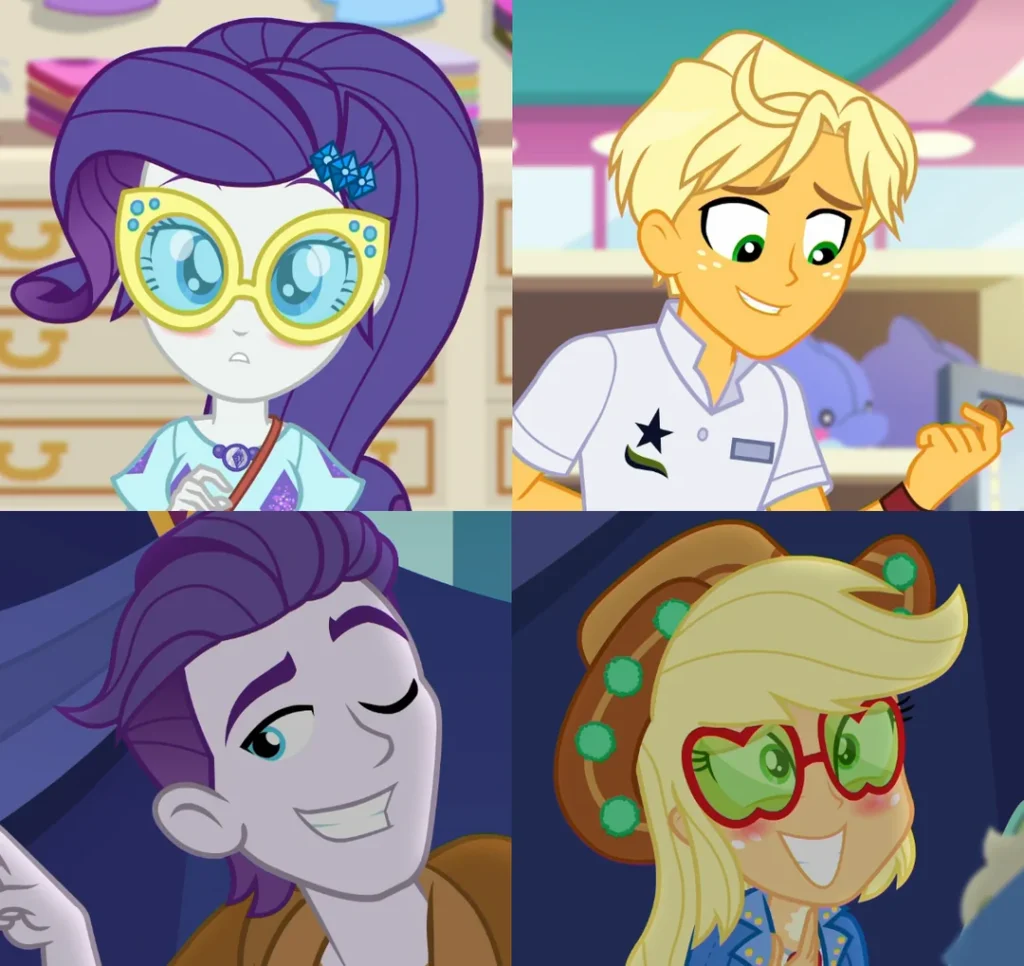
Throughout the Equestria Girls franchise there are multiple places where fans impose queer readings of interactions between Rarity and Applejack. This is very common within fandom spaces, especially ones with a large queer audience. Because of the history of Hays Codes–a set of self-censorship guidelines imposed by Hollywood that often targeted explicit depictions of queerness–queer audiences are more prepared to read coded messages within their media in order to find the representation they are looking for. By this point in the greater MLP franchise the creators weren’t strangers to the fan shipping culture. And their response to the Rarijack ship was. . . Raggamuffin. . . and Dirk Thistleweed.
Immediate reaction: 1) This was most definitely on purpose. 2) If they knew people were shipping Rarity and Applejack why create new characters that look like each other to pair together? 3) Why not just pair the girls together?
I understand that queer coding is sometimes a present and necessary part of how shows are able to include queer representation without receiving backlash from higher ups or unaccepting audiences. This hinting is sometimes the only tool available to creators when writing towards a mass (not specifically queer) audience. But that’s part of what confuses me about this approach. Everyone queer or not can see that Dirk is meant to be a stand-in for Rarity and Raggamuffin is meant to be a stand-in for Applejack, so it’s not properly “coded”. At the same time this queer ship is heavily popular within the queer parts of this fandom, so when catering to the people who enjoy this ship why would they opt for this kind of “coding” rather than explicitly depicting it. It feels very deliberate, like offering audiences a heteronormative alternative that simultaneously rejects queer readings of text, but acknowledges that there are queer readings of this relationship. It’s like that thing that hegemony does where it incorporates the subversion of itself within itself in order to gain more credibility and re-assert itself as correct and normal (Berlant & Warner, “Sex in Public”).
Appledash
Friendly Rivalry in Fall Weather FriendsEnding scene for Fall Weather Friends
Appledash fist bump Season 9, Episode 6
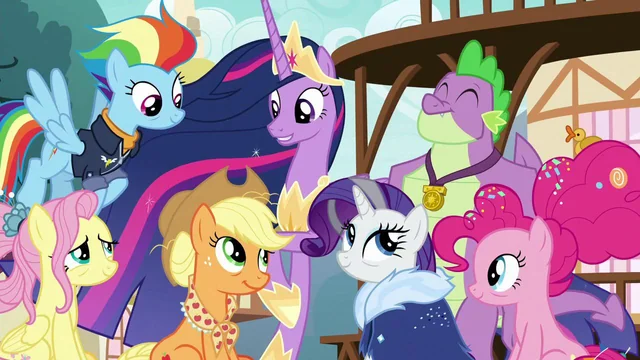
Appledash in the classic MLP television series is a little less problematic, but they have a lot less on-screen chemistry than Rarity and Applejack in Equestria Girls. In the series finale, The Last Problem (Season 9, Episode 26), when all of the mane six meet back up again, Applejack and Rainbow Dash enter princess Twilight’s throne room together, talking about doing chores like an old married couple. This for a lot of people was confirmation of the Appledash ship in classic MLP, but in all honesty outside of Fall Weather Friends (Season 1, Episode 13) Applejack and Rainbow Dash don’t really have a lot of episodes or even moments together. This depiction is closer to a more traditionally coded queer relationship, being ambiguous about the relationship, yet keeping the characters close. Even then the Appledash ship failed at communicating that sense of closeness throughout the previous 9 seasons, so this implied relationship, though welcomed, doesn’t feel earned.
Final Question
Is any of this representation? Especially if fans were gonna ship the ponies/girls anyway. What purpose does it serve to not fully engage with the audience? The creators are aware of the ships and seem to want to acknowledge them to give something to the fans, but these gestures feel empty and hollow (Warner, “In the Time of Plastic Representation”). Like despite trying to engage with queer readings of the characters, they don’t want to have explicitly queer characters. I do think that coding is a useful tool in art and not all queer relationships must be explicitly stated (Clark, “More Than Sex…”). Still I question what is the purpose of this specific kind of representation, that is disingenuous and heteronormative in essence? Would it have been better for the creators to leave the shipping content to the fans?
Bonus: Can you guess which ship is my favorite? Rarijack? Appledash? or a secret third option?
Carnivore diet people keep showing up on my Instagram and I’m not entirely sure why, especially given that I don’t eat red meat. The Carnivore Diet is a diet where individuals eat only animal products. This includes meat, dairy, and eggs, and excludes any plant products. The carnivore diet as we know it was first brought up in the mid 19th century, and then in 2018 gained massive internet traction through a book entitled The Carnivore Diet, by Shawn Baker, a former orthopedic surgeon and current diet influencer. It has become increasingly visible on social media, particularly as it has been taken up and made popular in far right movements. From my research on the carnivore diet, and its connections to the far right, it seems like it is most popular with white men.
The Carnivore Diet claims to be highly beneficial. People all over the internet talk about how it cured their eczema or acne or autoimmune disease or facilitated their weight loss and muscle gain. Medically and scientifically speaking, the carnivore diet is likely not safe for most people, due to the high risk of nutrient deficiencies and risk of kidney issues from consuming almost exclusively protein. The carnivore diet is one of the many fad diets trending on social media right now.
Meat and masculinity have long been tied together for American men. Meat, especially the consumption of it, is associated with strength, virility, and power. Meat consumption’s masculine associations also come from the way that meat consumption involves a violent power dynamic between the person eating the meat, and the animal they are consuming. Again, a reminder, I do eat meat, and I think eating meat is generally okay. To be a red-blooded American male, one has to eat meat. Conversely, vegetarian and vegan diets are considered feminine diets.
The Carnivore diet has emerged as the latest iteration of this meat centered masculinity and has been pushed heavily by male right wing influencers such as Joe Rogan. For the far right, masculinity is in crisis. “Real men” and their “manly” lifestyles are under attack. Eating meat and only meat is seen as a solution to this masculinity crisis. Men can get stronger and more powerful. Masculinity is not the only reason for the right wing enthusiasm for the carnivore diet. It is also seen as resistance to the left’s environmentalist goals. The carnivore diet is being used as a way of expressing political ideologies.
While there are women actively participating in the carnivore diet trend, it is still firmly based in patriarchy and white supremacy. The carnivore diet is also classed, eating exclusively animal products is expensive, and oftentimes not accessible. The narrative around the carnivore diet saving “real men” has gone as far as individuals claiming that the carnivore diet “cured” them of being transgender and/or homosexual. The carnivore diet trend is tied to this class in how it is connected to hyper-masculinity and patriarchy. The Carnivore diet and the dangerous rhetoric that comes with it is the latest of far right pipelines that continue to harm us all. All that in mind, the carnivores invading my Instagram have certainly not convinced me.
After our discussion on plastic representation in Tuesday’s class, I was feeling disenchanted in the media and the ongoing lack of meaningful representation. That night, I watched Luca for the first time, at the insistence of two of my housemates. They are both queer and love Luca, thinking of it as a story of coming out and being accepted. The movie is about two young boys—runaway sea monsters who can turn into humans while on land—experiencing a summer of self-realization together with their newfound human friend. Integral to the plot is their fear of being found out by the inhabitants of Portorosso, an Italian town known for hating and hunting sea monsters. Luca and Alberto have to hide who they really are in the presence of judgmental and fearful humans. At the climax of the movie, Alberto reveals his identity as a sea monster and Luca does not, betraying his friend and immediately regretting it. But Luca makes amends by saving Alberto from the movie’s villain, revealing his secret in the process. To both of their surprise, the town accepts them, with two town inhabitants revealing their scaly skin as well.
The plot has obvious potential for queer allegory and Luca and Alberto’s relationship can easily be read as a budding romance (falling in love with your best friend who you’re afraid has a heteronormative crush is a common gay experience, right?). Thus many viewers of the movie think of it as a queer story. To this point, Luca and Alberto’s identity as sea monsters, something they hide out of fear, is not something that can easily be changed without significant reworking of the plot. That is to say, Luca and Alberto don’t feel plastic or malleable or lacking depth. However, they are not explicitly gay. The director, Enrico Casarosa, has said that the boys are meant to be pre-pubescent and thus their friendship has the potential to develop into a romance, but is not of a romantic nature in the film itself. While disappointing, the boys are still visibly different and accepted as sea monsters—if not as gay lovers—which is heartwarming. Their sea monster-ness also seems to avoid the risk of positive or negative representation. Their fictitious identity can’t be compared to the ‘real’ experience of that identity, nor does their depiction on screen represent anyone explicitly.
Watching Luca provoked questions for me that we’ve been grappling with throughout the term: is it possible for movies to have organic (not plastic) representations that aren’t too positive or too negative or non-representative of the creators of the movie? Why are so many movies that queer people find community around not explicitly queer? Is that inherently bad?
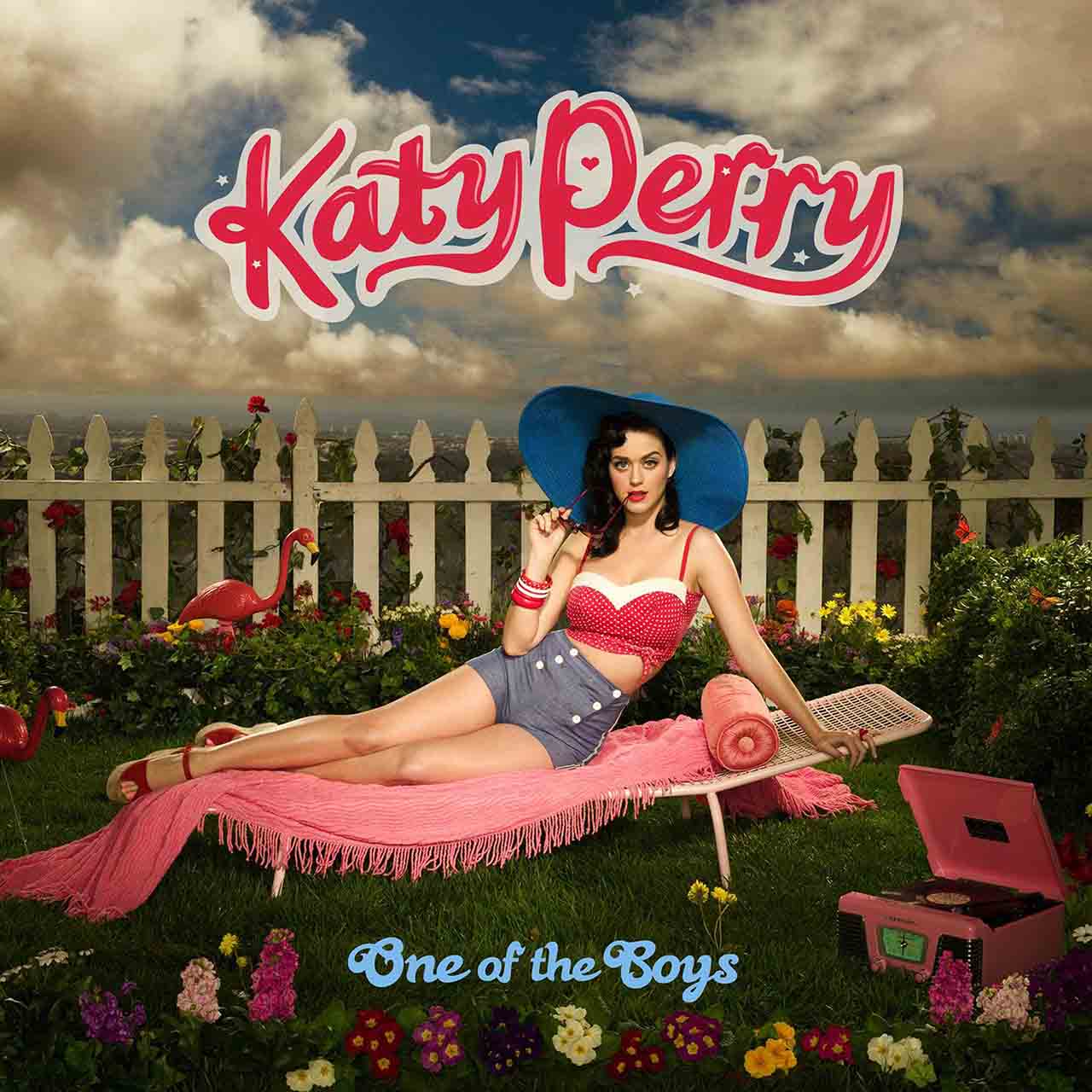
Firstly, I think speculating on the sexuality of a real person is not the right thing to do. And while the title of this post is attempting to do that, my goal is not uncover Katy Perry’s “true sexual identity.” It’s really none of my business. I want to explore Katy Perry’s song I Kissed A Girl as a piece of LGBTQ representation. From my limited research on Katy Perry’s sexuality, as well as only slightly more informed knowledge of her music, she seems to identify as heterosexual but has kissed a girl at one point.
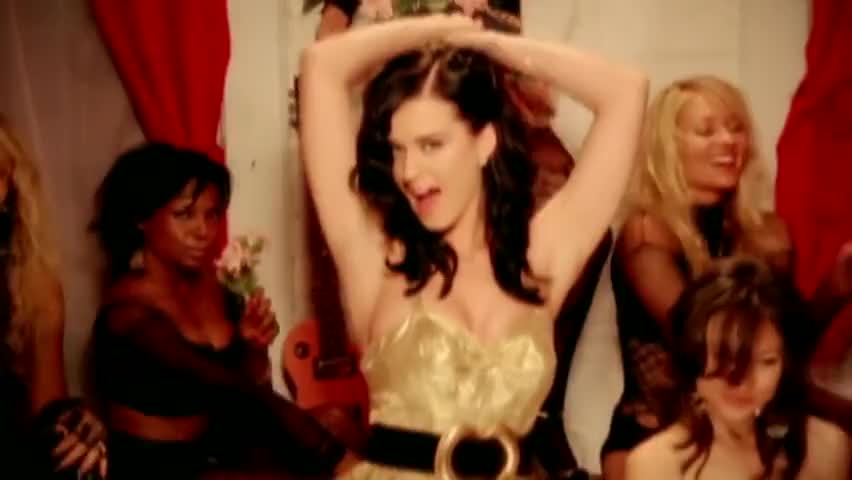
It’s a good song. It’s catchy, the chorus is easy to sing along with and it has a thumping, danceable beat throughout. It came out in April of 2008 as a single by Katy Perry. It had massive commercial success, topping charts for over a month post release. Interestingly enough, it came out only a few months after her highly problematic song Ur So Gay, in which she sings her frustrations with a boy who fits all sorts of gay stereotypes but isn’t gay. A brief diversion for this song, it came out in 2007, when discourse around gay people in media was pretty different than today, it still seems mysterious to me that a song that begins with the lines “I hope you hang yourself with your H&M scarf while jerking off listening to Mozart” would do as well as it did and also generate any popularity at all. But what do I know, I was four years old in 2007. Anyways, Ur So Gay was a crazy song, and its fascinating that it came out right before I Kissed a Girl. Equally fascinating is the fact that this information was edited off her Wikipedia page. I should also note that in the music video, while a cat is petted suggestively and several scantily clad women dance together, there is no actual kissing.
I Kissed a Girl is sung from the (female) singer’s perspective and is about kissing a girl (duh) and liking it. It frames kissing girls and enjoying it as something taboo, something that while perhaps is just an “experimental game” also “felt so wrong” and “felt so right.” The singer hopes her “boyfriend won’t mind it,” but she doesn’t seem that concerned about what her boyfriend might think given that it “ain’t no big deal, it’s innocent.” It trivializes and dismisses a non-straight feminine sexuality. It seems to play into the fetishization of wlw relationships that is still pervasive in popular culture. Katy Perry appears to utilize the taboo nature to gain more plays, it is tempting because it is not quite allowed. Katy Perry can make this song because in all other ways she is normative. I Kissed A Girl perhaps cultivates something homonormative.
I Kissed A Girl is obviously not perfect representation. But I don’t think it should be completely dismissed. It was one of very few explicitly LGBTQ pop culture moments when it came out. The song rose to fame at a particular moment in LGBTQ history in America. It was a time of new visibility and acceptance in straight popular culture, but only partially. I think there is still something to say for the ways that the song made visible female lesbian/bisexual sexuality in such a popular way, even if it is perhaps flawed.
Further complicating context that I don’t get into is that this song was co written and produced by the now infamous Dr. Luke, and I don’t know how that factors but it seems like there could be something there.
In this blog post, I am using Megan Thee Stallion’s use of anime superhero cosplay/inspiration as an example of “Fluxability”, and how it serves her as both “Megan Thee Stallion” vs. Megan Jovon Ruth Pete. With the cosplay and imagery of anime superheroes in and out of her artistry, Megan is able to bend between genders and adopt the qualities of the superheroes, such as strength and confidence. My thoughts are in conversation with “From American Marvels to the Mutant Generation: Reinventing the Superhero” by Ramzi Fawaz.
(***I do not know anything about the anime characters Megan cosplays… but as a heavy consumer and fan of her music as a queer rap artist from Houston, I think this is an extension of how“fluxability” can be interpreted as.)
“Rather than performing flexibility, I argue, the monstrous powers and bodies of postwar superheroes exhibited a form of fluxability, a state of material and psychic becoming characterized by constant transition or change that consequently orients one toward cultivating skills for negotiating (rather than exploiting) multiple, contradictory identities and affiliations.” (11)
Megan Thee Stallion: In Her Words – Official Trailer (2:12)
In her 2024 documentary, Megan Thee Stallion: In Her Words, Megan speaks about overcoming the trauma of being ridiculed, blamed, and not believed in after being shot by artist Tory Lanez, and grieving the loss of her mother, all while navigating both success and hate in her career. She uses an animation of herself switching between Megan Pete and her alter-ego superhero/rap character, Megan Thee Stallion. In this preview for the documentary, a clip of her fictional superhero character follows with the words, “HER POWER, HER STORY”, using superheroes to create a queer, confident and powerful persona, to inspire confidence is a common theme among her artistry. ‘“I’m half anime character, half rapper,’ says Megan Thee Stallion.” (Crunchyroll Interview)
Shoto Todoroki – ‘My Hero Academia’
Megan has a unique, aggressive, deep South style of rap, one that requires confidence and even cockiness in every delivery. When she speaks about loving her figure, being queer, and healing from her trauma, she has to embody a constant high level of confidence that is not realistic for anyone outside of her music and character. Her documentary breaks down what her cosplays and character, Megan Thee Stallion, can sometimes hide. Megan showcases both emotional vulnerability and cocky confidence, as well as resilience, qualities that often contradict each other and are traditionally associated with femininity and masculinity. However, Megan can switch between these characters to protect and process her personal life.
A woman with her lips painted bright red sensually blows out a candle as the camera pans out to reveal its position atop a cake decorated to look like the American flag. As the woman sings the words “American queen is the American dream” over the cake—interspersed with shots of young people frollicking and partying outside of a large white house—she paints a stark picture of American patriotism.
After the group presentation last week that discussed representations of America in music videos, I became curious about how America, the American Dream, and neoliberalism are represented from an outside perspective. This opening to “Hollywood” by Welsh singer MARINA (also known as Marina and the Diamonds) provides a stunning visual endorsement of the American dream. Throughout the video, MARINA dances through a large house wearing a variety of American flag themed outfits while partying, waving flags, and joyously indulging in her representation of the ideal Hollywood lifestyle.
Despite the video’s visual affirmation of the glamour of the American dream, MARINA’s lyrics paint a different picture of America. She sings about a hostess on her flight to the US “trying to stimulate a mind / that is slowly starting to decay” while reading a gossip magazine, singing to her “Hollywood infected your brain” and that she has been “puking American dreams” in the chorus. Her lyrics throw jabs like these at the vapid and materialistic nature of America and her conception of the American dream throughout the song. However, the clash between MARINA’s lyricism and the visuals of her music video communicate an important message: MARINA cannot help buying into the American dream—being “Obsessed with the mess that’s America”—because she fits the narrow vision of who the American dream is imagined for. She recognizes in her lyrics that she bears the privilege of fitting the image of an American celebrity or movie star, singing about being compared to Shakira and Catherine Zeta Jones. She cannot help but bite into the idea of the American dream, even as she criticizes it, because she knows that she can fit the vision of the “American queen” that she sings about.
This music video contrasts starkly with the video for Mitski’s “Your Best American Girl.” At the opening of the video, Miski sits propped on a chair as a crew neatens her outfit and fusses over applying bits of hairspray to her before she suddenly locks eyes with a man across from her. The two exchange flirtatious glances, smiles, and waves. As Mitski blushes and waves shyly, a white woman dressed in jean shorts and wearing a flower crown—the picture of an ideal All-American girl—approaches the man and the two start flirtatiously touching as the smile drops from Mitski’s face. As the two of them flirt and eventually progress to making out, Mitski turns to her own hand, sensually kissing and caressing it as shots of Mitski on her own contrast with shots of the couple.
In the background of shots of Mitski and the couple, she sings “And you’re an all-American boy / I guess I couldn’t help trying to be your best American girl.” As the video progresses, the couple becomes progressively more intimate and unclothed, eventually wrapping themselves in nothing but an American flag as Mitski plays guitar on her own. This juxtaposition between Mitski on her own and the couple shrouded in the flag, along with the lyrics, signal that this couple represents the American dream that Mitskii has been excluded from. As a Japanese-American, Mitski has grown up being caught between both her American birthplace and her Japanese heritage and close relationship with her Japanese ancestry. She laments in the song, “Your mother wouldn’t approve of how my mother raised me / but I do,” both illustrating the distance between her upbringing and that of this all-American boy and her refusal to shun her upbringing in order to fit into an American ideal.
Like MARINA, Mitski presents a story of aspiration of fitting into the narrative of the American dream as an outsider. Both simultaneously critique the American dream while singing about how they cannot help but reach for it. They demonstrate how culture has become so saturated with idealization of what is offered to those who fit the “all-American” ideal that, even in critiquing it and having some kind of distanced viewpoint, they cannot help but participate in the kind of behaviors and consumption that bring them closer to it. However, while MARINA’s video presents a story of someone who has been accepted into this ideal, in part because of her whiteness and conformity to American beauty standards, Mitski’s illustrates how this ideal remains exclusionary for those who do not fit the image of a “best American girl.” In contrast with MARINA’s video, which critiques America while providing a visual endorsement of the American dream, Mitski sings about aspiring towards an “all-American” ideal while visually representing this impossibility for her. No matter what she does or how much she tries to be an all-American girl like her counterpart in the video, even having a team of stylists fuss over her, she remains on the outside looking in.