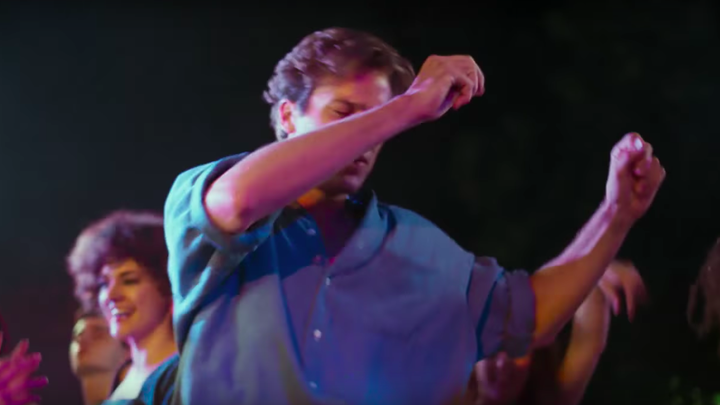
Around the one-hour and 20-minute mark of Call Me By Your Name, we finally see the beginnings of a moment between Elio and Oliver, the two protagonists and love interests. It is midnight after a party, and the two of them are standing side-by-side on a balcony. All you can hear is their breathing, a ruffling of shirts, and the high-pitched chirping of crickets. Oliver says, “I’m glad you came,” and lightly brushes his hand (holding a cigarette) over Elio’s before the two of them amble back inside the room. It’s summer in 1980s Italy, and both characters are wearing loose-fitting clothes, Oliver in a green rolled-up button-down and Elio in a white t-shirt and jeans. The camera lingers on their bodies as they slowly learn to get closer, Elio starting to lean more on Oliver and eventually, fully embracing him, hands in hair as they kiss and become more comfortable with each other. The intimacy increases as they get into bed, the camera spending a long time on their feet and then moving up to their bodies, and start to climb on top of each other, their breathing getting heavy and movements becoming more frantic. As Oliver strips off his belt, the camera pans away to look outside the window at the trees, only the sound of their breathing and faint crickets audible.
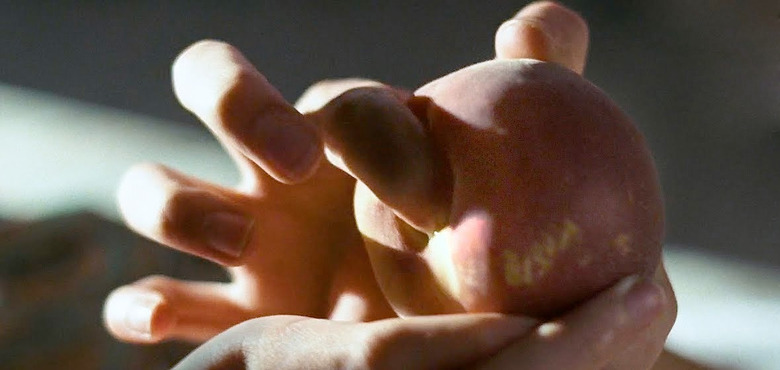
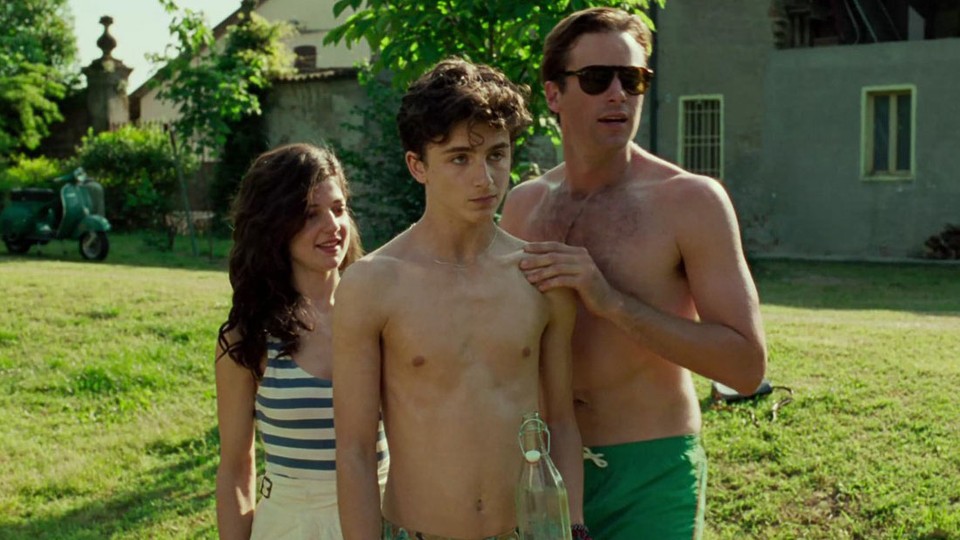
I found this scene a really interesting illustration of both Rodriguez’s “queer gestures” and Muñoz’s concept of a queer utopia. Although this scene represents a fulfillment of the potential for queer love (i.e. sex, or the implication of sex), this is not the first time that we sense queer undertones. Because they rarely speak to each other, some viewers may read Elio and Oliver’s budding relationship as platonic and far from the realm of sexual. And yet, what I think makes the film so powerful is its emphasis on queer gestures, that “socially legible and highly codified form of kinetic communication” that brings the two subtly and slowly together into a “we,” even if they don’t directly interact in ways customarily read as romantic (Rodriguez 6). So much of the film is predicated on those relational movements— the squeeze of a shoulder, the touching of a peach, a glance at a party—that by the time this specific scene rolls around, viewers already feel like the two have been involved in a kind of sensual, erotic play (and that this is the final, ultimate climax of those gestures). But even in this scene, gestures play a large role. When Elio moves his foot over Olivers, when they cling to each other, wrestling almost, they “counteract demands for corporeal conformity” and leave open space for a queer interpretation of the motions of their bodies (6).
Moving to Muñoz, part of this film’s appeal (and maybe also what makes it problematic) is its general tone of “not yet here” or “almost,” sharing the sentiment that “we may never touch queerness, but we can feel it as the warm illumination of a horizon imbued with potentiality” (Muñoz 1). A lot of this film just feels like waiting, but it is a waiting that is “laden with potentiality” (Rodriguez 5). Occuring at midnight, in that liminal space and time between the past and the future, this scene is situated perfectly in a moment that is “primarily about futurity and hope” (Muñoz 11). Its dark, isolated setting and limited diagetic sound also help create a spatially recognizable “queer horizon,” away from the oppressive gaze of others. This scene is also ripe with a sense of awkward hesitation and nervousness as the two characters fumble around each other, learning to touch each other in new ways and be together. This aligns with what Muñoz seems to be arguing for, that instead of being concerned fully with the here and now, there is a collapse in boundaries of what is and what could be; the trepidation of their actions—and the panning away of the camera— embodies his concept for queer utopia as “subjects can act in the present in the service of a new futurity,” a future that is excitable, but not fully in reach (16).
A scene that stood out to be in English television was the Bridgerton rendition of Indian wedding rituals. The show is set in old England, and it pleasantly surprised me that they have characters from India in their show. Particularly because of colonisation, a lot of people did move to England and beyond, so it would make sense to have this be part of the diversity in the show. It seemed natural and expected, rather than diversity being forced into a storyline where it doesn’t belong.
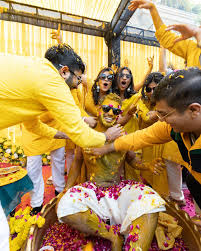
This part of the show has an Indian character engaged to the son of an old English family. This character, her sister and an older woman are taking part in a traditional Indian wedding ritual, called the Haldi ceremony. The background score is an instrumental version of a 90s bollywood song. The scene begins with traditional looking dishes in which someone is mixing turmeric and other ingredients for the ceremony. The background song has been remastered by using English instruments (like violins) for the Hindi song. There is a lot of yellow in the scene — from the clothes, to the marigolds, which are accurate for the traditional ceremony. Instead of Indian wear, the characters are wearing English-style dresses, and speak in a British accent. The ceremony only has three people, and seems to be taking place in the evening — which is unusual for this tradition. As are the candles that are lit in the back. The characters are discussing the upcoming nuptials. Apparently, the groom has pushed the wedding up, and the bride is nervous for it. She says that it is a clear sign of affection, but it has unnerved her. The women around her try to calm her down, as they apply turmeric on her arms. Their chats involve discussion about who the haldi is applied to and its significance — that the recipient finds a groom worthy of her — and the little sister (the bride) applies the paste to her older sister’s arms as well.
Instead of sunlight, bright outdoors, and a family-centred event, this one seems to be directed from a western perspective. It touches the values of the community briefly, but doesn’t take the time to delve deeper into why those customs are in place. While the storyline explains that the sisters are estranged from their grandparents, it seems strange to see no family at the wedding. Especially because Indian families are large, and everyone is invited to weddings — where the customs are primarily centred around bringing the family and friends together. Additionally, this ceremony would not take place in candlelight, but in the outdoors under the sun, or at least on a terrace and around tons of festivity. Showing Indian customs without the traditional outfits seems like an odd choice as well — if the sisters are tied to their roots enough to partake in this ceremony, why would the costume department not take more time and effort to give them appropriate traditional wear, especially for the time period they are in? Rather than traditional folk songs, the background is also an instrumental version of a popular song from 90s bollywood cinema. While the show does a good job of introducing these fleshed out characters and backstories, I wish more effort had been put into integrating their culture in this time period as well. The elements are superficially there, but not enough to make the ceremony believable or accurate for the population that resonates with this culture. There is a sense of exoticism of the characters’ backgrounds, but not an understanding. They are diverse at first glance, but their conversations, interpersonal dynamics, and even the visual elements of the scene are a westernised version of their culture.
Coming to gender dynamics, I am not surprised by the over representation of women in the scene. Especially in older times, there might be a difference in which gender attends which ceremony, and at times there might be a strict gender binary present. As the main characters, the women are depicted as beautiful, thoughtful and caring. I presume that the intended audience for this scene is the people in the Indian subcontinent, so I do wish there was more care taken to make the ceremony as accurate as possible, rather than a western product that only serves an exotic idea of the custom. As someone who is of the subcontinent, I am glad that there is an organic representation of this community in English media. However, I think we have a long way to go before the characters are shown as products of their time with appropriate depth, and the customs seem accurate to the time period and beliefs.
If you’re unfamiliar with the lyrical stylings of Aunt T. Jackie. Please take 1:27 minutes out of your day to listen to her viral song Piss On The Floor. Or better yet, watch the 1:56 minute music video.
The music video features Aunt T Jackie squatting in a skirt and “pissing” on the ground outside, a defiant response to a security guard who denies her access to the women’s restroom. Throughout the video, she twerks across a variety of locations, including one scene near the end where she appears masked, situating the performance within the context of the COVID-19 pandemic.
Aunt T Jackie’s Piss on the Floor is an undeniable act of intersectional, transfeminist pop culture creation. The viral hit connects deeply with the ideas explored in Zisler’s “Pop and Circumstance: Why Pop Culture Matters” and the film Tangerine (dir. Sean Baker). Zisler argues that pop culture is not trivial, but a vital site where meanings, identities, and politics are produced and contested. In a society where marginalized voices are often excluded from dominant narratives, pop culture becomes a crucial battleground for recognition and self-definition. Tangerine illustrates this power by centering the experiences of trans women of color, using low-budget, grassroots filmmaking to capture everyday moments of survival, friendship, and joy. The film’s rawness and authenticity challenge polished, stereotypical depictions of trans life that dominate mainstream media.
Similarly, “Piss on the Floor” is more than a joke song or viral meme; it is a bold act of cultural production that uses humor, chaos, and absurdity to push back against restrictive norms.
Aunt T. Jackie refuses sanitized, palatable versions of transness designed for cis comfort. Her unapologetic approach embodies Zisler’s argument that pop culture is not just entertainment but a site where communities can assert their presence, rewrite narratives, and imagine new possibilities for themselves. Through her humor and defiance, Aunt T Jackie claims a right to public space and bodily autonomy, showing how pop culture can both reflect and transform the terms of visibility and belonging.
Piss on the Floor also resonates strongly with transfeminist politics as outlined by Sara Ahmed and the conversation between Miss Major Griffin-Gracy and CeCe McDonald. Ahmed’s “An Affinity of Hammers” discusses how solidarity is forged not through sameness but through shared experiences of resistance, struggle, and collective action. Humor, anger, and joy become tools for building affinities that do not erase difference but honor it. In this light, Aunt T Jackie’s performance can be seen as a form of affective solidarity: an invitation to laugh, rage, and dance alongside her in the face of systemic exclusion.
Moreover, Miss Major and CeCe McDonald’s reflections on the politics of documentation provide a critical lens for understanding the significance of Aunt T Jackie’s self-representation. Documentation has historically been a tool used against Black trans women — a means of surveillance, criminalization, and erasure. Yet, when wielded by trans people themselves, it can become a site of empowerment and resistance. Piss on the Floor functions as a radical form of self-documentation: it captures a moment of refusal, of living loudly and visibly on one’s own terms. Like the documentary Major!, Aunt T Jackie’s work refuses to frame trans lives through tragedy alone. Instead, it insists on the validity of absurdity, joy, and messiness as modes of survival and self-affirmation. In doing so, Piss on the Floor expands the archive of trans existence, offering a vision of trans life that is irreverent, hilarious, chaotic, and utterly human.
This message becomes even more urgent when situated within the current wave of anti-trans legislation sweeping the United States, particularly around bathroom access. In recent years, so-called “bathroom bills” have attempted to ban trans people — especially trans women — from using public restrooms that align with their gender identity. These bills weaponize public fear and ignorance, framing trans bodies as threats to cisnormative spaces. Aunt T Jackie’s video directly subverts this narrative: she refuses to be invisible, refuses to be shamed, and refuses to be policed. By publicly reclaiming her bodily needs and refusing to be pushed aside, she asserts that trans people do not owe compliance, quietness, or respectability to a society that systematically marginalizes them.
Moreover, the humor and absurdity of Piss on the Floor serve as a survival strategy in the face of dehumanizing legislation and rhetoric. Rather than engaging with these attacks on trans rights through solemn appeals for empathy — which often still leave trans people vulnerable — Aunt T Jackie wields humor as a weapon. Her laughter, her dancing, and her defiant act of “pissing” become radical tools for asserting her humanity. This is particularly powerful in a political moment where trans people are increasingly portrayed as either tragic victims or dangerous predators. Piss on the Floor refuses both of these frameworks, offering instead a vision of trans life that is ungovernable, joyful, furious, and fully alive.
Aunt T Jackie’s performance also speaks to the broader struggle for public space. As bathroom bills and other anti-trans measures attempt to push trans people out of shared spaces, the right to simply be in public becomes a battleground. The video reclaims public spaces — sidewalks, parking lots, lawns — not as sites of exclusion but as stages for trans visibility and defiance. In doing so, Aunt T Jackie reminds us that the fight for trans rights is not just about legal recognition; it is about the fundamental right to exist freely and unapologetically in the world.
The comment section of the music video further expands on how policing bathrooms doesn’t only affect trans women:
Increasingly, gender non-conforming people, especially people of color are being harassed for using the proper bathroom. This harassment is not just about transphobia in a general sense; it is deeply tied to racism, sexism, and the enforcement of narrow European beauty standards. In a society where whiteness, thinness, and cisnormative femininity or masculinity are treated as the baseline for “real” or “acceptable” gender presentation, anyone who deviates from these norms is placed under heightened scrutiny and suspicion.
The assumption that gender should be easily and immediately “readable” — and that it should conform to Eurocentric ideals of beauty, hair texture, body shape, and clothing — leaves many gender non-conforming people at constant risk of being misgendered, policed, or excluded. If you are perceived as too tall, too broad, too dark-skinned, or insufficiently feminine or masculine by white, cisgender standards, your right to basic bodily autonomy is called into question. In this context, the bathroom becomes not just a functional space, but a battleground where racialized gender expectations are violently enforced.
This policing of public space through both legal and social means reflects a broader effort to control who is seen as belonging in society and who is not. Anti-trans bathroom bills are just one formal expression of this violence — an attempt to legislate out of existence the people who already face the most scrutiny and exclusion. In everyday practice, though, these laws embolden individuals to act as informal enforcers, harassing people whose existence challenges their rigid ideas about gender and race. As such, the bathroom fight is not just about where people piss; it is about who is recognized as fully human, whose needs are considered legitimate, and whose bodies are treated with basic respect.
PUBLIC is a music band led by John Vaugh on vocals/guitar, Ben Lapps on drums, and Matt Alvardo on bass. They are a young band from Cincinnati, Ohio. I must confess, I do not know much about PUBLIC. I am not a superfan, yet I sincerely scoured the internet like one. The internet tells me that PUBLIC is a genre-bending classic-rock-indie-pop band that is famous for their viral (think: TikTok videos and soundtracks) music, and in this thought piece, I describe the music video of their song “Make You Mine.” A 3-minute, 55-second video, released on October 14, 2019, is directed by Brandon Chase and John Jigitz, starring male lead Manny Spero and female lead Ashley Puzemis. The music video and song “Make You Mine” (not to be confused with the more popular song by Madison Beer with the same song title) is about love: teenage romance, to be specific.
Video Description: The video starts with a close-up of the male lead looking around and into the camera awkwardly, lips pursed. He’s a cute, teenage, shy boy with fluffy jet black locks on his lightly pimple-prone head. He’s light-skinned, white-passing, but ethnically ambiguous. He looks East Asian or mixed. And he’s chubby. The camera zooms out, and the audience sees that he’s at a party. The camera follows him; it’s his story. He’s holding a red solo cup; there are young people around, all talking to each other, but he’s not talking to anyone. He drinks from his cup, and at 18 seconds, the pretty blonde female lead walks into the party. She literally walks into the party after pushing party streamers away from her face, and is followed by a group of similarly pretty friends. She’s wearing a green top, blue jeans, and has a fresh and full blowout. She’s conventionally attractive and is confident in her smile. The camera flips to the male lead. We follow his gaze, eyeing the girl with a sense of yearning and longing. He walks away, and the camera pans to the singers of the band PUBLIC. They’re almost always in the background. juxtaposing and adding to the story that is unfolding on screen.
He’s walking across the party to get another drink and notices her looking at him. He raises his drink to say hi! A pull focus shot shows the girl’s reaction: she motions with her hand: Come here! Cue: Slow motion of the girl smiling angelically. He’s elated. He can’t believe it. He crosses the band PUBLIC playing at the party, and they’re hanging out at the party now! Cue: Chorus.
“It’s nothing funny, just to talk. Put your hand in mine.
You know that I want to be with you all the time
You know that I won’t stop until I make you mine
You know that I won’t stop until I make you mine
Until I make you mine.”
They dance in slow motion and smile at each other till one of the blonde girl’s friends pulls her away. Before being politely yanked away, she taps the left side of his chest with her pink, freshly done nails. White men throw ping pong balls into red solo cups. Battling against these pretty white men in black tank tops and t-shirts are the girl and the boy. There are more montage scenes of white girls, primarily blonde, dancing and swaying to the music in the disco-lit house, followed by several shots of the boy and girl chilling by the pool and then in a bathtub with two more friends. Their hands are close. Then we see wide-angle shots of the boy and girl at a tennis court. They’re playing tennis while the band is in the foreground. They’re at a park. At a beach.
Then, skateboarding. Holding hands at the beach. Running around. The light changes to a pinkish purple. It almost feels like a memory. The video is interspersed with shots of the band PUBLIC. The three men in the PUBLIC band are sitting on the beach, playing their respective instruments.
The camera zips back quickly to the present – coalescing all the romantic shots of the boy and the girl into the shots in a quick four-second montage. We now see that all the scenes of the girl and boy being cute and romantic were just a fantasy in the boy’s head. The camera re-focuses on the boy, who is still at the table, getting a drink. He looks at her again, from afar, and shakes his head. She’s talking to another boy, yet she steals another glance at him. The camera pans back to the band and they sing:
“You know that I won’t stop until I make you mine.”
The boy walks back across the party with his second drink. And he bumps into her accidentally. In slow motion, she looks shocked. She mouths an apology, “I’m so sorry!” and he shakes his head again, smirking and smiling, affirming that it’s okay.
The band continues:
“Until I make you mine.”
Balloons appear, falling from the ceiling, and she’s dancing again, with him. They’re both smiling and there is no denying that there is a spark of hope – end scene.
Analysis: The music video is geared at younger audiences – teenagers. The two lead characters are young high schoolers at a party. The red solo cups, LED lighting, a band playing in the background, friends talking, and jamming to music are reminiscent of a quintessential American High School culture portrayed in popular media. I know that the video follows the boy’s gaze. And in his gaze, I follow the girl too. Vicariously. I understand longing and yearning. I understand that this music video, although seemingly innocuous in its message, makes me feel more frustrated about the narrative of teenage love.
It’s a boy and a girl. Boy likes girl. Boy can’t really have girl. Oops!
A cis-hetero lovers’ tale as old as time.
To add more context, in this video, it’s a shy, unconvetentionally attractive boy who yearns for the popular, conventionally attractive, nice girl. How will he ever fulfil his desire? Will it just be in his head? The narrative is certainly framed by his view, his longing. I infer that this story is set up in a way that reminds the audience that while you may have a shot at love, it may also be contingent upon gendered themes of luck (are you a boy? or a girl?) and looks. The video shows that she’s popular, always surrounded by friends and guys trying to talk to her. Yet, she is nice enough to steal glances and smile at the boy who yearns for her. She isn’t mean or pretentious. She’s skinny, able-bodied, blonde and simply beautiful. She is the archetype of the female protagonist in an American movie. There is nothing duplicitous or multi-dimensional about her character. She exists, without any depiction of how or why she is yearned and wanted. She is simply wanted. We know that. We can glean all this information. She’s pretty. Of course, she’s wanted.
All we see her as is the girl who is wanted. The girl that the boy dreams of – skating, playing tennis, running around the beach with. She has no say. No lines, besides mouthing an apology when he spilled his drink on himself by bumping into her at the crowded party.
In contrast, the male lead, the boy, isn’t the conventionally attractive man that one would see in movies. He’s asian(ish), a little chubby, and doesn’t have an entourage of friends surrounding him at any given moment. Yet, there’s something about him that I find appealing. I am a romantic, and I love, love. I yearn for it in all forms and shapes. I make no provisions or exact criteria for who I love, yet while reflecting, I notice that I have never ever, loved or yearned for a person who may have been considered ‘ugly.’ I must note that being beautiful has a highly racialized context to it. I’m an Indian person, on the lighter end of the skin color spectrum. I dress and dye my hair in ways that scream: ethnically ambiguous. Yet, I am also seen as a girl (regardless of my non-binary gender identity), who is also a little chubby. I’ve been in the same position as the male lead is portrayed in. I implicty know how boys and men would find me more attractive (see my confessions above).
Except, I’m no man. I can fantasize, and I have fantasized about boys in just the way the male lead in the music video fantasizes about the unreachable, untouchable, too-pretty-for-him girl. But I can’t chase. I have never expected to bump into a man I yearn for, and then have him take me to a beach for a romantic adventure, or a tennis court for a friendly love-all match, or a park for an elaborate date. Here’s the key: take. Why did I, as the girl in my story, expect these actions to be done by a boy? Would it sound ridiculous if I were the one who took responsibility? The responsibility to chase and to attract does not solely belong to the male figure. Or does it? I certainly see the male protagonist do the ‘chasing’ more often in pop culture.
Additionally, I am frustrated because, as a girl, I cannot see myself in the female protagonist. I know, inherently, that I cannot be the skinny, pretty blonde girl that is so obviously wanted and undeniably, overrepresented. Representation matters. I am woefully aware of it, because I almost never see people like me represented in the mainstream media that pervades (my world and) the world of pop culture. I understand that teliologically, mere representation is not the same is fixing the cause of the issue. It will take more than an accurate representation to change the way we think about sexuality and maleness and femaleness, and how deserves to be on screen. Yet, perhaps, implicitly, I know that my attempt at looking more ethnically ambiguous stems from my desire to seem closer to the normative identity of whiteness (in America) while internalizing the exoticism of my skin, tongue (language), and culture to seem palatable and appealing to men I deem attractive. I know that true love will see past the attraction. Yet, it is the first thing I see. You do too, don’t you? You see that it’s always the boy chasing the girl. You know that no matter what the boy looks like, she’s definitely going to be pretty. And in most cases, she’s going to be white.
I notice my otherness. I sense it refelcted in the boy. I know I can never be her. I know I could probably be him. Our social locations are too far apart. But I understand the sentiment of the video. I know what yearning and love feel like.
Beyond the racialized lens, I also noticed how I view the world through my consumption of teen romance (primarily Western-dominated) that shaped the better half of my life. And for most of it, I viewed it through the male gaze. Like the boy in “Make You Mine,” I saw the boys and men in romance movies looking at women and girls as desirable beings and things to chase. John Berger’s 1972 monograph Ways of Seeing sums it up nicely: Men act and women appear. I noticed how I looked at the woman in the video and recognized that I wasn’t just looking at her, I was looking to be like her. I was informing myself of how to be desirable. What is it about her that makes her the object of a man’s desire? I found nothing, besides luck and looks.
Am I selfish for this cutting analysis? Perhaps! This reflection speaks just as much about the perspectives I hold due to my unique positionality and lived experience. Have I judged a relatively sweet and cute teen romance through an unforgiving lens and racialized critique of masculinity and femininity? Perhaps. A cute romance may make us all swoon and kick our feet in the air. I love romances. I am a soft, sentimental sob at heart. “Make You Mine” made me smile and cry, and it also reminded me that many love stories in the mainstream aren’t actively made for me or people like me. I simply cannot, on a temporal level, connect with the characters. Perhaps I am too cynical, and I should settle for the symbolic representation of young love and hope. But, for once, I would like to feel full – full of the I know you feel when you watch a love story unfold. Then, perhaps, this is the right class to take for such a quixotic task to happen!
True Blood is one of the classic vampire TV shows. Created in 2008, it’s set in a fictional small town in southern Louisiana and revolves around Sookie, a telepathic waitress. While not necessarily current, it remains relevant today. In many ways, the show was progressive for its time, yet watching it now, one is also reminded of its many flaws. This scene focuses on an interaction between the character of Lafayette and three restaurant customers. Lafayette is a black gay man who is open about his sexuality. He works as a cook at the restaurant, as well as in construction, and as a dealer of V (vampire blood is an illegal drug in this tv universe). Lafayette is unique as an on screen queer character. He is never shown in a stereotypical, hyper-feminine way, nor an aggressively repressed masculine manner. He is almost always portrayed as both loudly feminine and masculine. In the scene below, there is a clear juxtaposition between his more feminine outfit, jewelry, and makeup, and his aggressive style of confrontation and his ability to best three men in a physical altercation.
The scene opens with a view from within the kitchen facing out towards the window into the dining area. We see Lafayette stirring something on the stove as Arlene, one of the waitresses, brings a plate up to the window. Lafayette asks if there’s a problem with the burger. Arlene responds by attempting to brush it off, saying “it’s just a couple of drunk rednecks.” Lafayette seems to sense it’s more than that, presses again, asking what the problem is. Arlene tries to say that it’s not worth it. As they speak, the camera flips back and forth between them. Lafayette continues to ask Arlene what the issue with the burger is. She eventually tells him. As she begins to tell him, the camera briefly flashes over the group of men, then back to Arlene. The men’s issue with the burger becomes apparent when Arlene says that they told her that “the burger might have AIDS.” As she says this, Lafayette develops a serious expression. He pulls off his clip-on earrings and his apron, clearly preparing for confrontation. As he does this, the music gets louder. As we see him leave the kitchen, Arlene begins to look nervous.
Lafayette walks out into the dining area carrying the plate that had been returned. He saunters up to the table and asks, “Scuse me, who ordered the hamburger *pause* with AIDS?” The men at the table begin to snicker. The camera moves shakily onto a white, blond man wearing a camo shirt who claims that he ordered the hamburger deluxe. Lafayette responds, getting louder as he goes, “In this restaurant, a hamburger deluxe come with French fries, lettuce, tomato, mayo, and AIDS.” Shouting, he continues, asking the whole restaurant, “do anyone got a problem with that?” The man he was speaking to responds that yes, he does have a problem, because he’s “an American, and [he] got a say in who makes [his] food.”
Lafayette responds, telling the man, “Well, baby, it’s too late for that. Faggots been breeding your cows, raising your chickens, even brewing your beer long before I walked my sexy ass up in this motherfucker. Everything on your goddamn table got AIDS.” As he says the word beer, the camera flashes to one of the other men drinking his beer and then slowly putting it down as he hears what Lafayette is saying. The camera then returns its focus to Lafayette as the man still says he won’t eat “no AIDS burger.” Lafayette then leans down and says softly, “Well, all you gotta do is say hold the AIDS. Here.” He then licks the bun and shoves it in the man’s face, saying, “Eat it.” Another one of the men gets up to try and punch Lafayette, but Lafayette is faster, and knocks two of them down before they can get to him. The men stop trying to attack Lafayette and sit back in their booth as he says “Bitch, you come in my house, you gonna eat my food the way I FUCKING MAKE IT! Do you understand me?” He then softly tells them to tip their waitress and walks away. As Lafayette walks back into the kitchen, he high-fives Jason, another customer at the restaurant.
In this scene, we see several complicated dynamics. Lafayette’s character stands up to men who seem to have an automatic association between gay men and AIDS. This group of men assumes that food made by a gay man will have AIDS. Lafayette doesn’t tell them they’re wrong; he leans in, pushing them to be even more uncomfortable. In his assertion of dominance over this group of straight men, he challenges and subverts the norms expected of gay men. He is not trying to change anyone’s minds, he’s not trying to be gentle, or kind. And that is significant in itself. Gay men are not often shown as non-sexual aggressors. Lafayette is loud and physical in his aggression, but his aggressiveness is not sexual.
In this scene, and many others, Lafayette is portrayed as hot-headed and confrontational. In this way, the character also plays into existing stereotypes of black men as aggressors. Lafayette is one of two black leading characters, the other being his cousin Tara, and the only black man. In this scene, which puts one black man against three white men, his race, while not meant to be the identity in focus, is evident. The viewer assumes, likely accurately, that the group of men he is interacting with is racist as well as homophobic (given the setting and previous scenes on the show). His race and sexuality together inform how he is seen and treated by the customers.
The music video for “Lucky,” a song off of the pop and R&B album Where the Butterflies Go in the Rain, starts with an old-fashioned title card reminiscent of an old Hollywood film introducing Raveena and “The Worm.” You then see Raveena—wearing headphones and glasses and holding a book—run to her window and stare with intrigue at The Worm walking by her house. The Worm is a human-sized caterpillar, a literal interpretation of the “love-starved shell” and “black shades” Raveena says her lover hides behind in her lyrics. The music video then shows a montage of Raveena and The Worm on dates at a bookstore or having a picnic, making drinks, playing the piano, and slow dancing. These scenes are spliced with up close shots on a cam recorder of them seemingly documenting falling in love while Raveena croones “my feminine love can heal all the hurt.” Occasionally, lyrics will be displayed on the bottom of the screen: “let me be your escape from the world,” and “you must know one thing—I will change.”
The second chorus sees Raveena waking up, looking around, and realizing her lover had turned into a little moth beside her. A white, plague doctor-esque moth holding a single white rose looks over the scene, before the cam recorder montage of Raveena and The Worm falling in love returns, with more lyrics displayed: “if only you can see how you make me blush,” “I see your roses in every moment,” and “won’t you see them fall?”
The music video ends with Raveena slowly walking towards a giant chrysalis in a white dress, then going back to the scene where Raveena sees the little moth. . . only this time, it flies away.
The song and music video is about the transformational power of love, how the right relationship can help a person grow their wings.
The only characters featured in the music video are Raveena—a beautiful thirty-two year old Indian American woman—and The Worm. While the montage scenes feel like they could have been taken from any movie depicting a love story, the social roles are somewhat subverted given that the love interest is a caterpillar, with no clear gender, age, class, or ethnicity. However, the identity of The Worm never posed a problem in their love story; both Raveena and The Worm are represented as normal, valuable, and worthy of love. Neither are objectified. While the ambiguity of The Worm’s identity seems to be a general representation of otherization (and not a specific intersection of marginalized identities), The Worm itself is not othered.
As a music video, it’s a pretty lighthearted and silly piece of media. However, I found the rejection of the typical over sexualization of young, beautiful women in music videos no less meaningful!
Taylor Swift’s, “The Man” music video opens with a man in a suit, hands in his pockets, staring at a city skyline outside of the window of his corner office. The camera follows him as he exits his office and his employees cheer for him as he stands soaking in their praise, hands outstretched in a show of self-satisfaction. In the next scene, the same man sits on a train, aggressively man-spreading and smoking a cigar. The camera starts by centering on him, then slowly zooms out to reveal those sitting around him coughing from his cigar smoke that has spread across the train car. In the next scene, the man weaves through a sea of scantily-clad women laying on towels on the deck of a cruise ship. Again, the man is centrally located in the shot while the women exist in the exterior of the shot and are on a plane below him as they are laying down while he is standing. Later on in the music video, we see a scene of the same man sitting on a fountain in a park, holding a small child. He again takes a central position in the shot, while we see other people surrounding him, cheering and smiling at him in a show of appreciation. In the last shot of the music video, the man, dressed in an all-white tennis outfit and matching sweat band, smashes his tennis racket onto the court and upends a basket of tennis balls in a display of unbridled rage. The camera then pans out and we see that this tennis court is actually a set. The man walks over to Taylor Swift herself sitting on a chair labeled “director” and asks how the take was. She responds “Pretty good, but could you try and be sexier, maybe more likeable this time?”
The various scenes in “The Man” music video drive home the message that being a man affords one certain rights to space, opportunity, and treatment. His central position in the shots demonstrate the dominance and deference he is given as a man. In the majority of the scenes, he acts like a total sleazeball yet continues to act this way as those around him either reward him or stay silent about his behavior. The chorus of the Man: “I’m so sick of running as fast as I can Wondering if I’d get there quicker if I was a man, And I’m so sick of them coming at me again, ‘Cause if I was a man, Then I’d be the man,” highlights the access to status and opportunity that being a man offers. While Taylor Swift is not wrong in noting that the patriarchal structure we live under grants status and privilege to men simply on the basis of their gender, her lyrics lack nuance and an intersectional lens. The core message of “The Man,” that men are advantaged and women are disadvantaged, lacks an understanding of the way social, economic, racial, political, and other factors privilege certain people and disadvantage others. While Taylor Swift would “be the man” if she “was a man,” other women would not because they are not white, affluent, and able-bodied. Taylor Swift centers white womanhood as the default female experience, which comes through when she imagines herself as a powerful and privileged man. Swift’s centering of white womanhood is further illuminated by her dialogue at the end of the music video. She tells the male actor to “try and be sexier,” clearly playing on the sexist trope of male directors urging female actresses to be more sexual and appealing to the male gaze. While this is a very real phenomena, this comment completely disregards the oversexualization of women of color in contrast with the desexualization of white women. Along with truly being one of Taylor Swift’s worst songs, “The Man” offers a commentary on sexism and patriarchal structures that completely lack any sort of intersectional analysis or thought.
A young man wearing a casual t-shirt with the sleeves cut off walks into an extravagant house, looking around as another young man walks down a large staircase wearing what looks like expensive workout clothing, asking, “excuse me, can I help you?” The first man, Noah, reacts with annoyance and defensiveness, calling for his friend as yet another polished looking man in workout clothes appears at the top of the stairs, greeting Noah with a polite but contemptuous attitude as he informs him that his friend drank too much the night before. He makes a snide remark about Howie, Noah’s friend, being unaccustomed to top shelf-shelf liquor. As Noah roams through the lavish and modernly barren house, he runs into another man, Will, who attempts to offer Noah some water and apologize for the disposition of some of his friends. Noah brushes off Will’s apology and offers to help, instead criticizing Will and poking fun at his use of disposable water bottles. The camera follows Noah into the next room as he meets Howie, who has woken up in a large bathtub. As Howie recounts the night before from the bathtub while Noah sits perched on the rim, the two Asian men are backlit by the large window and stand out against the sterile white tile. Noah urges Howie to not get too attached to a man who Howie had been flirting with the day before and who had stayed up with him while he was sick, dismissing Howie’s perception of the night’s intimacy and warning against getting too caught up in feelings for someone he had just met.
This scene follows the main character of the 2022 film Fire Island, a reimagining of Jane Austen’s classic novel Pride and Prejudice that centers around the interpersonal relationships of a group of gay men spending their summer on Fire Island. Here, Noah’s entrance into the world of some of the wealthy, white inhabitants of Fire Island highlights some of the expectations, stratification, and class disparity among the men on the island. The occupants of the house treat Noah with contempt, looking down on him both literally (from the luxurious staircase) and figuratively, as they feign not recognizing him and make disparaging remarks about him and his friend being unable to afford expensive liquor. Noah responds with a standoffish and defensive demeanor as a mechanism of self defense. However, when Will (who viewers eventually come to understand as the Darcy equivalent to Noah’s Elizabeth) greets Noah with genuine apologeticness and willingness to help, Noah treats him as if he has shown the same condescension and mockery as his peers. His reaction to Will’s kindness, which Noah does not even interpret as kindness, demonstrates how he has developed a general distrust of the wealthier and more socially advantaged gay men on the island who could potentially look down on him. His response to Howie’s discussion of the preceding events further illustrate his attitude towards the other men on the island. As he urges Howie not to bank on a romantic connection, Noah reveals how he has attempted to make himself invulnerable as a result of the power imbalances between men on the island. Even the framing of Howie and Noah in the bathroom marks them as out of place, which Noah has responded to by putting up a defensive front. He treats romance with contempt, viewing the other men on the island as only looking for sexual connections and not having a genuine respect or romantic desire for him and his friends. The power imbalances layer on top of the expectation of potential attraction create an environment in which Noah feels as if he must go into his interactions with the expectation of being used or not truly seen. Though this attitude protects him from the WASPy characters who greet him on the staircase, it also disallows him from seeing the genuine attempts at connection made by Will and by Howie’s love interest. Will himself is also an Asian man, and clearly demonstrates that he understands that pain and ostracization that his friends can cause when he attempts to apologize to Noah. However, because of his class association with the white characters who have slighted Noah, he does not trust Will enough to recognize the ways in which they have had similar experiences.
“The White Lotus” is an acclaimed HBO satirical comedy-drama anthology series created, written, and directed by Mike White. The show premiered on July 11, 2021, and was originally greenlit in October 2020 as a limited series. Following its critical success, HBO renewed it as an anthology series. Each season is set at a different White Lotus luxury resort hotel and follows the guests and staff during a week-long stay, exploring how their various psychosocial dysfunctions affect their interactions. The series features a new ensemble cast each season, with only a few characters returning across seasons.
The season maintains the show’s tradition of exploring themes related to wealth, privilege, and social dynamics through dark comedy and satire.
This analysis examines a pivotal scene from White Lotus Season 3, Episode 5, featuring Rick and Frank’s conversation at a bar. Rick who has a revenge storyline that comes to a head in the season.
Scene Analysis
In this scene, Rick (a cisgender white male) meets Frank at a bar to request a gun. During their conversation, Frank reveals his experiences in Bangkok, where he initially indulged in objectifying and consuming Asian women sexually. Frank describes his journey: “When I got here, I was like a kid in a candy store. I was picking up girls every night. I was out of control. I became insatiable.”
Frank then reveals his existential crisis: “After about a thousand nights like this, you start to lose it. I started wondering, where am I going with this? Why do I feel that need to fuck all these women? What is desire?” His conclusion was profound yet troubling: “I realized that I could fuck a million women, I’d never be satisfied. Maybe what I really want is to be one of these Asian girls.”
Frank’s “solution” was to hire white middle-aged men to have sex with him while he wore perfume and lingerie to embody his fantasy of being an Asian woman. He even hired Asian women to watch these encounters, completing his fantasy of experiencing what it feels like to be desired as an Asian woman by someone like himself. This elaborate scenario represents Frank’s attempt to achieve a kind of wholeness experience – simultaneously being the subject who desires and the object who is desired.
This scene demonstrates several problematic intersections of identity:
Race and Gender: Frank’s fetishization of Asian women reduces them to exotic objects rather than full human beings with agency. His perception of Asian women represents them as a monolithic category stripped of individuality and cultural specificity.
Power Dynamics: The scene illustrates how white male privilege operates globally, with Western men traveling to Asia specifically to exploit perceived power imbalances. Frank’s ability to commodify both his desire and the fulfillment of that desire reflects his position of economic and social power.
Sexual Identity: Frank’s journey raises questions about desire, power, and the conflation of admiration with appropriation. His experience represents a peculiar intersection of objectification and subjectivity – he wants to experience being objectified while maintaining his subjectivity, a privilege denied to those he objectifies.
The scene reinforces several problematic binaries:
Active/Passive Binary: Frank positions white men as active consumers and Asian women as passive objects to be consumed.
East/West Binary: The scene perpetuates orientalist notions of Asian women as exotic others, available for Western consumption.
Male/Female Binary: Despite Frank’s gender experimentation, he still operates within rigid conceptions of masculinity and femininity, where being female means being desired and lacking autonomy.
Personal Impact and Critical Response
This portrayal vividly shows how objectification operates across global contexts. The episode makes clear that men like Frank—who envy women for their perceived sexual power—misunderstand that objectification is not empowering but dehumanizing.
Online, some men complain that they want to be “spoiled” and treated like princesses. What’s striking is that even when men such as Frank try to grasp women’s experiences, they do so through a narcissistic lens. Frank wants to feel desired as an Asian woman because he treats his own desire as inherently flattering; he sees admiration from middle‑aged white men as an honor, and therefore assumes women must experience it as empowering. Many men share this belief that women hold sexual advantages, yet they ignore the loss of autonomy that accompanies objectification. Frank’s experiment—becoming the object of desire—exposes a worldview in which women exist chiefly as reflections of male longing.
Crucially, he never considers Asian women’s real experiences beyond his fantasies.
The scene hints at a wider pattern: cisgender men often envy what they perceive as women’s sexual “power.” Unlike Frank—who (misguidedly) tries to experience that position firsthand—many men react to their envy with resentment, punishing women for a supposed advantage that is, in reality, a form of disempowerment. This resentment surfaces as misogyny, harassment, or even violence.
The broader social reality is that when men feel threatened by what they interpret as female privilege, they frequently lash out—whether through everyday sexism or by following figures like Andrew Tate who frame women as conquests. Frank’s response—attempting to embody the object of his own desire—is unusual only in method; it remains fundamentally narcissistic and exploitative because he continues to appropriate Asian women’s identities for his personal gratification and self‑discovery.
The Duality of Objectification and Subjectivity
Frank’s elaborate sexual scenario represents a fascinating paradox. Unlike the women he objectifies, Frank can experience being objectified while simultaneously maintaining his subjectivity and agency. He orchestrates his own objectification, hiring both the men who will desire him and the women who will witness his being desired. This represents a kind of wholeness experience that combines both objectification and subjectivity – he gets to feel what it’s like to be desired while maintaining complete control over the scenario.
What Frank fails to understand is that real women rarely get to experience this duality. In most men’s viewpoints, women exist as objects to be consumed rather than subjects with agency. Women are constantly objectified in media, advertising, pornography, and everyday interactions, but rarely get to define the terms of that objectification or move freely between being subject and object as Frank does.
In Stars and Time, you play as Siffrin, a nonbinary rogue within a party of heroes just before they face the main villain known as the King. Siffrin is set up as a support character for Mirabelle, a housemaiden for the religion of Change, and the hero who has been exploring the land, gathering all the people within the party, and leading the charge against the King and saving the world. However, upon the final day when the party reaches the King’s castle, Siffrin learns that they can loop to the start of the day and is the only one who remembers anything before the loop. Siffrin uses their newfound power to guide the group through the traps and enemies in the castle to help them defeat the king, but this takes numerous loops to achieve this, and Siffrin continues to try various means of saving the world. On top of each loop, Siffrin would hold conversations with their party members, and during one such conversation before their party reaches the castle, decides to hang out with Mirabelle to talk about her dilemma.
As a housemaiden of Change, Mirabelle has a duty to her faith, a faith that she loves and believes in immensely. However, as part of her belief, she is needed to undergo changes to herself, which is normally fine with her as she enjoys trying new things, although there is one part of her that she doesn’t want to change.
“ I’m not. . . Interested in that dating stuff.”
As part of her faith, Mirabelle feels pressured into needing to date someone to be a good housemaiden, needing to love a person romantically, as it is believed to be the best way of changing oneself. To Mirabelle, the idea of loving someone romantically and to “Do things with them” makes her uncomfortable, as well as a mistake.
“And it makes me feel like a mistake”
“That I must be broken for not being able to want these things. B-because everyone else can.”
Within this discussion, two parts of Mirabelle’s identity conflict with each other: the first being her faith, whereas the other is her sexuality. To Mirabelle, for her to follow her faith, she would need to move past her sexuality, but to keep her sexuality would mean not changing and not following her faith. This conflict is a major point of insecurity for her, and makes her question her own identity as a housemaiden, causing her to doubt whether or not she is truly the hero that everyone deserves.
After Mirabelle laid out her struggles, Siffrin mentions how they too are not interested in doing things with people as well, to which Mirabelle was relieved to know that she was not the only one. Furthermore, Siffrin mentioned an alternative in which Mirabelle enacts change by breaking the social norms and choosing not to change. While initially rejecting the idea, not believing that is how change works, Mirabelle comes to welcome the idea, which not only brings her comfort and joy, but also gives her a newfound confidence in herself.