Categories
Uncategorized

Growing Pains: is Big Mouth more than just gross?

Premiering in 2017, Netflix’s show “Big Mouth” has become one of the company’s most notable shows. The series follows a group of middle school students as they explore the ups and downs of puberty, sex, and their bodies. While the series is known for its star-studded cast of voices (Nick Kroll, John Mulaney, Maya Rudolph, to name a few) and its distinguishable animation style, I find the existence of the show itself a fascinating thing when thinking about representation. Particularly, I’m interested in where the show lies in the discourse between Kristen Warner’s “In the Time of Plastic Representation” and Aymar Christian’s “Beyond Branding” and whether it is a “good” or “bad” representation. 

Known for its graphic depictions of sex, bodily changes, queerness, etc…the show has garnered much negative attention. There are some insane, honestly gross plotlines (i.e. when we find out that one of the most sexually-driven characters, 13-year-old Jay Bilzerian, has frequent sex with his pillow (“Pam”), and eventually impregnates her with a mini pillow) that at times, make it hard to watch without cringing. Indeed, while the show is extremely funny, many find it strange and unwatchable in that it depicts the sex lives of minors, yet is geared towards an adult audience. In fact, many websites say that the show isn’t even appropriate for 12-year-old audiences…even though that is the exact age demographic represented! It does make us question: what work is this representation actually doing? To what extent is it simply sexually exploiting children for adult entertainment? Is it simply a marketing opportunity for Netflix where “intersectionality has superficial branding value” and the real demands and desires of communities and viewers aren’t being taken seriously?


I think it’s less black-and-white than that. In fact, I do not think that the show is an example of Warner’s “plastic representation” because there is actual “meaningful imagery” in the show’s 8-season-long exploration of puberty, hormones, emotions—all things that we, even as adults, must contend with (Warner 35). While, of course, some parents might not allow their young children to watch the show (for obvious reasons), the series does a pretty good job at educating viewers about sex (much more than the basics we get in high school sex ed) and everything associated with it. Behind all of the gross humor and uncomfortable yet memorable lines, the series exposes and normalizes the raw, awkward truths of growing up, experiences that we ALL  go through but don’t talk about. And, I would argue, having it be on a platform as big as Netflix is important for the mass audience it reaches.

While we can argue that the series is disgusting, we can also observe the myriad ways in which the show is doing good work for our world. Articles like “Big Mouth is Telling #MeToo Stories Better Than Any Other Show on TV” (Esquire) or “Big Mouth: Can TV Teach Us To Be Better People?” (Women Empowering Women) reveal how the series is not simply entertainment, but educational in its deep attention to relatable topics such as consent, birth control, periods, sexuality, fingering, depression, masturbation, anxiety, etc… As the show comes to a close, I still don’t quite know where I stand. The show can be gross and uncomfortable, but it can also be funny and make people feel seen. In many ways, I find joy and comfort in the series because finally, someone is talking about these things! And to me, that means something.

Categories
Uncategorized

“The Best Met Gala We’ve Seen in Years”

Even if we don’t believe in or support the Met Gala, we cannot deny…it’s incredibly fun to look at (and in some cases, critique) all of the outfits on display each year. The Met Gala has always garnered a range of reactions: some praise it as a celebration of fashion’s growth and reach, while others consider it a massive event of elitism, a consumerist distraction, and heavily removed from social realities. 

For most viewers of the Met Gala, the rolled out carpet, flashing cameras, and luxurious bathroom selfies exist outside of their frame of reality. It is an event of exclusivity, a public space and encounter that only few will ever be able to access/be invited to, i.e. not us. That is indeed part of its appeal, but also what makes it so polarizing. And yet, in the month of May, it is the thing on everyone’s lips. 

This year, however, things were a little different. This year, the Met Gala’s theme was “Superfine: Tailoring Black Style” with a dress code of “Tailored for You.” Unlike previous themes predicated on White/European fashion and history (or ones where no one understood the assignment cough cough Camp: Notes on Fashion), this year the focus was on Blackness and Black culture, and people everywhere were ecstatic to say the least. Not only were the Met Gala 2025 chairs prominent Black figures in media and fashion —Colman Domingo, A$AP Rocky, Pharrell Williams, and Lewis Hamilton— but all eyes and cameras were on Black attendees, another notable shift from previous years. Such a focused theme and celebration of Blackness in the limelight reminds me of bell hooks’ experience at the cinema, or rather, what she wished it could have been. For the first time, Black audiences may not have needed to develop an “oppositional gaze” in order to experience the Met, not needing to “consciously resist…identification” so as to “not look too deep” (hooks 212).

This time, it was their lives that were centered, their history, their fashion. They did not need to find a way to make themselves present in an absence of their selfhood, but could see themselves represented in these figures— adorned in gorgeous attire—who looked like them. And truly…the looks this year were STUNNING and it was so refreshing to see such a commitment to theme, especially by Black attendees (my favorites include Janelle Monae, Teyana Taylor, and Lauryn Hill!)

Indeed, as Law Roach so appropriately said, “They done fucked up and made the Met Gala Black!” 


And yet…something about this feels not quite right. Why did Anna Wintour choose this theme? Noticing the backlash, was this all just a play to appease spectators of color to raise more awareness and by extension, raise more money? To what extent is the Met a site of tokenism in this one-off occasion where finally there is a recognition of Black livelihood? I am hesitant to say that there was no consideration of Black spectatorship, for making a spectacle of Blackness for one night and one night only sends a message: our recognition of your culture is temporary, and yet, by centering it this once, we can control the way you interrogate us. We are giving you a platform, we are putting you on display, be grateful and give us your attention. Even the New York Times, in an article titled The Tricky Politics of This Year’s Met Gala, wrote that “suddenly the Met…has begun to look like the resistance. And the gala, which in recent years has been criticized as a tone-deaf display of privilege and fashion absurdity, is being seen as…a display of ‘allyship’” (Friedman 2025). But…is it? Is this truly the most radical act of solidarity and collectivity in our current climate? Or is it a simple motion of performative inclusivity? If Blackness was truly important to the Met, it would be present in every single Met Gala. There would be genuine, active, mutual-aid efforts on the part of the Met to support Black communities. So again… I ask… to what extent might we imagine this event as sincere appreciation or commodification of Black culture—an event where capturing and manipulating the gaze of the “Other” (the non-elite, the normal, the common) is an essential act for its survival and continuation?

Categories
Uncategorized

Call Me by Your Name (Sometime in the Future?)

Around the one-hour and 20-minute mark of Call Me By Your Name, we finally see the beginnings of a moment between Elio and Oliver, the two protagonists and love interests. It is midnight after a party, and the two of them are standing side-by-side on a balcony. All you can hear is their breathing, a ruffling of shirts, and the high-pitched chirping of crickets. Oliver says, “I’m glad you came,” and lightly brushes his hand (holding a cigarette) over Elio’s before the two of them amble back inside the room. It’s summer in 1980s Italy, and both characters are wearing loose-fitting clothes, Oliver in a green rolled-up button-down and Elio in a white t-shirt and jeans. The camera lingers on their bodies as they slowly learn to get closer, Elio starting to lean more on Oliver and eventually, fully embracing him, hands in hair as they kiss and become more comfortable with each other. The intimacy increases as they get into bed, the camera spending a long time on their feet and then moving up to their bodies, and start to climb on top of each other, their breathing getting heavy and movements becoming more frantic. As Oliver strips off his belt, the camera pans away to look outside the window at the trees, only the sound of their breathing and faint crickets audible. 

Colors in call me by your name (2017) dir. Luca Guadagnino –  @eliochalametsstuff on Tumblr

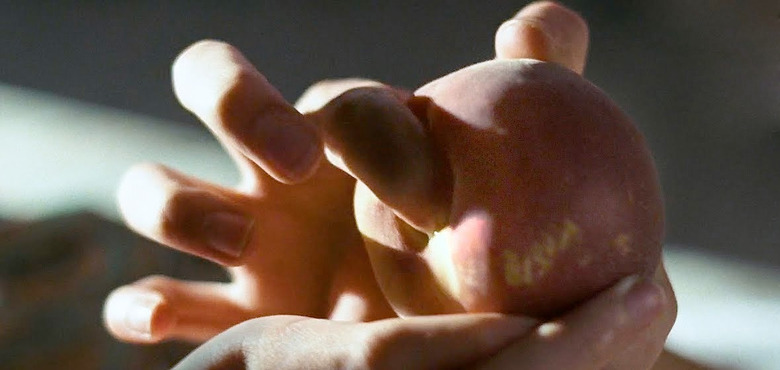
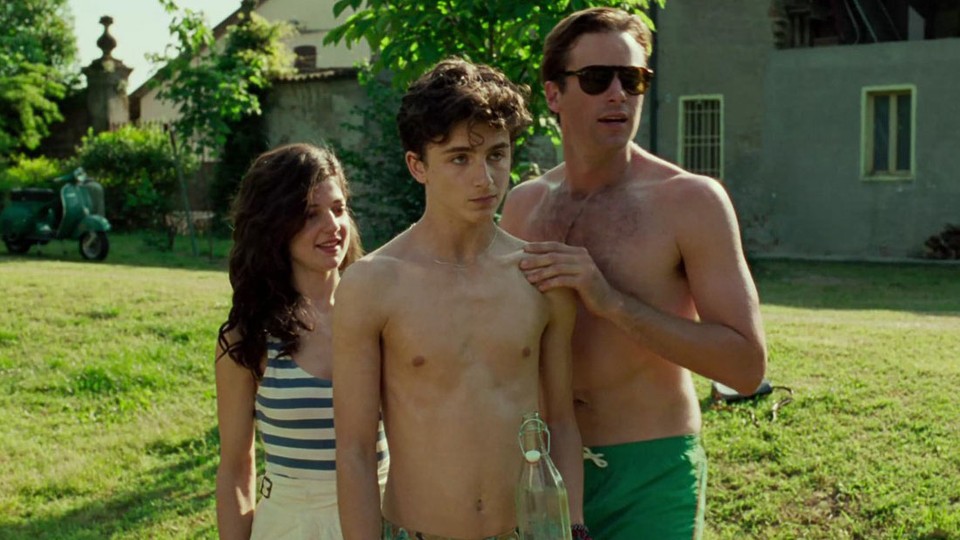
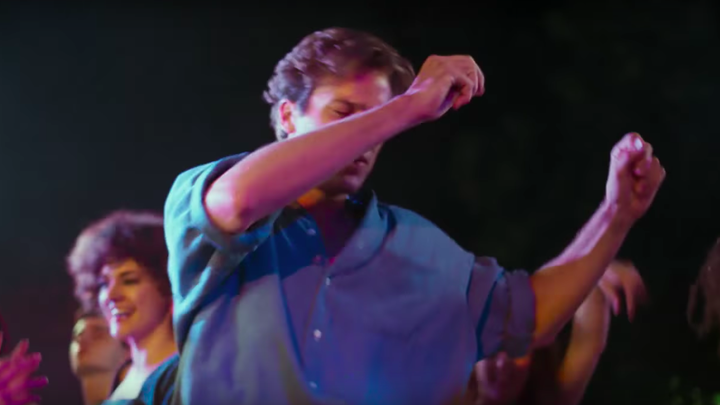
I found this scene a really interesting illustration of both Rodriguez’s “queer gestures” and Muñoz’s concept of a queer utopia. Although this scene represents a fulfillment of the potential for queer love (i.e. sex, or the implication of sex), this is not the first time that we sense queer undertones. Because they rarely speak to each other, some viewers may read Elio and Oliver’s budding relationship as platonic and far from the realm of sexual. And yet, what I think makes the film so powerful is its emphasis on queer gestures, that “socially legible and highly codified form of kinetic communication” that brings the two subtly and slowly together into a “we,” even if they don’t directly interact in ways customarily read as romantic (Rodriguez 6). So much of the film is predicated on those relational movements— the squeeze of a shoulder, the touching of a peach, a glance at a party—that by the time this specific scene rolls around, viewers already feel like the two have been involved in a kind of sensual, erotic play (and that this is the final, ultimate climax of those gestures). But even in this scene, gestures play a large role. When Elio moves his foot over Olivers, when they cling to each other, wrestling almost, they “counteract demands for corporeal conformity” and leave open space for a queer interpretation of the motions of their bodies (6). 

Call Me by Your Name' Doesn't Mention AIDS—but That Doesn't Mean It Isn't  Thinking About It - The Atlantic
Revisiting the Dance-Floor Scene in 'Call Me by Your Name' - The Atlantic

Moving to Muñoz, part of this film’s appeal (and maybe also what makes it problematic) is its general tone of “not yet here” or “almost,” sharing the sentiment that “we may never touch queerness, but we can feel it as the warm illumination of a horizon imbued with potentiality” (Muñoz 1). A lot of this film just feels like waiting, but it is a waiting that is “laden with potentiality” (Rodriguez 5). Occuring at midnight, in that liminal space and time between the past and the future, this scene is situated perfectly in a moment that is “primarily about futurity and hope” (Muñoz 11). Its dark, isolated setting and limited diagetic sound also help create a spatially recognizable “queer horizon,” away from the oppressive gaze of others. This scene is also ripe with a sense of awkward hesitation and nervousness as the two characters fumble around each other, learning to touch each other in new ways and be together. This aligns with what Muñoz seems to be arguing for, that instead of being concerned fully with the here and now, there is a collapse in boundaries of what is and what could be; the trepidation of their actions—and the panning away of the camera— embodies his concept for queer utopia as “subjects can act in the present in the service of a new futurity,” a future that is excitable, but not fully in reach (16). 

Categories
Uncategorized

Abbott Elementary S2E20, “Educator of the Year”

In the episode “Educator of the Year,” a 2-minute scene captures a contentious conversation between the protagonist and second-grade teacher at Abbott Elementary, Janine Teagues, and Cassandra O’Neil, the mother of her student Deshaun. The scene begins with Janine alone in her classroom, checking her phone and sighing before walking into the hallway and spotting Ms. O’Neil, whom she has been expecting all day. With a smile and welcoming gesture, she invites the woman inside, but is quickly corrected by “Ms. O’Neil” with a nonchalant and uninterested “Cassandra is just fine.” The camera follows the two back into the classroom—Janine in a puffed turquoise and light green dress encircled with a gold belt, and Cassandra in a blue button-down uniform—as they sit down and promptly get into the circumstances of the visit. As Janine enumerates the details of Deshaun’s behavior, the stable view of her is disrupted as the camera flits back and forth, showing a progressively more irritated Cassandra who rolls and widens her eyes, sighing in her seat. There is then silence and a wide shot of the two women, Cassandra looking down and saying “Mm-hmm, I see,” and checking her watch. The tension builds as the camera closes in and jumps rapidly from Janine to Cassandra, Cassandra to Janine, with Cassandra’s heated retorts like “Thought what, exactly?” producing a furrowed brow and backtracking from Janine. Although she sustains strong eye contact, speaks slower, and uses more exaggerated hand movements, Janine’s attempts to break through with Cassandra are shattered as she snaps, “We are not a team. And I don’t know how he could be the best student he could be with a teacher like you.” Janine, in a sitcom-style fourth wall break, glances at the camera in disbelief, stammers, but ultimately loses control of the situation as Cassandra gets increasingly frustrated, collects her things, and states “If this is the best you can do, you are the worst teacher I have ever seen” before walking out, leaving Janine bewildered, silent, and sad. 


Set in an underfunded elementary school in Philadelphia, Abbott Elementary regularly explores the intersections of race, gender, and socio-economic status within its community. In this particular scene, we observe two working Black women attempting to navigate their respective struggles and motivations, albeit unsuccessfully. Both viewers and Janine enter the scene with an expectation of solidarity, an assumption of understanding between two individuals who are vying for the same objective (Deshaun’s academic success) and have overlapping identities (Black, woman, career). And yet, the interaction is frustrating and hard to swallow as the two women fail to see eye-to-eye, their opposing viewpoints on the matter embodied in the rapid cuts and minuscule zoom-in techniques that create layers of misunderstanding. As the protagonist, viewers are often more immediately sympathetic to Janine, whose most prominent trait is her confidence in her teaching ability. Indeed, on Reddit and X, viewers absolutely HATED Cassandra, finding her rude, dislikable, and yet sadly familiar to many real-life teachers. And while conscious acting choices (tone of voice, hand gestures, facial expressions) are key in creating this characterization, I think many viewers jumped to attack and shame this figure of a Black, working mother as rude, ungrateful, standoffish, etc… especially next to the warm and determined figure of Janine. There is danger in binarizing the two women as good and bad, right and wrong, but the show perpetuates such a reading by not bringing Cassandra back at a later point in the episode for further conversation and/or context. Instead, what we get is a disheartened Janine, crying to her coworkers about a parent who “destroyed her,” and the remainder of the episode is dedicated to her coworkers uplifting and affirming her teaching ability. And while I do not doubt that there are parents who exhibit those traits and who degrade teachers who are just trying their best, I also think Cassandra’s character contains more nuances than just being a “bad parent.” We don’t know the circumstances at home, the toil of her work, the presence or absence of another caretaker…I believe the show could have benefited from a deeper examination of Cassandra’s background, even at the risk of communicating less potently the message of educators’ inability to solve every problem for their students.