Around the one-hour and 20-minute mark of Call Me By Your Name, we finally see the beginnings of a moment between Elio and Oliver, the two protagonists and love interests. It is midnight after a party, and the two of them are standing side-by-side on a balcony. All you can hear is their breathing, a ruffling of shirts, and the high-pitched chirping of crickets. Oliver says, “I’m glad you came,” and lightly brushes his hand (holding a cigarette) over Elio’s before the two of them amble back inside the room. It’s summer in 1980s Italy, and both characters are wearing loose-fitting clothes, Oliver in a green rolled-up button-down and Elio in a white t-shirt and jeans. The camera lingers on their bodies as they slowly learn to get closer, Elio starting to lean more on Oliver and eventually, fully embracing him, hands in hair as they kiss and become more comfortable with each other. The intimacy increases as they get into bed, the camera spending a long time on their feet and then moving up to their bodies, and start to climb on top of each other, their breathing getting heavy and movements becoming more frantic. As Oliver strips off his belt, the camera pans away to look outside the window at the trees, only the sound of their breathing and faint crickets audible.

I found this scene a really interesting illustration of both Rodriguez’s “queer gestures” and Muñoz’s concept of a queer utopia. Although this scene represents a fulfillment of the potential for queer love (i.e. sex, or the implication of sex), this is not the first time that we sense queer undertones. Because they rarely speak to each other, some viewers may read Elio and Oliver’s budding relationship as platonic and far from the realm of sexual. And yet, what I think makes the film so powerful is its emphasis on queer gestures, that “socially legible and highly codified form of kinetic communication” that brings the two subtly and slowly together into a “we,” even if they don’t directly interact in ways customarily read as romantic (Rodriguez 6). So much of the film is predicated on those relational movements— the squeeze of a shoulder, the touching of a peach, a glance at a party—that by the time this specific scene rolls around, viewers already feel like the two have been involved in a kind of sensual, erotic play (and that this is the final, ultimate climax of those gestures). But even in this scene, gestures play a large role. When Elio moves his foot over Olivers, when they cling to each other, wrestling almost, they “counteract demands for corporeal conformity” and leave open space for a queer interpretation of the motions of their bodies (6).
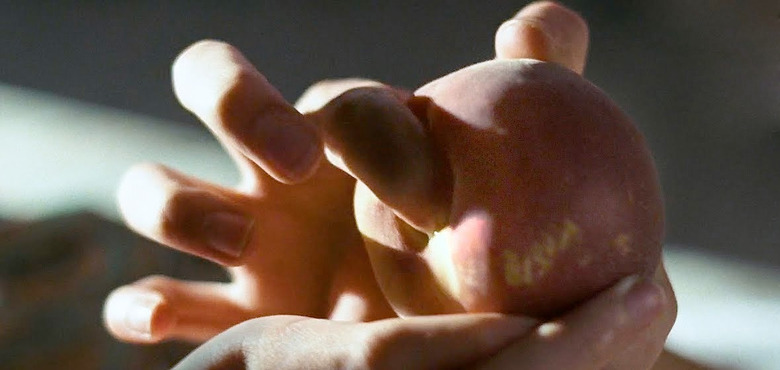
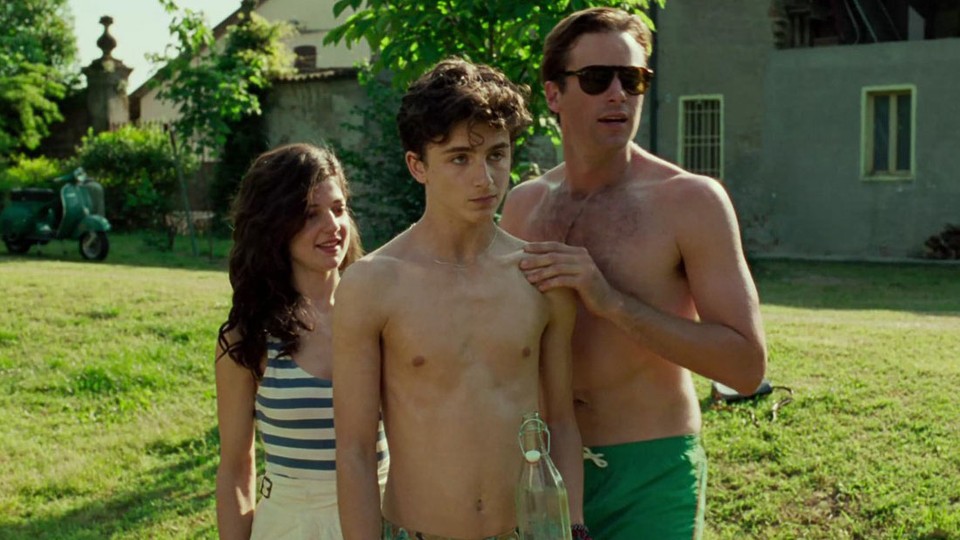
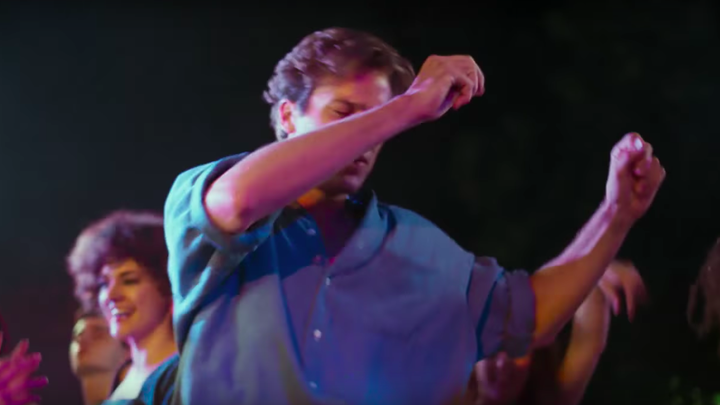
Moving to Muñoz, part of this film’s appeal (and maybe also what makes it problematic) is its general tone of “not yet here” or “almost,” sharing the sentiment that “we may never touch queerness, but we can feel it as the warm illumination of a horizon imbued with potentiality” (Muñoz 1). A lot of this film just feels like waiting, but it is a waiting that is “laden with potentiality” (Rodriguez 5). Occuring at midnight, in that liminal space and time between the past and the future, this scene is situated perfectly in a moment that is “primarily about futurity and hope” (Muñoz 11). Its dark, isolated setting and limited diagetic sound also help create a spatially recognizable “queer horizon,” away from the oppressive gaze of others. This scene is also ripe with a sense of awkward hesitation and nervousness as the two characters fumble around each other, learning to touch each other in new ways and be together. This aligns with what Muñoz seems to be arguing for, that instead of being concerned fully with the here and now, there is a collapse in boundaries of what is and what could be; the trepidation of their actions—and the panning away of the camera— embodies his concept for queer utopia as “subjects can act in the present in the service of a new futurity,” a future that is excitable, but not fully in reach (16).
2 replies on “Call Me by Your Name (Sometime in the Future?)”
Abby, I really enjoy your application of Rodriguez’s theory of queer gestures in thinking about the budding relationship between Elio and Oliver. As you note, the profoundness of their intimacy stems from the accumulation of these gestures overtime that build and build into something bigger. I think something that defines the emerging intimacy between Elio and Oliver is the characteristic of several of these gestures; they are so “small or quotidian as to escape notice.” These gestures hold deep meaning to Elio and Oliver, yet oftentimes escape notice from other characters in the film. In this way, Elio and Oliver’s intimacy is defined outside of the binds and expectations of external forces. This also made me think about what “socially legible” really means. While Elio and Oliver are able to read the romantic or sexual undertones of their shared gestures, other characters in the film are not. How then do we define social legibility if one’s identity and social context impacts the way they discern the meaning of a gesture?
I completely agree that Call Me By Your Name serves as a great example of queer gesture. Specifically, the movie does an interesting job of capturing the complexity of when gesture is legible and to whom. Though many of Oliver and Elio’s gestures towards each other are understood by the two of them and not the other characters, sometimes Elio and Oliver themselves question their understanding of gesture. For example, when the two first get together, Oliver explains to Elio that he had touched/grabbed his shoulders earlier in order to show Elio that he liked him, asking “couldn’t you tell?” However, Elio had been unsure of Oliver’s intent, and only with this communication did it become entirely clear to him. This potential for miscommunication and misunderstood gesture demonstrates the delicate balance of gesture and its often precarious nature.