Categories
Uncategorized

Representation of The American Dream in MARINA’s “Hollywood” and Mitski’s “Your Best American Girl”

A woman with her lips painted bright red sensually blows out a candle as the camera pans out to reveal its position atop a cake decorated to look like the American flag. As the woman sings the words “American queen is the American dream” over the cake—interspersed with shots of young people frollicking and partying outside of a large white house—she paints a stark picture of American patriotism. 

After the group presentation last week that discussed representations of America in music videos, I became curious about how America, the American Dream, and neoliberalism are represented from an outside perspective. This opening to “Hollywood” by Welsh singer MARINA (also known as Marina and the Diamonds) provides a stunning visual endorsement of the American dream. Throughout the video, MARINA dances through a large house wearing a variety of American flag themed outfits while partying, waving flags, and joyously indulging in her representation of the ideal Hollywood lifestyle. 

Despite the video’s visual affirmation of the glamour of the American dream, MARINA’s lyrics paint a different picture of America. She sings about a hostess on her flight to the US “trying to stimulate a mind / that is slowly starting to decay” while reading a gossip magazine, singing to her “Hollywood infected your brain” and that she has been “puking American dreams” in the chorus. Her lyrics throw jabs like these at the vapid and materialistic nature of America and her conception of the American dream throughout the song. However, the clash between MARINA’s lyricism and the visuals of her music video communicate an important message: MARINA cannot help buying into the American dream—being “Obsessed with the mess that’s America”—because she fits the narrow vision of who the American dream is imagined for. She recognizes in her lyrics that she bears the privilege of fitting the image of an American celebrity or movie star, singing about being compared to Shakira and Catherine Zeta Jones. She cannot help but bite into the idea of the American dream, even as she criticizes it, because she knows that she can fit the vision of the “American queen” that she sings about.

This music video contrasts starkly with the video for Mitski’s “Your Best American Girl.” At the opening of the video, Miski sits propped on a chair as a crew neatens her outfit and fusses over applying bits of hairspray to her before she suddenly locks eyes with a man across from her. The two exchange flirtatious glances, smiles, and waves. As Mitski blushes and waves shyly, a white woman dressed in jean shorts and wearing a flower crown—the picture of an ideal All-American girl—approaches the man and the two start flirtatiously touching as the smile drops from Mitski’s face. As the two of them flirt and eventually progress to making out, Mitski turns to her own hand, sensually kissing and caressing it as shots of Mitski on her own contrast with shots of the couple.

In the background of shots of Mitski and the couple, she sings “And you’re an all-American boy / I guess I couldn’t help trying to be your best American girl.” As the video progresses, the couple becomes progressively more intimate and unclothed, eventually wrapping themselves in nothing but an American flag as Mitski plays guitar on her own. This juxtaposition between Mitski on her own and the couple shrouded in the flag, along with the lyrics, signal that this couple represents the American dream that Mitskii has been excluded from. As a Japanese-American, Mitski has grown up being caught between both her American birthplace and her Japanese heritage and close relationship with her Japanese ancestry. She laments in the song, “Your mother wouldn’t approve of how my mother raised me / but I do,” both illustrating the distance between her upbringing and that of this all-American boy and her refusal to shun her upbringing in order to fit into an American ideal.

Like MARINA, Mitski presents a story of aspiration of fitting into the narrative of the American dream as an outsider. Both simultaneously critique the American dream while singing about how they cannot help but reach for it. They demonstrate how culture has become so saturated with idealization of what is offered to those who fit the “all-American” ideal that, even in critiquing it and having some kind of distanced viewpoint, they cannot help but participate in the kind of behaviors and consumption that bring them closer to it. However, while MARINA’s video presents a story of someone who has been accepted into this ideal, in part because of her whiteness and conformity to American beauty standards, Mitski’s illustrates how this ideal remains exclusionary for those who do not fit the image of a “best American girl.” In contrast with MARINA’s video, which critiques America while providing a visual endorsement of the American dream, Mitski sings about aspiring towards an “all-American” ideal while visually representing this impossibility for her. No matter what she does or how much she tries to be an all-American girl like her counterpart in the video, even having a team of stylists fuss over her, she remains on the outside looking in.

Categories
Uncategorized

Defying Heteronormativity In The Great British Baking Show

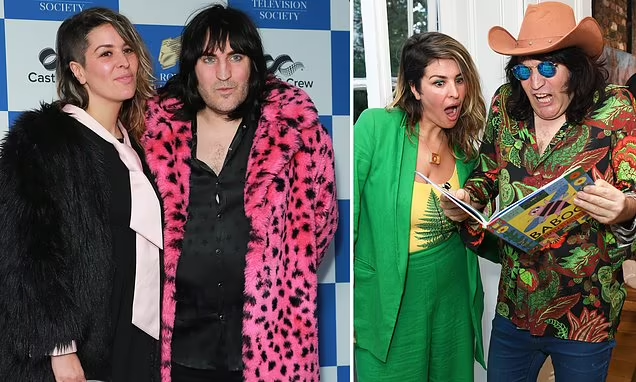
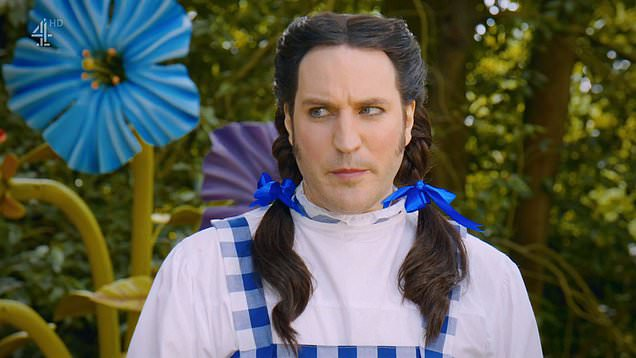
As one host yells to the bakers that they have half an hour left to complete their technical challenge, his coworker leaps down from out of frame. Wearing high-heels boots and a black, flowy, graphic button-up that reads “PHENOMENA” and has intricate illustrations on it, he apologizes for the surprise entrance, explaining that he had been on the ceiling eating bugs. During the time call before his leap from the ceiling, Noel and his co-host, Matt, had been pretending to lean in for an intimate kiss. Earlier this year, my housemate introduced me to The Great British Baking Show, which immediately charmed me with its whimsical challenges and shockingly positive competitive environment. One of the longstanding hosts of the show, Noel Fielding, particularly contributed to the show’s allure and delight. This entrance of Noel’s from the season 10 finale serves as a typical example of his eccentric style and surreal humor, which bring a key element of absurdity and comedy to the show. After watching several episodes, it becomes clear that his ability to comfort competitors, ease the anxieties of the competition, poke fun at and joke with the judges, and generally form relationships and connections with all personalities on the show makes him a crucial part of keeping the quintessential loveliness and lighthearted atmosphere of the Bake Off alive.

Noel immediately reads as queer, both in his eclectic fashion sense and in his general transgression of gender norms. His style often seems to take inspiration from 70s or punk style, with brightly colored sweaters and leather pants. Often donning heeled boots, eye makeup, a flowing hairstyle, and graphic shirts and sweaters that appear feminine or relatively gender-neutral, he moves across and between gender lines with his clothing choices. In his interactions with contestants and judges, he not only shows an ability to switch between humorous teasing and comforting sensitivity, but also jokingly alludes to sexual or romantic attraction to or relationships with a variety of his coworkers, from the overtly and traditionally masculine Paul Hollywood to his more recent co-host Alison Hammond. 

Since being introduced by my housemate, I have become an avid watcher of the show. While Noel never alludes to anything specific about his identity (either gender identity or sexuality), I had always assumed a kind of queerness and fluidity to him. A few weeks ago, when watching the show in my kitchen while fittingly feeding my sourdough starter, the same housemate who had introduced me to the show saw me watching it, remarking, “can you believe that Noel is 50 and straight with kids??” A quick google search confirmed—Noel has been in a long term relationship with a woman (DJ Lliana Bird) for over a decade and has several children with her. 

This revelation, and why Noel’s apparent heterosexuality might have come as such a shock to my housemate, illustrates a key argument in Cathy Cohen’s “Punks, Bulldaggars, and Welfare Queens”: heteronormativity does not necessarily equate to heterosexuality. Cohen explains, “The inability of queer politics to effectively challenge heteronormativity rests, in part, on the fact that despite a surrounding discourse which highlights the destabilization and even deconstruction of sexual categories, queer politics has often been built around a simple dichotomy between those deemed queer and those deemed heterosexual” (440). Given this dichotomy between queerness and heterosexuality, the reality that Noel often does challenge heteronormativity through both his presentation and his relation to others on the show positions him as queer and therefore not heterosexual. However, he provides an example of how one’s sexuality does not necessarily reflect the queerness of their politics or interactions. As Cohen further notes, “Queer means to fuck with gender. There are straight queers, bi queers, tranny queers, lez queers, fag queers, SM queers, fisting queers in every single street in this apathetic country of ours” (452). Noel, in his transgressive performance of gender, becomes an example of someone Cohen might dub a “straight queer” and helps reconstruct notions of the relationship between queerness and sexuality.

Categories
Uncategorized

Community Stratification in Fire Island

A young man wearing a casual t-shirt with the sleeves cut off walks into an extravagant house, looking around as another young man walks down a large staircase wearing what looks like expensive workout clothing, asking, “excuse me, can I help you?” The first man, Noah, reacts with annoyance and defensiveness, calling for his friend as yet another polished looking man in workout clothes appears at the top of the stairs, greeting Noah with a polite but contemptuous attitude as he informs him that his friend drank too much the night before. He makes a snide remark about Howie, Noah’s friend, being unaccustomed to top shelf-shelf liquor. As Noah roams through the lavish and modernly barren house, he runs into another man, Will, who attempts to offer Noah some water and apologize for the disposition of some of his friends. Noah brushes off Will’s apology and offers to help, instead criticizing Will and poking fun at his use of disposable water bottles. The camera follows Noah into the next room as he meets Howie, who has woken up in a large bathtub. As Howie recounts the night before from the bathtub while Noah sits perched on the rim, the two Asian men are backlit by the large window and stand out against the sterile white tile. Noah urges Howie to not get too attached to a man who Howie had been flirting with the day before and who had stayed up with him while he was sick, dismissing Howie’s perception of the night’s intimacy and warning against getting too caught up in feelings for someone he had just met.

This scene follows the main character of the 2022 film Fire Island, a reimagining of Jane Austen’s classic novel Pride and Prejudice that centers around the interpersonal relationships of a group of gay men spending their summer on Fire Island. Here, Noah’s entrance into the world of some of the wealthy, white inhabitants of Fire Island highlights some of the expectations, stratification, and class disparity among the men on the island. The occupants of the house treat Noah with contempt, looking down on him both literally (from the luxurious staircase) and figuratively, as they feign not recognizing him and make disparaging remarks about him and his friend being unable to afford expensive liquor. Noah responds with a standoffish and defensive demeanor as a mechanism of self defense. However, when Will (who viewers eventually come to understand as the Darcy equivalent to Noah’s Elizabeth) greets Noah with genuine apologeticness and willingness to help, Noah treats him as if he has shown the same condescension and mockery as his peers. His reaction to Will’s kindness, which Noah does not even interpret as kindness, demonstrates how he has developed a general distrust of the wealthier and more socially advantaged gay men on the island who could potentially look down on him. His response to Howie’s discussion of the preceding events further illustrate his attitude towards the other men on the island. As he urges Howie not to bank on a romantic connection, Noah reveals how he has attempted to make himself invulnerable as a result of the power imbalances between men on the island. Even the framing of Howie and Noah in the bathroom marks them as out of place, which Noah has responded to by putting up a defensive front. He treats romance with contempt, viewing the other men on the island as only looking for sexual connections and not having a genuine respect or romantic desire for him and his friends. The power imbalances layer on top of the expectation of potential attraction create an environment in which Noah feels as if he must go into his interactions with the expectation of being used or not truly seen. Though this attitude protects him from the WASPy characters who greet him on the staircase, it also disallows him from seeing the genuine attempts at connection made by Will and by Howie’s love interest. Will himself is also an Asian man, and clearly demonstrates that he understands that pain and ostracization that his friends can cause when he attempts to apologize to Noah. However, because of his class association with the white characters who have slighted Noah, he does not trust Will enough to recognize the ways in which they have had similar experiences.