As one host yells to the bakers that they have half an hour left to complete their technical challenge, his coworker leaps down from out of frame. Wearing high-heels boots and a black, flowy, graphic button-up that reads “PHENOMENA” and has intricate illustrations on it, he apologizes for the surprise entrance, explaining that he had been on the ceiling eating bugs. During the time call before his leap from the ceiling, Noel and his co-host, Matt, had been pretending to lean in for an intimate kiss. Earlier this year, my housemate introduced me to The Great British Baking Show, which immediately charmed me with its whimsical challenges and shockingly positive competitive environment. One of the longstanding hosts of the show, Noel Fielding, particularly contributed to the show’s allure and delight. This entrance of Noel’s from the season 10 finale serves as a typical example of his eccentric style and surreal humor, which bring a key element of absurdity and comedy to the show. After watching several episodes, it becomes clear that his ability to comfort competitors, ease the anxieties of the competition, poke fun at and joke with the judges, and generally form relationships and connections with all personalities on the show makes him a crucial part of keeping the quintessential loveliness and lighthearted atmosphere of the Bake Off alive.

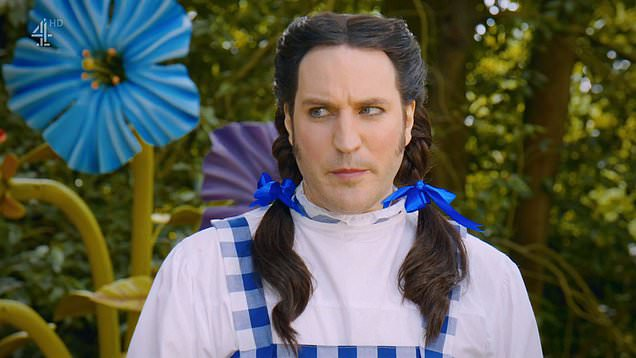
Noel immediately reads as queer, both in his eclectic fashion sense and in his general transgression of gender norms. His style often seems to take inspiration from 70s or punk style, with brightly colored sweaters and leather pants. Often donning heeled boots, eye makeup, a flowing hairstyle, and graphic shirts and sweaters that appear feminine or relatively gender-neutral, he moves across and between gender lines with his clothing choices. In his interactions with contestants and judges, he not only shows an ability to switch between humorous teasing and comforting sensitivity, but also jokingly alludes to sexual or romantic attraction to or relationships with a variety of his coworkers, from the overtly and traditionally masculine Paul Hollywood to his more recent co-host Alison Hammond.

Since being introduced by my housemate, I have become an avid watcher of the show. While Noel never alludes to anything specific about his identity (either gender identity or sexuality), I had always assumed a kind of queerness and fluidity to him. A few weeks ago, when watching the show in my kitchen while fittingly feeding my sourdough starter, the same housemate who had introduced me to the show saw me watching it, remarking, “can you believe that Noel is 50 and straight with kids??” A quick google search confirmed—Noel has been in a long term relationship with a woman (DJ Lliana Bird) for over a decade and has several children with her.
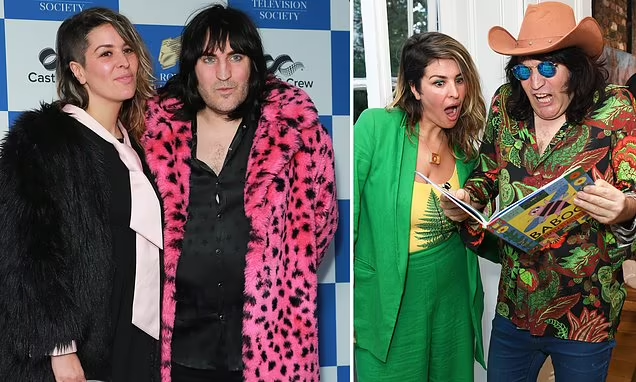
This revelation, and why Noel’s apparent heterosexuality might have come as such a shock to my housemate, illustrates a key argument in Cathy Cohen’s “Punks, Bulldaggars, and Welfare Queens”: heteronormativity does not necessarily equate to heterosexuality. Cohen explains, “The inability of queer politics to effectively challenge heteronormativity rests, in part, on the fact that despite a surrounding discourse which highlights the destabilization and even deconstruction of sexual categories, queer politics has often been built around a simple dichotomy between those deemed queer and those deemed heterosexual” (440). Given this dichotomy between queerness and heterosexuality, the reality that Noel often does challenge heteronormativity through both his presentation and his relation to others on the show positions him as queer and therefore not heterosexual. However, he provides an example of how one’s sexuality does not necessarily reflect the queerness of their politics or interactions. As Cohen further notes, “Queer means to fuck with gender. There are straight queers, bi queers, tranny queers, lez queers, fag queers, SM queers, fisting queers in every single street in this apathetic country of ours” (452). Noel, in his transgressive performance of gender, becomes an example of someone Cohen might dub a “straight queer” and helps reconstruct notions of the relationship between queerness and sexuality.
2 replies on “Defying Heteronormativity In The Great British Baking Show”
Thank you for this engaging and thought-provoking reflection on Noel Fielding’s role in “The Great British Baking Show.” Your reading of his gender performance is especially powerful in illustrating how queerness is not strictly tethered to sexual orientation, but can instead be located in the disruption of normative gender and relational structures.
What stands out most in your piece is the way you center Fielding’s aesthetic and affective presence, not as a gimmick, but as a sustained performance that destabilizes gender norms in the space of what is typically considered cozy, domestic, and apolitical television. The Bake Off tent, with its gingham bunting and pastoral charm, may not seem like the obvious stage for anti-normativity, but Fielding’s surreal humor, campy outfits, and fluid intimacy with cast and contestants stretch the boundaries of what “straight” masculinity can look like on mainstream TV.
I love the GBBS and love this reading of it! My favorite seasons of the show were the first seven, featuring Sue Perkins and Mel Giedroyc as co-hosts. Unfortunately, they’re not on Netflix anymore, but in these seasons, Sue was openly gay (although she was outed against her will in 2002). While Mel was (and still is) married to a man, the two co-hosts wore colorful blazers over t-shirts (in a stereotypical lesbian way, not a Mary Berry or Prue Leif copycat way) and were close, to the point that they could be mistaken as a couple. When the two left the show, their roles were filled by Noel Fielding and a rotating partner. Having Sue be replaced by Noel almost felt like the show producers were filling a “gay representation quota.” The fact that Noel was assumed to be gay but not actually provokes questions for me about whether implicit or explicit representation should be prioritized and whether queer sexualities or gender queer expression should be prioritized if there is only one queer ‘role.’