(https://www.youtube.com/watch?v=DFcAPww3CuM)
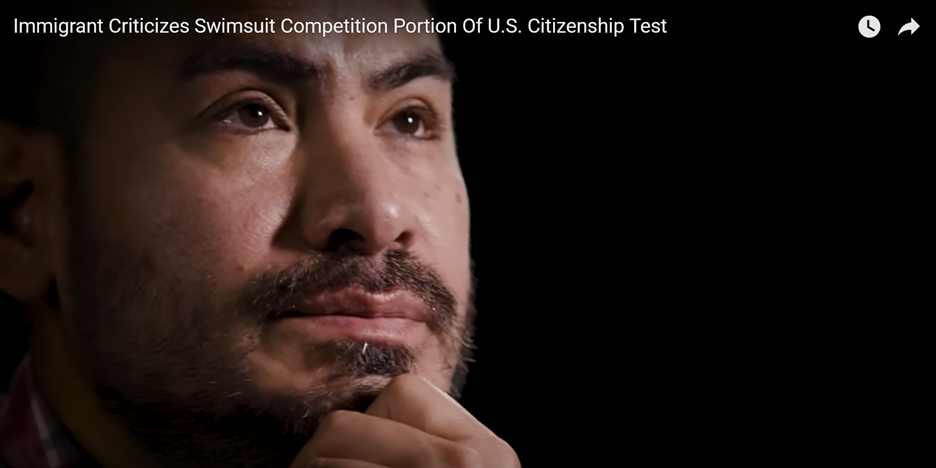
To be clear, there is no swimsuit competition component to the U.S citizenship naturalization process. This is a surrealist insert by the otherwise serious The Onion News Network. The goal here is clear, through a formal interview format, replete with sad violins, The Onion seeks to criticize the naturalization process by hyperbolizing its anti-immigrant bias.
The first fifteen seconds of the 90 second clip are sensible as Steven Gimenez, the video’s sole speaker, makes valid critiques about the many requirements and roadblocks that make it clear to [certain] immigrants that “this country doesn’t want you here.” These lamentations about the legal process are, of course, fully merited. Since the 1965 Hart-Cellar act the number of visas given has been severely capped for countries in Latin America (of whom Gimenez, an Argentinian is meant to represent). Pathways to citizenship for undocumented immigrants is practically non-existent and since the 1996 Illegal Immigration Reform and Immigrant Responsibility Act necessitates self-deportation for 10 years before being able to apply (even if sponsored on the grounds of family reunification). 1996 also saw the Personal Responsibility and Work Act that restructured the welfare system of the US and initially made even legal immigrants unable to access any social safety net. Although that provision was reversed, accessing social welfare programs (like SNAP, WIC, TANF, Medicaid, or whatever else) makes one liable to be a public charge which severely damages anyone’s case for naturalization. And all that’s not even touching the xenophobic rhetoric that is pervasive across the airwaves and visible in many parts of the nation.
But obviously a satirical piece of media can’t serve all that drudgery and still stay funny. So instead they make swimsuit competitions a stand-in for the reasons immigrants get rejected from citizenship. They make Gimenez say with full sincerity and gravity, “you can spend your time studying the constitution, declaration of independence, know the names of all nine Supreme Court Justices, and you can still be rejected because your suit has left unsightly tan lines.” This he continues is an unfair double standard and that he hopes such a requirement is removed so that “even less sexy immigrants can become citizens too.”
Although Steven Gimenez’s character ostensibly qualifies as an Avatar in the sense McMillan describes, there is a source pause in folding something from The Onion and something perhaps more intentional like the avatars arising in Beyonce’s Lemonade into the same space. For McMillan, he took his avatar production analytic to examine how avatars “comment[ed] back on identity, to subvert the taken-for-granted rules for properly embodying a black female body” (McMillan, 12). My hesitation to ascribe avatar status to Gimenez is not to do with fear of expanding McMillan’s ideas of avatars to performances outside Black performance art. McMillan already does this in allowing the “fraudulent identities in faux biographies, video art, printed newsletters, and … digital media like Tumblr and YouTube” (McMillan, 13). Instead the hesitation is in seeing Gimenez’s character as perhaps a reduced form of performing objecthood. The intent to subvert taken-for-granted rules is certainly there; the whole point of the video is to critique the idea of a valid American (naturalized citizen). But the method is wholly unserious, and perhaps this makes the avatars feel attenuated – more objets d’art than embodied subject.
All that is not to diminish the video’s power to focus the viewer’s oppositional gaze. Quoting and expanding on Manthia Diawara, bell hooks argues: “‘Every narration places the spectator in a position of agency….’ Of particular concern for [them] are moments of ‘rupture’ when the spectator resists ‘complete identification with the film’s discourse’” (bell hook, 209). In this case, the moment of rupture is fairly immediate. Saying with temerity and seriousness the pain caused by the swimsuit competition portion of the naturalization process necessarily pulls the viewer into a fictional plane of reality. But the viewer knows this (unless they are immensely gullible). From this perspective, the viewer is forced to interrogate not the avatar before them (Steven Gimenez is a perfectly normal person) but the systems of immigration, citizenship, and belonging. Obviously, we know that there is on swimsuit competition in any legal procedure, but invoking the imagery sends the viewer into a constant state of criticism in search of what the swimsuit competition is a stand-in for.
On its own, the video does not provide the wrap-around context needed to make full sense of the systems it is criticizing. But the oppositional gaze it conjures remains active long after its completion.