Categories
Uncategorized

Selective Inclusion in an ICE Promotional Video

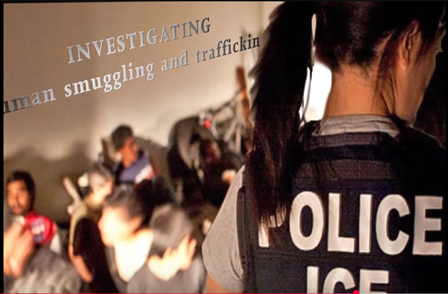
With the ongoing hostilities and terror immigrant communities are facing, I thought it timely to investigate the self-image of US Immigration and Customs Enforcement (or as artist Ricardo Levins Morales names them US Intimidation and Community Eradication). Turns out that three years ago, the office ICE.gov YouTube channel published a recruitment video showcasing just what exactly ICE is about.

It is an excruciating two-minute watch full of antiquated edits of floating texts and unbelievable naïve presentations of the actual “work” they do. When not explicitly calling out what is happening on screen, there is a near 100% chance that it will just be b-roll footage of a heavily militarized ICE agent crossing the screen. All the while there is a rhythmic thumping in the background, occasionally colored by a faraway brass section. When there is an explanation for the footage, it is always an image of the job done. ICE agents standing heroically in frame, or in the case of “pursuing human rights violators” section, ICE agents very slowly climbing up stairs. I am tempted to say that one of the ICE agents is chasing the other in this scene.

Never is there any problematic footage of the people and communities that they hurt: no footage of family separation, scarcely any footage of detention centers, and no (warrantless) home raids.

Where I want to draw the most attention too, though, is the professional shots of Hispanic appearing women in ICE uniform. As I read it, ICE is sending a message to the demographics it hunts telling them they are an inclusive and welcoming workspace (provided you have papers). Ignore the hostile glares from the officers in the background, there is at least token representation in the force, and that should be seen as sufficient to say there is diversity. Similar to the strategies of Warner’s Plastic Representation, ICE exercises a selective inclusion into the hegemonic picture of itself and other law-enforcement. It directly challenges the viewers probable pre-conceptions that ICE agents are all white nationalists seeking to eliminate those who, in the words of our current president, are “poisoning the blood of our country.” I cannot say it is a very successful challenge, but it is notable at least that the effort was made.

The end title card tries to tie everything and everyone together by uttering the downright slanderous statement that “we are ICE.” The hell we are.

Categories
Uncategorized

Hyper Able-Bodiedness in a Dentist Commercial

              We so commonly speak of media as representing ideals, whether that be in some covert unspoken way or in a flashy provocative spell. Throughout the course we have been training a kind of oppositional, or at the very least, critical gaze to the media we consume. However, as McRuer makes note, this awareness raising has not really touched the discourse of compulsory able-bodiedness. It is often taken as the natural state of things, which encourages a passive reception. It is harder though to accept the reality shown when it is so out-of-this-world. That is to say, rarely is compulsory able-bodiedness so blatant and extreme as it is in the following dental commercial.

              Title The Juggler, this 30 second dental advertisement sits squarely in a neoliberal America. The title’s namesake is seen with four arms attached and more off the frame doing many necessary tasks. She’s feeding a baby, cooking an American breakfast (eggs and bacon), folding laundry, doing paperwork, typing furiously on her mac-keyboard, and as the narrator tells us booking a dentist appointment. And throughout it all, she never expresses the slightest bit of discontent. In fact, the seems happy to do all these (mostly domestic) tasks – none of which seem to be done for her own sake. A person holding a pan with eggs and a person holding a computer

AI-generated content may be incorrect.

              The main sell the advertisement is attempting to make is that Ideal Dental allows busy patients like Teal-shirt below to schedule their appointments on Saturdays. That’s it. No special mention of the quality of dentistry nor the kinds of services offered. Those parts are already coded in in the architype of the patient they present. Our unproblematic patient is (hyper)able-bodied, ostensibly middle/upper-class, and already dentally hygienic. That she’s white, young, a mother, and employed cannot go unmentioned.

              We have spent a lot of time deconstructing, critiquing, and on occasion obliterating ideals. Confronting hegemonic ideologies such as heteronormativity and homonationalism are all about emptying out the signs of the “ideal.” Doing that meta ideologic work, the kind Sandoval includes as a methodology of the oppressed, means asking first what is ideal – so interrogating the image above – and then putting it into relation with other (equally arbitrary) ideals.

Being able to schedule dentist appointments on Saturdays is ideal only in the context where scheduling it on weekdays compromises one’s productivity. The connection between healthcare and work is, to the detriment of the unemployed and low-wage workers, the manufactured reality of America. The implicit ideological message then is that a good American would take advantage of the Saturday slots. And not only that, but we should also be grateful for that flexibility as it leaves us with more room to do other kinds of work. That Sunday is still not an option is curious as well. It looks like ideal dental observes the Christian Sabbath.

A screenshot of a website

AI-generated content may be incorrect.Framing dental health as a secondary necessity to work is also part of the ads messaging. Taking a look at their website, it is also clear that dental healthcare is seen not as healthcare in the traditional sense (that is caring about one’s wellbeing) but instead it is a professional service meant to ensure patient satisfaction. Convenience, comfort, and modernity are all stressed in both the ad and website. The chatbot prompt is friendly in a servile kind of way. The end goal is to have the patient smile, which while certainly a goal for dentistry, does away with all the other reasons someone might be going to a dentist unrelated to cosmetics.

              The appearance of a third arm comes out again in the final seconds of the ad. It is, in this case wholly unnecessary to have more limbs as the actress is no longer multi-tasking. Yet it reappears just to take her phone out of her pocket and then lingers for no apparent reason. A hyper compulsory able-bodiedness is unabating.

Categories
Uncategorized

Satire and Weakened Avatars

(https://www.youtube.com/watch?v=DFcAPww3CuM)

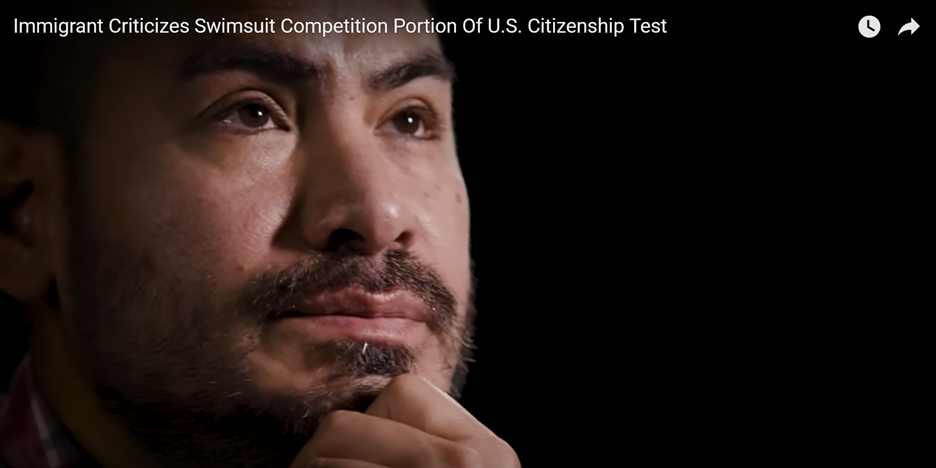
            To be clear, there is no swimsuit competition component to the U.S citizenship naturalization process. This is a surrealist insert by the otherwise serious The Onion News Network. The goal here is clear, through a formal interview format, replete with sad violins, The Onion seeks to criticize the naturalization process by hyperbolizing its anti-immigrant bias.

            The first fifteen seconds of the 90 second clip are sensible as Steven Gimenez, the video’s sole speaker, makes valid critiques about the many requirements and roadblocks that make it clear to [certain] immigrants that “this country doesn’t want you here.” These lamentations about the legal process are, of course, fully merited. Since the 1965 Hart-Cellar act the number of visas given has been severely capped for countries in Latin America (of whom Gimenez, an Argentinian is meant to represent). Pathways to citizenship for undocumented immigrants is practically non-existent and since the 1996 Illegal Immigration Reform and Immigrant Responsibility Act necessitates self-deportation for 10 years before being able to apply (even if sponsored on the grounds of family reunification). 1996 also saw the Personal Responsibility and Work Act that restructured the welfare system of the US and initially made even legal immigrants unable to access any social safety net. Although that provision was reversed, accessing social welfare programs (like SNAP, WIC, TANF, Medicaid, or whatever else) makes one liable to be a public charge which severely damages anyone’s case for naturalization. And all that’s not even touching the xenophobic rhetoric that is pervasive across the airwaves and visible in many parts of the nation.

            But obviously a satirical piece of media can’t serve all that drudgery and still stay funny. So instead they make swimsuit competitions a stand-in for the reasons immigrants get rejected from citizenship. They make Gimenez say with full sincerity and gravity, “you can spend your time studying the constitution, declaration of independence, know the names of all nine Supreme Court Justices, and you can still be rejected because your suit has left unsightly tan lines.” This he continues is an unfair double standard and that he hopes such a requirement is removed so that “even less sexy immigrants can become citizens too.”

            Although Steven Gimenez’s character ostensibly qualifies as an Avatar in the sense McMillan describes, there is a source pause in folding something from The Onion and something perhaps more intentional like the avatars arising in Beyonce’s Lemonade into the same space. For McMillan, he took his avatar production analytic to examine how avatars “comment[ed] back on identity, to subvert the taken-for-granted rules for properly embodying a black female body” (McMillan, 12). My hesitation to ascribe avatar status to Gimenez is not to do with fear of expanding McMillan’s ideas of avatars to performances outside Black performance art. McMillan already does this in allowing the “fraudulent identities in faux biographies, video art, printed newsletters, and … digital media like Tumblr and YouTube” (McMillan, 13). Instead the hesitation is in seeing Gimenez’s character as perhaps a reduced form of performing objecthood. The intent to subvert taken-for-granted rules is certainly there; the whole point of the video is to critique the idea of a valid American (naturalized citizen). But the method is wholly unserious, and perhaps this makes the avatars feel attenuated – more objets d’art than embodied subject.

            All that is not to diminish the video’s power to focus the viewer’s oppositional gaze. Quoting and expanding on Manthia Diawara, bell hooks argues: “‘Every narration places the spectator in a position of agency….’ Of particular concern for [them] are moments of ‘rupture’ when the spectator resists ‘complete identification with the film’s discourse’” (bell hook, 209). In this case, the moment of rupture is fairly immediate. Saying with temerity and seriousness the pain caused by the swimsuit competition portion of the naturalization process necessarily pulls the viewer into a fictional plane of reality. But the viewer knows this (unless they are immensely gullible). From this perspective, the viewer is forced to interrogate not the avatar before them (Steven Gimenez is a perfectly normal person) but the systems of immigration, citizenship, and belonging. Obviously, we know that there is on swimsuit competition in any legal procedure, but invoking the imagery sends the viewer into a constant state of criticism in search of what the swimsuit competition is a stand-in for.

            On its own, the video does not provide the wrap-around context needed to make full sense of the systems it is criticizing. But the oppositional gaze it conjures remains active long after its completion.

Categories
Uncategorized

Infidelity & Masculinity in Christian Nodal’s “Adios Amor”

We open with a short aerial shot of an agricultural landscape that is peripheral to the logo of the production company. The accordion and other instruments are already in session when the scene shifts to the singer longingly leaning on barrels of alcohol as the camera glides towards him. He’s wearing dark clothing, a red and black combination of a caballero outfit, with a heavy silver cross the size of a small child’s hand shining at the center of his chest. This is the form the singer takes when exiting the storyline of the music video that is introduced shortly after these establishment shots.

As the vocals start gearing up for entry, we return to the agricultural scenery where the singer is toiling. He’s a young man with a very boyish face, and although he goes to wipe sweat of his forehead, he looks to have already been bereft of perspiration or dirt on his denim work-wear. The moment the vocals announce themselves, the video begins alternating between the singer as a singer, in his red and black wear, and the singer as a character in the story arc. When out of the story, the singer has behind him a stoic mariachi band who play the instrumentals of the song but never interact with the world they are placed in. This transience doesn’t apply to the emotionally strung singer who readily drinks the tequila that comes from the colorful and, no doubt, brand placed bottles on the bar counter.  

The story of the music video is a that of a courting relationship between the singer (farmworker) and a love interest (bartender). In the initial phase, the two are intimate with each other. At the bar alone, they greet each other with great affection – kissing each other over the counter. There is comfort evident in the hand placement and in the ease of laughter and smiles. Their standing is further solidified in the scene where they are on the back of a horse being unmistakable as a couple. Here the singer holds the bartender closely and delivers a kiss that neither reacts much to. These outdoor shots, happening in the day, are drained of much of their saturation and brightness.

Conflict arises at the entry of another man at the bar. He is not much different from the singer in appearance or dress, but clearly, he was persuasive as he quickly charmed the bartender whilst our protagonist is absent. Our singer returns to the bar with a cheerful smile and a bouquet of flowers only to be greeted by his presumed partner sitting on the knee of another man. She is wearing a darker, redder shade of lipstick than before and her clothing is likewise more revealing than in past interactions. As she sits on the stranger’s knee and caresses his head, she pays no attention to our singer.

But she herself ends up becoming a secondary accessory to the charming man who as it turns out is something of a womanizer. Outside in the night and in front of a conveniently placed Porsche, the bartender is unceremoniously dumped in favor of a new woman. Angered, she walks off in search of our singer and finds him sitting at the end of a pedestrian stone bridge.

It’s still nighttime but their meeting is strongly illuminated. He is not angry and there is still kindness and affection in the way he looks and addresses her, but his mind is already made up. As the song goes, he bids farewell to his “love,” resigning himself to forgetting her even if he still has feelings for her.  And so the video ends with a close up of the nonplused bartender watching her former suitor walk off.

There is nothing revolutionary in this story. But that is not to say that its handling of infidelity, class differences, alcohol and gender are done on a single dimension. At the core of the video is the masculinity of the singer. Our singer is certainly presented as a virtuous person to whom our sympathies are owed. He’s clean shaven, wears a cross, “toils” on a farm, brings flowers, dresses like a cowboy and has a horse to boot. In effect, his masculinity is constructed as safely traditional machismo. However the story, it must be recalled, is told by him and through his memories. And these memories cannot be taken as pristine as he is seen drinking at nearly every appearance.

The primacy of alcohol is never questioned, and its inescapability is presented as a refuge. Much of the story is set in a bar, and it is in the same bar the singer spends his time outside the story. Perhaps it is less a matter of cultural signaling and more a consequence of brand placement, but the end message is the same: drinking is a healthy and potentially manly response to heartbreak. The singer is allowed to be emotional while inebriated, but he is considerably more subdued and stoic when sober.  

Infidelity is also treated in a way to secure the singer’s masculinity. First, it is the bartender who leaves him (and ultimately tries to get him back). Second, his apparent loss was presumably due to a gulf in wealth between him and the other suitor. But it was already established that he is a hard, honest worker, so comparing him to someone with enough resources to own a luxury car is presented as unfair and not an indictment of our singer’s shortcomings.

On the one hand, I am glad to see that he did not return to the bartender who cheated on him. Knowing one’s worth is an important thing, but I also do not want to ignore the potential problems coming from the music video. By having a safe self-insert character in a tale of heartbreak, the audience can be easily, and perhaps passively, moved to view the story as a kind of template to follow. I do not mean a blind substitution of reality with fiction. Instead, I am eyeing the way certain themes are romanticized to reinforce problematic norms especially those related to drinking. Drowning in alcohol should not be seen as a prerequisite to showing emotion. But maybe this concern is overstated? Prior to searching for the music video, I had only ever streamed the song. Of the 1.5B views, I wonder how many can be counted as legitimate viewings of the video and not just the audio.