We so commonly speak of media as representing ideals, whether that be in some covert unspoken way or in a flashy provocative spell. Throughout the course we have been training a kind of oppositional, or at the very least, critical gaze to the media we consume. However, as McRuer makes note, this awareness raising has not really touched the discourse of compulsory able-bodiedness. It is often taken as the natural state of things, which encourages a passive reception. It is harder though to accept the reality shown when it is so out-of-this-world. That is to say, rarely is compulsory able-bodiedness so blatant and extreme as it is in the following dental commercial.
Title The Juggler, this 30 second dental advertisement sits squarely in a neoliberal America. The title’s namesake is seen with four arms attached and more off the frame doing many necessary tasks. She’s feeding a baby, cooking an American breakfast (eggs and bacon), folding laundry, doing paperwork, typing furiously on her mac-keyboard, and as the narrator tells us booking a dentist appointment. And throughout it all, she never expresses the slightest bit of discontent. In fact, the seems happy to do all these (mostly domestic) tasks – none of which seem to be done for her own sake.

The main sell the advertisement is attempting to make is that Ideal Dental allows busy patients like Teal-shirt below to schedule their appointments on Saturdays. That’s it. No special mention of the quality of dentistry nor the kinds of services offered. Those parts are already coded in in the architype of the patient they present. Our unproblematic patient is (hyper)able-bodied, ostensibly middle/upper-class, and already dentally hygienic. That she’s white, young, a mother, and employed cannot go unmentioned.
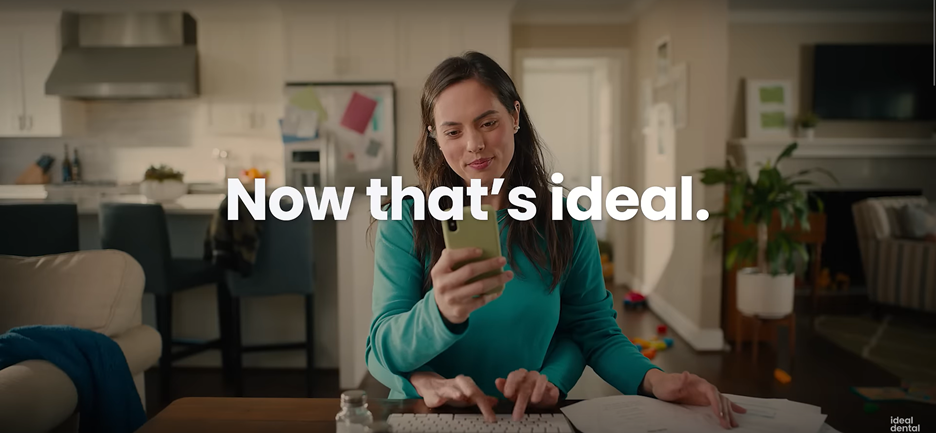
We have spent a lot of time deconstructing, critiquing, and on occasion obliterating ideals. Confronting hegemonic ideologies such as heteronormativity and homonationalism are all about emptying out the signs of the “ideal.” Doing that meta ideologic work, the kind Sandoval includes as a methodology of the oppressed, means asking first what is ideal – so interrogating the image above – and then putting it into relation with other (equally arbitrary) ideals.
Being able to schedule dentist appointments on Saturdays is ideal only in the context where scheduling it on weekdays compromises one’s productivity. The connection between healthcare and work is, to the detriment of the unemployed and low-wage workers, the manufactured reality of America. The implicit ideological message then is that a good American would take advantage of the Saturday slots. And not only that, but we should also be grateful for that flexibility as it leaves us with more room to do other kinds of work. That Sunday is still not an option is curious as well. It looks like ideal dental observes the Christian Sabbath.
Framing dental health as a secondary necessity to work is also part of the ads messaging. Taking a look at their website, it is also clear that dental healthcare is seen not as healthcare in the traditional sense (that is caring about one’s wellbeing) but instead it is a professional service meant to ensure patient satisfaction. Convenience, comfort, and modernity are all stressed in both the ad and website. The chatbot prompt is friendly in a servile kind of way. The end goal is to have the patient smile, which while certainly a goal for dentistry, does away with all the other reasons someone might be going to a dentist unrelated to cosmetics.
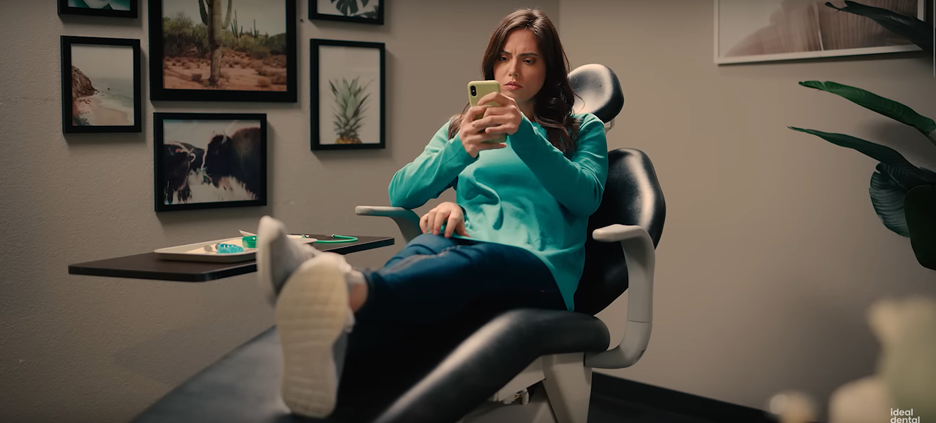
The appearance of a third arm comes out again in the final seconds of the ad. It is, in this case wholly unnecessary to have more limbs as the actress is no longer multi-tasking. Yet it reappears just to take her phone out of her pocket and then lingers for no apparent reason. A hyper compulsory able-bodiedness is unabating.
One reply on “Hyper Able-Bodiedness in a Dentist Commercial”
While this post powerfully critiques The Juggler through the lens of compulsory able-bodiedness and neoliberal productivity, it’s also essential to consider how the ad reinforces another form of normalized labor: compulsory motherhood—the often invisible, undervalued, and unrelenting responsibility expected of mothers.
From the perspective of a mother, the ad is less about superhuman productivity and more about the taken-for-granted expectation that she perform unpaid, domestic, and emotional labor flawlessly and without complaint. The woman in the ad juggles feeding a baby, folding laundry, cooking, scheduling appointments, and completing professional tasks—each chore performed with ease and a serene smile. This depiction doesn’t just uphold a neoliberal able-bodied fantasy—it perpetuates the myth of the “good mother”: self-sacrificing, ever-capable, and never overwhelmed. Her hyper-ability is not aspirational; it’s oppressive.
The ad subtly communicates that needing support—or worse, failing to meet every obligation—is a personal failure. It erases the material realities that real mothers face: unaffordable childcare, medical bills, food insecurity, and lack of access to paid leave or mental health resources. By presenting motherhood as something a woman can “handle” with enough arms and a good attitude, the ad normalizes exploitation. This mother doesn’t need rest, partnership, or a social safety net—just another appendage.
Even the convenience the ad offers (Saturday appointments) is framed not as a relief for exhausted caretakers, but as a way to maximize productivity. It assumes the woman will continue working Monday through Friday and fulfilling family obligations without pause. There’s no space for recovery, reflection, or even leisure. And yet, the ad suggests she should be grateful—thankful for the crumbs of flexibility in a system that thrives on her unpaid labor.
From this perspective, the ad’s use of the smiling, multi-tasking mother figure isn’t just about able-bodiedness—it’s about a gendered ideology of thankless care, tightly woven into capitalism’s need for invisibilized domestic work. In Sandoval’s terms, the ad cloaks these ideologies in the “myth of the ideal,” and it’s only by reading against the grain—through a critical, oppositional gaze—that we begin to see just how much labor is demanded from women under the guise of choice and capability.
By pairing the discourse of compulsory able-bodiedness with that of compulsory caregiving, we see how intersecting ideologies constrain women, especially mothers, into roles that serve the economy but rarely serve them. The problem isn’t that she needs more arms—it’s that the system was never built to support her in the first place.