Categories
Uncategorized

Infidelity & Masculinity in Christian Nodal’s “Adios Amor”

We open with a short aerial shot of an agricultural landscape that is peripheral to the logo of the production company. The accordion and other instruments are already in session when the scene shifts to the singer longingly leaning on barrels of alcohol as the camera glides towards him. He’s wearing dark clothing, a red and black combination of a caballero outfit, with a heavy silver cross the size of a small child’s hand shining at the center of his chest. This is the form the singer takes when exiting the storyline of the music video that is introduced shortly after these establishment shots.

As the vocals start gearing up for entry, we return to the agricultural scenery where the singer is toiling. He’s a young man with a very boyish face, and although he goes to wipe sweat of his forehead, he looks to have already been bereft of perspiration or dirt on his denim work-wear. The moment the vocals announce themselves, the video begins alternating between the singer as a singer, in his red and black wear, and the singer as a character in the story arc. When out of the story, the singer has behind him a stoic mariachi band who play the instrumentals of the song but never interact with the world they are placed in. This transience doesn’t apply to the emotionally strung singer who readily drinks the tequila that comes from the colorful and, no doubt, brand placed bottles on the bar counter.  

The story of the music video is a that of a courting relationship between the singer (farmworker) and a love interest (bartender). In the initial phase, the two are intimate with each other. At the bar alone, they greet each other with great affection – kissing each other over the counter. There is comfort evident in the hand placement and in the ease of laughter and smiles. Their standing is further solidified in the scene where they are on the back of a horse being unmistakable as a couple. Here the singer holds the bartender closely and delivers a kiss that neither reacts much to. These outdoor shots, happening in the day, are drained of much of their saturation and brightness.

Conflict arises at the entry of another man at the bar. He is not much different from the singer in appearance or dress, but clearly, he was persuasive as he quickly charmed the bartender whilst our protagonist is absent. Our singer returns to the bar with a cheerful smile and a bouquet of flowers only to be greeted by his presumed partner sitting on the knee of another man. She is wearing a darker, redder shade of lipstick than before and her clothing is likewise more revealing than in past interactions. As she sits on the stranger’s knee and caresses his head, she pays no attention to our singer.

But she herself ends up becoming a secondary accessory to the charming man who as it turns out is something of a womanizer. Outside in the night and in front of a conveniently placed Porsche, the bartender is unceremoniously dumped in favor of a new woman. Angered, she walks off in search of our singer and finds him sitting at the end of a pedestrian stone bridge.

It’s still nighttime but their meeting is strongly illuminated. He is not angry and there is still kindness and affection in the way he looks and addresses her, but his mind is already made up. As the song goes, he bids farewell to his “love,” resigning himself to forgetting her even if he still has feelings for her.  And so the video ends with a close up of the nonplused bartender watching her former suitor walk off.

There is nothing revolutionary in this story. But that is not to say that its handling of infidelity, class differences, alcohol and gender are done on a single dimension. At the core of the video is the masculinity of the singer. Our singer is certainly presented as a virtuous person to whom our sympathies are owed. He’s clean shaven, wears a cross, “toils” on a farm, brings flowers, dresses like a cowboy and has a horse to boot. In effect, his masculinity is constructed as safely traditional machismo. However the story, it must be recalled, is told by him and through his memories. And these memories cannot be taken as pristine as he is seen drinking at nearly every appearance.

The primacy of alcohol is never questioned, and its inescapability is presented as a refuge. Much of the story is set in a bar, and it is in the same bar the singer spends his time outside the story. Perhaps it is less a matter of cultural signaling and more a consequence of brand placement, but the end message is the same: drinking is a healthy and potentially manly response to heartbreak. The singer is allowed to be emotional while inebriated, but he is considerably more subdued and stoic when sober.  

Infidelity is also treated in a way to secure the singer’s masculinity. First, it is the bartender who leaves him (and ultimately tries to get him back). Second, his apparent loss was presumably due to a gulf in wealth between him and the other suitor. But it was already established that he is a hard, honest worker, so comparing him to someone with enough resources to own a luxury car is presented as unfair and not an indictment of our singer’s shortcomings.

On the one hand, I am glad to see that he did not return to the bartender who cheated on him. Knowing one’s worth is an important thing, but I also do not want to ignore the potential problems coming from the music video. By having a safe self-insert character in a tale of heartbreak, the audience can be easily, and perhaps passively, moved to view the story as a kind of template to follow. I do not mean a blind substitution of reality with fiction. Instead, I am eyeing the way certain themes are romanticized to reinforce problematic norms especially those related to drinking. Drowning in alcohol should not be seen as a prerequisite to showing emotion. But maybe this concern is overstated? Prior to searching for the music video, I had only ever streamed the song. Of the 1.5B views, I wonder how many can be counted as legitimate viewings of the video and not just the audio.

Categories
Uncategorized

Sexual Deviance and Fetish in Season 3 of The White Lotus

Season 3 of The White Lotus, like seasons 1 and 2, portrays the vacation stay of an eclectic cast of resort guests that ultimately ends in a murder. The show is dark and satirical, and the characters are wealthy and generally unlikeable. In episode 5, Rick goes to Bangkok on a quest to avenge his dead father, and meets up with an old friend Frank, who he’s asked to bring him a gun. While the two catch up at a dimly lit bar, Frank goes on a crazy monologue about his journey to sobriety and celibacy. He tells Rick that he moved to Bangkok because he “always had a thing for Asian girls.” When he first moved, he was partying and having sex constantly and “was out of control.”

I started wondering, where am I going with this? Why do I feel this need to fսck all these women? What is desire? The form of this cute Asian girl, why does it have such a grip on me? ‘Cause she’s the opposite of me? She gonna complete me in some way? I realized that I could fսck a million women, I’d still never be satisfied. Maybe… Maybe what I really want, is to be one of these Asian girls.”

He proceeds to tell Rick in detail about how he explored sex with men (“white guy, my age”) while role playing as one of the “Asian girls.” Periodically throughout the monologue, the camera pans to Rick, who looks perplexed, and mildly disgusted. The show’s core eerie leitmotif builds in the background. At the end, he explains that he got into Buddhism and became sober and celibate.


Frank, like most of the cast, is generally not a character that the audience is meant to like. He’s wealthy and slimy and it’s implied that he used to be a hit man. As he speaks, the music imbues a sense of dread, and even Rick, who’s also a sleazy character, seems aghast at his monologue. In this sense, the show can be read as critical of Frank’s blatant fetishization and objectification of Asian women. However, the topic is not ever explicitly addressed or criticized, and Frank doesn’t appear in any other episodes. While race, class, and sex are all key themes in The White Lotus, with the show making a clear critique of the character’s privilege and ignorance, it’s often unclear how the viewer is meant to interpret the depictions of sexual deviance. The season also includes a portrayal of incest and references to voyueristic fantasies, all of which involve characters who are obnoxious and cruel. Are we meant to judge them for their sexual desires? Or simply see the hypocrisy in the way that they remain rigidly adherent to other gender and sexual norms? Frank’s monologue is the show’s only mention of cross-dressing or gender nonconformity, and it only appears accompanied by racist and misogynistic dialogue. TERFs online have labelled Frank as autogynephilic, and have claimed this scene as evidence that trans women are all just men with deviant sexual fetishes. While this interpretation is misinformed and bigoted, it does highlight that in many ways, The White Lotus representation of sexual nonconformity falls flat. It adds intrigue and shock factor, while skimping on any opportunity for a more nuanced or radical discussion of the subject matter.

Categories
Uncategorized

Identity and Power Fantasy within Wolfenstein: The New Order

When the concept of alt history is brought up in the context of intellectual property, it tends to call to mind poorly researched and overly indulgent fantasy that is not worthy of genuine consideration. This is especially true when these alternative histories address the Second World War with the concept of a hypothetical Axis victory being peddled in various forms from obscure internet forums to large franchises such as video game series Wolfenstein. In its forty-year lifespan over a dozen entries, Wolfenstein gives its player the power fantasy of killing Nazis as American darling William Joseph “B.J.” Blazkowicz. While many of the earlier titles centered around an indulgent romp of computerized gore, explosions and swastikas, modern iterations find time to take B.J. away from his arcade shooter roots to provide legitimate analysis of fascism and identity, even if they throw him back into the fray immediately after.

One such scene is found in the 2014 release of Wolfenstein: The New Order.  In a relatively mundane cut-scene, B.J. is on a train bound for Berlin, filling a dinky paper cup with coffee from the dining car on the train. Suddenly, the train begins to shake as BJ is interrupted by Frau Engel, a major antagonist of the game along with a ten-foot-tall Nazi combat robot. Yet, combat does not break out; they walk past you and take a seat at one of the tables. Control is given over to the player and you attempt to casually leave but are accosted by Engel. If you ignore her you are blocked by the robot; your only answer is to sit down. As you take your seat, Engel grabs you by the wrist and pulls you in, noting your distinctive Aryan features and the fact that you came from good genetic stock. She then casually asks you to play a “little game” with her to test if you are truly Aryan as she fiddles with a Luger pistol that she places between you on the table. You as the player are then tasked with selecting a series of three photos, you heart racing as you try and parse what seem to be random images with your life on the line. If you hover your mouse over the gun, a prompt pops up to interact with it, but choosing to do so results in Engel snatching the gun away and promptly putting a bullet into your head. You have no power here. Upon restarting, you point between the cards again, and upon picking the final one, you once again find the gun pointed at your head. Just as it seems Engel is about to pull the trigger, she begins laughing. She claims that she has an innate ability to tell if someone is not Aryan, and the cards you picked didn’t matter. A non-Aryan, she says, would have gone for the gun. With this, you are free to leave the dining car and move on with the game. The irony of this scene is that despite his strong jawline, blue eyes, and blond hair, B.J. is Jewish. While it is not perhaps fully explored within the game, it is an established, and important part of his identity within the later entries in the series. A series that also prominently features queer, disabled, black, and Jewish characters who all fight alongside B.J. in his quest to defeat Nazis.

This specific scene depicts a core flaw of fascist ideology that is further heightened through the medium it is portrayed in. A main issue with fascism is that it is not a stable ideology, its stability is founded on the formation of outgroups that are demonized and destroyed. It always needs that outgroup. Fascism is an ouroboros that will eventually turn on its own as it seeks to continue the cycle of punching down. Normally, the player attempts to defeat fascism with fantastic weapons, but here, if you attempt to fight, you are immediately and casually executed. In your first-person perspective, the assault rifle normally in your hands is replaced by a tray with a cup of coffee and a carton of milk. The larger-than-life power fantasy of Wolfenstein, and of video games in general is turned off. You are no longer a one-man army. You are just a man. And with your strength stripped away by the mechanics of the scene, it shows the player that your enemy will not necessarily be defeated through brute strength, but rather, that the ideology itself is built on a rotten foundation.

Categories
Uncategorized

Abbott Elementary S2E20, “Educator of the Year”

In the episode “Educator of the Year,” a 2-minute scene captures a contentious conversation between the protagonist and second-grade teacher at Abbott Elementary, Janine Teagues, and Cassandra O’Neil, the mother of her student Deshaun. The scene begins with Janine alone in her classroom, checking her phone and sighing before walking into the hallway and spotting Ms. O’Neil, whom she has been expecting all day. With a smile and welcoming gesture, she invites the woman inside, but is quickly corrected by “Ms. O’Neil” with a nonchalant and uninterested “Cassandra is just fine.” The camera follows the two back into the classroom—Janine in a puffed turquoise and light green dress encircled with a gold belt, and Cassandra in a blue button-down uniform—as they sit down and promptly get into the circumstances of the visit. As Janine enumerates the details of Deshaun’s behavior, the stable view of her is disrupted as the camera flits back and forth, showing a progressively more irritated Cassandra who rolls and widens her eyes, sighing in her seat. There is then silence and a wide shot of the two women, Cassandra looking down and saying “Mm-hmm, I see,” and checking her watch. The tension builds as the camera closes in and jumps rapidly from Janine to Cassandra, Cassandra to Janine, with Cassandra’s heated retorts like “Thought what, exactly?” producing a furrowed brow and backtracking from Janine. Although she sustains strong eye contact, speaks slower, and uses more exaggerated hand movements, Janine’s attempts to break through with Cassandra are shattered as she snaps, “We are not a team. And I don’t know how he could be the best student he could be with a teacher like you.” Janine, in a sitcom-style fourth wall break, glances at the camera in disbelief, stammers, but ultimately loses control of the situation as Cassandra gets increasingly frustrated, collects her things, and states “If this is the best you can do, you are the worst teacher I have ever seen” before walking out, leaving Janine bewildered, silent, and sad. 


Set in an underfunded elementary school in Philadelphia, Abbott Elementary regularly explores the intersections of race, gender, and socio-economic status within its community. In this particular scene, we observe two working Black women attempting to navigate their respective struggles and motivations, albeit unsuccessfully. Both viewers and Janine enter the scene with an expectation of solidarity, an assumption of understanding between two individuals who are vying for the same objective (Deshaun’s academic success) and have overlapping identities (Black, woman, career). And yet, the interaction is frustrating and hard to swallow as the two women fail to see eye-to-eye, their opposing viewpoints on the matter embodied in the rapid cuts and minuscule zoom-in techniques that create layers of misunderstanding. As the protagonist, viewers are often more immediately sympathetic to Janine, whose most prominent trait is her confidence in her teaching ability. Indeed, on Reddit and X, viewers absolutely HATED Cassandra, finding her rude, dislikable, and yet sadly familiar to many real-life teachers. And while conscious acting choices (tone of voice, hand gestures, facial expressions) are key in creating this characterization, I think many viewers jumped to attack and shame this figure of a Black, working mother as rude, ungrateful, standoffish, etc… especially next to the warm and determined figure of Janine. There is danger in binarizing the two women as good and bad, right and wrong, but the show perpetuates such a reading by not bringing Cassandra back at a later point in the episode for further conversation and/or context. Instead, what we get is a disheartened Janine, crying to her coworkers about a parent who “destroyed her,” and the remainder of the episode is dedicated to her coworkers uplifting and affirming her teaching ability. And while I do not doubt that there are parents who exhibit those traits and who degrade teachers who are just trying their best, I also think Cassandra’s character contains more nuances than just being a “bad parent.” We don’t know the circumstances at home, the toil of her work, the presence or absence of another caretaker…I believe the show could have benefited from a deeper examination of Cassandra’s background, even at the risk of communicating less potently the message of educators’ inability to solve every problem for their students.

Categories
Uncategorized

Framing Elle: How Media Turns Identity into Spectacle in “Heartstopper”

In Heartstopper Season 3, Episode 6 (“Body”), a key scene places Elle Argent, a Black trans sixth-form student and emerging artist, in the spotlight of a radio interview. What begins as a celebration of her rising popularity quickly becomes invasive. The interviewer introduces Elle by noting her 50,000+ followers, then pivots to asking if her art is informed by her trans identity. Elle answers proudly, but when the interviewer adds, “And that’s so important right now, isn’t it?” Elle’s expression falters—captured in a close-up as her confidence turns to discomfort. The conversation spirals as the interviewer references a “culture war” between feminists and trans activists, then brings up a past guest who warned that allowing trans women into women’s bathrooms would increase sexual assault cases. Elle remains composed, asserting, “Trans people aren’t up for debate. We’re human beings.” But she pushes further, ultimately naming the previous guest’s views as transphobic. Her parents, watching from another room, confront the event organizer: “I thought she was here to discuss her art.”

This scene powerfully illustrates how marginalized identities—especially trans identities—are often objectified under the guise of inclusion. By asking Elle to respond to the harmful stereotype that trans women pose a threat in public bathrooms, the interviewer perpetuates a longstanding trans misogynistic narrative. Framed as a “neutral” question, it forces Elle to justify her existence instead of celebrating her work. The interviewer also attempts to pit trans rights against feminism—framing them as incompatible. This tactic is both dishonest and dangerous. It ignores that many trans people are feminists, and that trans-inclusive feminism is essential to the broader fight for gender justice. This false dichotomy distracts from shared goals, reinforcing binaries that uphold exclusion rather than solidarity.

The scene’s direction—lingering close-ups, awkward pauses, tightening camera angles—emphasizes Elle’s emotional labor. Her identity as a young, Black, trans woman and artist is reduced to a political flashpoint, and her art is sidelined. Even her well-meaning allies, like Tao and her parents, hesitate—highlighting how institutional norms can paralyze even supportive voices. Personally, this scene was both moving and frustrating. Elle’s poise is admirable, but her forced vulnerability reflects a painful reality: that visibility doesn’t guarantee safety or respect. Representation matters—but how that representation happens matters more. Elle should have been allowed to speak freely about her art and bring up her own identity if she felt the need to. It shouldn’t have been a topic of conversation forced upon her with no preparation. She and other trans people deserve to be recognized for more than just their trans identities, seen as real people not symbols. 

Categories
Uncategorized

Close Analysis of a Scene, The Handmaiden

The clip starts with the camera positioned so that viewers see two women together in a bedroom. One is shown to be receiving a foot massage from the other, the latter dressed in servant’s clothes, while the former is dressed luxuriously on the sofa bed. The woman on the sofa bed’s hair is elegantly swept up but has strands dangling from the updo, and light makeup is done. The servant woman on the floor has her hair tied into braids and no makeup. They are both speaking Korean in a Japanese house, decorated with flowers and hues of blue, brown, and pink. The servant woman is distractedly questioning how far the other has traveled and congratulating her fortune to be coupled with such a powerful man, presumably her husband to be. The woman atop the sofa bed diverges and implies her contentment is false, saying she’d be satisfied staying with the other woman. The servant woman keeps congratulating her on what a husband she has while continuously massaging her feet in an attempt to distract her. The woman on the sofa bed says she is not sure if she even loves her husband, and the servant woman says she must. This prompts the woman on the sofa bed to remove her foot from the other’s grasp and asks how she knows she must love her husband. With her head hung low, the other responds that she’s been observing her behavior and describes her sighs and distant looks as ones of love and admiration for her husband-to-be. The woman on the sofa bed speaks in a desperate plea that even if she were to denounce her love for him and proclaim it for someone else, would the other woman still want her to marry him? The other sighs and grabs her foot once more, and says, “You will love him”. This makes the woman on the sofa bed slap her twice, pull her up from her feet, and push her out of her room.

This scene is one of my favorites from the film The Handmaiden, a sapphic historical thriller that takes place in Japanese-occupied Korea. The Japanese woman on the sofa bed, Hideko, is portrayed as elegantly wealthy and more powerful than her Korean inferior, Sook-hee. This portrayal is tied to both the visual of the scene and their ethnicities. Hideko’s Japanese garments and position atop the sofa bed display her power over Sook-hee as an occupier. She sits leisurely above Sook-hee, not only still but also receiving a foot massage from the other woman while she is undecorated in plain robes. Their conversation showcases the problems sapphic women had, and still have, regarding love and survival. Sook-hee’s congratulations are forced, and it is obvious they have been or want to be romantically involved. Hideko, holding the social power she does in occupied Korea, offers a denouncement of her engagement, but that does not satisfy Sook-hee. Sook-hee wants Hideko to go through with the marriage in order for Hideko to be provided for as a woman, something Sook-hee cannot offer her considering their time and environment. Hideko’s status allows her to simply question whether they should pursue their relationship fully, but Sook-hee’s does not. Their relationship is complicated by the historical context of their time. It works against them, as both their sexuality and ethnicity must be considered as a part of their choice to be together. I love this scene and believe the emotions they display: longing, suffering, wishfulness, distraction. It portrays the secretive nature of a sapphic relationship during this time, but also hopefulness in their ability to even consider future pursuit.

Categories
Admin

Tips for Posting on the Blog

Welcome to WordPress. If this is your first time making a WordPress site, try checking out Getting Started with WordPress to orient yourself. You should have received an email (be sure to check your Spam folder) with your username and a link to set your password.

If you enter the site rgsinpop2025.cmoore.sites.carleton.edu and scroll to the bottom, you will see a place to log-in.

Scrolling to the bottom of the site, you’ll see a link on the left to log-in.

Beyond your personal username and login, I have also created a password for the blog as a whole, which you will need to type in to initially enter. This keeps our blog posts limited to our classroom community. I have listed the blog password on Moodle, underneath the link to the site. If you ever see a request for the password, without a request for your username info, this is probably the password to use.

Your first blog post of a minimum of 350 words (about a page and a half of double-spaced text if you are thinking about the size of an essay) is due on Sunday 4/20 by midnight.

The prompt from 4/15 offers you a suggested process for approaching the first post rather than a list of things you must do–there’s no way to answer all of those questions in such a short post, so please just think of them as possible questions to consider when you analyze the form and content of popular culture (there are many questions that could just as usefully be asked). The gist of the assignment is to spend half or less (approximately 100-175 words) of the post describing a scene and the second half or more (approximately 175-250 words) bringing an intersectional analysis to bear on what you observed. Choose anything you like!

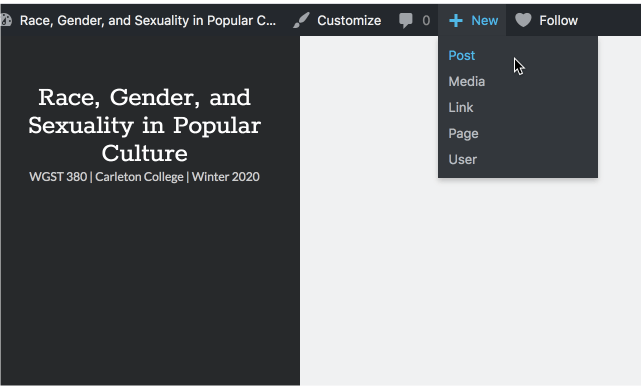
In order to post, my advice is to write your content in a word file that you save to your computer so that you do not lose it in the process in case there is a problem with uploading. Then go to your dashboard on the blog: http://rgsinpop2025.cmoore.sites.carleton.edu/wp-admin, log-in, and press “new” from the top of the page. You can title your post, paste in your content, and add any links or images you wish. Here’s what the dropdown looks like:

To add your post, click on “+ New” in the top bar and then “Post”
This is what the text editing area looks like within WordPress, once you’ve elected to add a new post.
You can add in images, links, files, etc. in “Add a Block” by clicking on the plus sign.

If you highlight all of the text you’ve written in the entire post, you can see how many words you’ve written on the right hand side. It is always fine to go over word count, but please do try to make the minimum word count.

Once I’ve highlighted all of the paragraphs (or blocks in WordPress), I can see the wordcount on the right hand side.

In general: Write blog posts that you would click on and read all the way through if you saw them linked on social media. Write about TV that gets you curious, while stretching your critical muscles and keeping it relevant to the class!

Here’s an example of one online platform for pop cultural criticism, if you want to get a sense of the rhetorical style common to this medium: https://www.avclub.com/

And here, by the way, is how to make a link. Hover over the content you want to link and click the link button shown below:

Please contact me if you have any problems with the technology. Looking forward to reading your first posts soon! Happy blogging!