Premiering in 2017, Netflix’s show “Big Mouth” has become one of the company’s most notable shows. The series follows a group of middle school students as they explore the ups and downs of puberty, sex, and their bodies. While the series is known for its star-studded cast of voices (Nick Kroll, John Mulaney, Maya Rudolph, to name a few) and its distinguishable animation style, I find the existence of the show itself a fascinating thing when thinking about representation. Particularly, I’m interested in where the show lies in the discourse between Kristen Warner’s “In the Time of Plastic Representation” and Aymar Christian’s “Beyond Branding” and whether it is a “good” or “bad” representation.
Known for its graphic depictions of sex, bodily changes, queerness, etc…the show has garnered much negative attention. There are some insane, honestly gross plotlines (i.e. when we find out that one of the most sexually-driven characters, 13-year-old Jay Bilzerian, has frequent sex with his pillow (“Pam”), and eventually impregnates her with a mini pillow) that at times, make it hard to watch without cringing. Indeed, while the show is extremely funny, many find it strange and unwatchable in that it depicts the sex lives of minors, yet is geared towards an adult audience. In fact, many websites say that the show isn’t even appropriate for 12-year-old audiences…even though that is the exact age demographic represented! It does make us question: what work is this representation actually doing? To what extent is it simply sexually exploiting children for adult entertainment? Is it simply a marketing opportunity for Netflix where “intersectionality has superficial branding value” and the real demands and desires of communities and viewers aren’t being taken seriously?
I think it’s less black-and-white than that. In fact, I do not think that the show is an example of Warner’s “plastic representation” because there is actual “meaningful imagery” in the show’s 8-season-long exploration of puberty, hormones, emotions—all things that we, even as adults, must contend with (Warner 35). While, of course, some parents might not allow their young children to watch the show (for obvious reasons), the series does a pretty good job at educating viewers about sex (much more than the basics we get in high school sex ed) and everything associated with it. Behind all of the gross humor and uncomfortable yet memorable lines, the series exposes and normalizes the raw, awkward truths of growing up, experiences that we ALL go through but don’t talk about. And, I would argue, having it be on a platform as big as Netflix is important for the mass audience it reaches.
While we can argue that the series is disgusting, we can also observe the myriad ways in which the show is doing good work for our world. Articles like “Big Mouth is Telling #MeToo Stories Better Than Any Other Show on TV” (Esquire) or “Big Mouth: Can TV Teach Us To Be Better People?” (Women Empowering Women) reveal how the series is not simply entertainment, but educational in its deep attention to relatable topics such as consent, birth control, periods, sexuality, fingering, depression, masturbation, anxiety, etc… As the show comes to a close, I still don’t quite know where I stand. The show can be gross and uncomfortable, but it can also be funny and make people feel seen. In many ways, I find joy and comfort in the series because finally, someone is talking about these things! And to me, that means something.
Reality TV is entertaining. Real people are #cringe, and we love the messy, cringey reality depicted on screens. In the same vein, I recently spent three hours of my precious life watching a 2025 film called Sikandar (translation from Hindi: King, alludes to Alexander the Great). The film’s hero/protagonist is Salman Khan, a well-known giant in the Indian/Bollywood film industry. He usually (every Salman Khan film I’ve ever watched, which is 24) plays the hunky hot full of swag and nonchalant action hero. Tamil movie maker, AR Murugadoss, wrote the screenplay, dialogues, and directed the Sikandar movie. Yet there is nothing that really holds the story together. For two hours and 23 minutes, I watched in awe, and comedic disbelief (no comedic relief), how it built up a slow yet action-packed storyline that purely stroked the hero, Salman Khan’s male hero complex. It is simply action (men fighting each other in various positions and locations for various reasons), pure drama and action. There is no critical analysis needed, in fact, I propose this film does not require an ounce of thought to watch. It is meant for passive viewing (at least for me) because the film’s cinematography is beautiful, full of colorful action and people-packed scenes, and brilliant lighting. The film starts off with Sikandar depicted as an actual King (King of Rajkot) with fantastical superhuman strength. Immense wealth (he owns 25% of India’s Gold, which is several hundred metric tonnes). He is in the present-day post-COVID, digital age, contemporary India. He’s got a city that worships him and is a good man. The film emphasizes his fights with rap music in Hindi and English. Every fight is filmed in slow motion. All the punches land. He’s decidedly cool and does not break a sweat. But because of his various royal and philanthropic responsibilities, he is too busy for his kind and protective wife, Queen Saisri. She passes away within a year of marriage, dying while protecting him (in the first 35 minutes of the film). She donates her eyes, lungs and heart to three strangers. Sikandar, crying his eyes out, feeling really sad about losing his young late wife who he did not actually know (because he’s so busy and they were married only for a year) to find the three people who have his late wife’s organs for closure. The antagonist is artificially introduced as a high-ranking politician who wants to kill the three people with Sikandar’s late wife’s organs. Why? The politician believes that Sikandar is responsible for killing his (lecherous, entitled creep) beloved 30-year-old son (who actually died in an accident). Confused? I am, too.
Let me confuse you further. The Queen’s eyes go to a smart yet submissive stay-at-home wife, Vaidehi, who is not allowed to work because of a patriarchal family head (#my_house, #my_rules kind of situation). Queen’s lungs go to an orphan living in the polluted slums of Mumbai (the world’s biggest slums are in Mumbai, which also happens to be the movie capital of India #Bollywood). Lastly, the queen’s heart goes to a modern teenager Nisha who loves her gym-loving hunky Alpha male boyfriend (he does not seem to love her). Every person with the Queen’s organs has their problems solved by Sikandar. Sikandar teaches feminism to an upper-caste Brahmanical patriarchal Indian family, solves an environmental problem in the most polluted city in the world, and ALSO makes a young girl realize that her alpha male boyfriend isn’t emotionally available and she shouldn’t waste her precious heart on him (literally). Impossible premise.
The reason I chose to explain this impossible film is because of the explicit mention and commentary on ‘alpha male’, how Sikandar, as the ‘real’ alpha male, corrects and changes the wrong alpha males to save the women and empower them, allegedly. My question is, why does so much of it still hinge on hegemonic associations of power and the very real capacity to do harm and violence? The way Sikandar solves problems is primarily through his wealth and violence: by beating the shit out of goons who want to beat him up, or killing hitmen who want to hurt women and children (who have his late wife’s organs). It is hard to analyze and answer such questions. This film is so hard to take seriously. I cannot analyze any part of it seriously because it is so bad, yet I try, as it remains enduringly popular. It may be a commercial failure, but it still grossed over 50 million dollars in the first few months of its release.
Figure 1. Netflix Does Not Allow ScreenShots!! Nisha in Yellow.
The interesting analytical bit is in the last 30 minutes of the movie. Nisha (modern teenage girl with Sikandar’s late wife’s heart) is outside her large mansion-like house with her dad, Sikandar, and his bodyguards. The audience can assume she’s wealthy and modern because of her Westernized clothing, streaked blonde and brown hair, low-cut dress, and luxury cars strewn around. Kapil, her boyfriend, shows up with a bandaged eye and bruised body. She’s erratic and frantically apologizing to her “boyfriend,” Kapil, who was beaten up by Sikandar at his gym.
Her dad tries to tell her that Kapil is here to tell her that he doesn’t love her. And the teen daughter, Nisha, screams back and says it doesn’t matter because she loves him and that’s enough.
Immediately after, she says, “Kapil is an Alpha and Alpha means King.”
One of the hunky bodyguards (their one dimensional role is to literally stand by Sikandar) exclaims (putting her back in her place, allegedly!) that she has no idea what she’s talking about.
He further reveals that the Sikandar isn’t a random nobody but the “King of Rajkot and very very wealthy man who is taking care of the people who have his late wife’s organs.” In a sense, Sikandar is established as the real alpha.
Nisha, in less than two seconds after her erratic outburts apolgies and asks for the King Sikandar’s forgiveness.
I infer Nisha’s character as stereotype in opposition to the masculine men around her. She’s the chaotic, emotional feminine. She is the heart of the film cinematically, narratively, ideologically and discursively owned by Sikandar. She is less a person and more a custodial vessel of the hero’s grief, a surrogate mourner, a daughter-substitute, a body on lease. She’s a young woman who feels too much, who loves wrong, and who must be guided, corrected, or mourned. What a sterotype! I infer her mistake, as not being too emotional but being emotionally loyal to the wrong man. The solution? Sikandar reeducates her affective compass. She’s not punished directly, she is rescued into clarity by male rationality, wealth, and muscle. This is not love. This is re-domestication.
For the life of me, I could not tell you the plot or motivation except the film follows Sikandar helping (empowering) poor and disadvantaged common folk and that all of this started because his wife died and he is trying to be less nonchalant and be a better man. Indian cinema is rich, complex and contains multitudes. This film is not emblematic of Indian cinema, yet it is typical of a popular action packed genre of Indian films. Let my critique not dissuade you from Indian cinema, especially bollywood. Although it has all the hallmarks of a bollywood movie: 1. Intense choreographed dancing, singing 2. Length (Bollywood films are egregiously long. Much like this thought piece. They are a time investment.) 3. Colorful. 4. Repetitive plots and definite happy endings. It is not a symbol of a good movie. And Sikandar definitely proves that popularity may not mean good content.
Zach Cregger’sBarbarian (2022) is the reason I double check my Airbnbs. In this thriller horror movie, a nightmarish situation unfolds when a woman and a man double‑book a shitty looking Airbnb. It doesn’t end well (it ends in the rubble of a Detroit house that hides generations of violence). I love horror films! Especially ones with female(ish) villain/antagonist characters. I always love seeing what trope the female monsters take – “mothers, monsters or whores”. Last year I took a class with Summer Forester, called Women and War in the Middle East, and I read a paper that tried to make sense of women who commit unimaginable political violence, murders, violence in war etc. I’m drawing on this particular reading called “Mothers, Monsters, Whores: Women’s Violence in Global Politics” by Laura Sjoberg and Caron E. Gentry to understand how in Barbarian (2022), the main female monster is understood.
I’ve always wondered, why are there so many female monsters? Why is it so easy to villanize womanhood? In Barbarian, the “monster” is named Mother. And, she’s a monster living in a giant underground basement of a house for more than 40 years. She’s 6 feet 8 inches tall, gargantuan proportions, matter hair, naked white body, no ability to speak, and epic strength. You can tell she’s the “monster.”
The reason she’s the monster is because of Frank. In the movie, flashbacks to a hppaier “white picket fence” America back in Raegen era reveal a man named Frank. He spent decades spent decades abducting women, imprisoning them in underground rooms, and fathering children with them—children who were, in turn, assaulted and inbred. I hated watching this part, but Mother is the last of last of those descendants: feral, gigantic, and desperate to nurture whatever human stumbles into her tunnels. as animalistic, but the film repeatedly frames her actions as warped caregiving: she bottle‑feeds Tess, cradles a camcorder playing a nursing tutorial, and ultimately throws herself off a water tower to save Tess’s life. Using Laura Sjoberg and Caron Gentry’s reading, I think popular culture slots violent women into three reductive tropes—mother, monster, whore, thereby stripping them of political context and restoring patriarchal “normality.” When women’s violence is monstrous, the narrative pathologizes the woman and lets the system that produced her off the hook . Barbarian weaponizes that very expectation: we enter anticipating a freakish killer, then discover she is the living evidence of men’s unchecked power. But, it also tried to humanize her by showing us that her actions aren’t just scary and violent. It’s all she knows. She’s never left her house. And all she knows about the world is from one education DVD in her captive basement, on how to rear and nurture young babies.
But, I don’t want to just analyze her. I want to analyze the men in the movie. I think they’re the real monsters — respectable men who build or exploit brutal systems that hurt women. I choose to analyze AJ Gilbride, a character we are first introduced as a white able bodied guy riding a beautiful red sedan without a hood, in a picturesque ocean side road. He’s the kind of villain twenty‑first‑century capitalism loves: a slick Hollywood bro who can monetize anything— even a torture labyrinth. When he discovers the hidden hallway beneath his Detroit Airbnb (where the Monster lives), his first thought is not Who suffered here? but How much can I list this for? Tape‑measure in hand, he tries to convert trauma into real‑estate value. To me, he’s the real barbarian. Not the “monster.” AJ’s entrance shifts the film from gothic nightmare to #MeToo parable. He’s an actor who’s accused of sexual assault (He admitted to his guy friends that it just “took some convincing” but they were both totally into it), and he arrives in Detroit AirBnB to liquidate the property and fund his legal defense. He descends into the tunnels, tape measure in hand, giddy over “livable space” even as bloodstains darken the walls. That instinct to monetize is its own violence, turning trauma into square feet and victims into line items. But at the end of the film, there’s a small moment of redepmtion. The three characters, AJ, Tess the girl, and a homeless man sit by a makeshift fire a few blocks outside the house they were trapped in, after having almost escaped the clutches of Mother. AJ says, “I did that” (Alluding to having SHOT the girl while runnign away from Mother in the tunnels) “It was an accident,” says the girl.
“Doesn’t matter. It was my fault,” says AJ.
“I hurt somebody. It matters. I might be a bad person. Or maybe I’m a good person who did a bad thing.” He pauses for a moemnt of reflection and with tears in his eyes, and almost genuine concern, he says, “I can’t change what I’ve done but I can fix it.”
The homeless man interjects, “You ain’t gonna do nobody no help if you get yourself killed” pointing to the dark outside. Mother arrives almost immediately after. Rips Frank, the homeless mant o shreads and runs after the two characters, her ‘babies.’ And his almsot redemption arc evaporates the moment danger looms. He throws Tess off the water tower to buy himself seconds, proving that his earlier remorse was never about repair, only optics. Where The Mother kills to protect her “child,” AJ kills to protect his brand. In the final scence, Tess, the girl, is lying on the road, with Mother crooning and towering over her. She has a gun in hand, the same gun that AJ shot her with. And Tess whispers “I’m sorry” before ending The Mother’s suffering. Her apology acknowledges the creature’s stolen humanity and invites the audience to grieve, not simply recoil.
I think of this film often, especially its succint title, because it forces me to rethink: Who is the monster, the barbarian? Is it easy to point to The Mother’s grotesque form which is mostly because of the the violence impressed upon her body by her father/grandfather/abuser Frank. Or is it Frank and AJ , men who embody the systemic barbarism that mainstream society rarely names?
In 2026, professional women’s baseball will return to the United States for the first time since the World War II–era All-American Girls Professional Baseball League (AAGPBL). The Women’s Professional Baseball League (WPBL) is more than a nostalgic revival—it marks a pivotal cultural moment to rethink who belongs in sports, how identities are expressed, and what true visibility means.
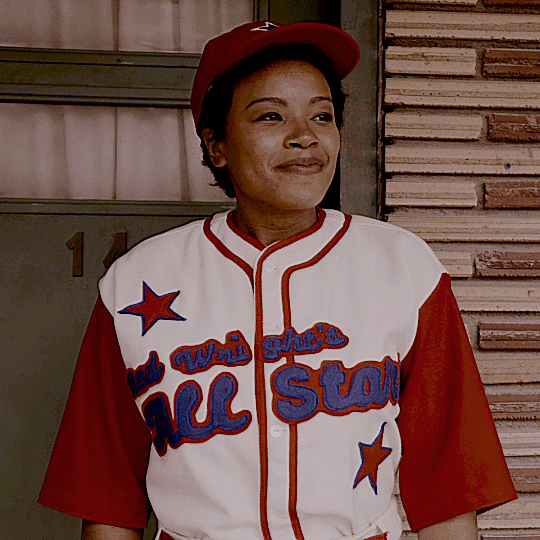
For decades, women’s baseball was erased or sidelined. The 1992 film A League of Their Own gave us a beloved but simplified story, largely overlooking the complex intersections of race, gender, and sexuality. The recent Amazon Prime reboot pushes beyond nostalgia, centering queer and BIPOC experiences that have long been excluded from baseball’s history. While characters like Max Chapman—a Black, gender-nonconforming, lesbian pitcher—and their transmasculine Uncle Bert remain supporting figures, their stories bring crucial visibility to the layered identities navigating the sport.
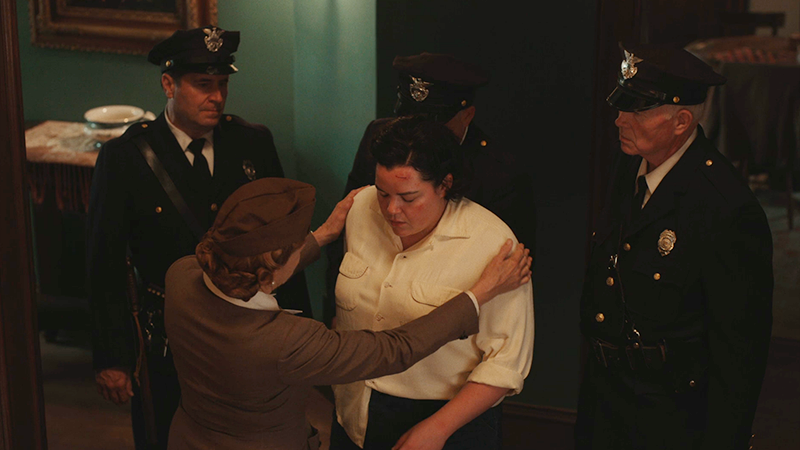
The show also honors the Negro Leagues, weaving Black baseball history into the narrative and underscoring that baseball’s story is inseparable from America’s ongoing racial realities. It doesn’t shy away from systemic oppression, depicting police brutality during a raid on an underground speakeasy and contrasting it with a Black queer house party held out by the train tracks—in a neighborhood neglected by law enforcement—reminding us that sports exist within broader social struggles.
A recurring motif is the players’ fraught relationship with gender norms and appearance. Players are fined for wearing pants in public and trade creative methods—like using ration cards to buy boxer briefs under the guise of purchasing for a brother—as small acts of rebellion against rigid expectations. This tension extends to the AAGPBL’s strict emphasis on femininity: the league made significant investments to ensure players appeared stereotypically feminine, enforcing rules on makeup, hairstyles, and playing in skirts. The show includes candid reflections from players grappling with these contradictions—athletes forced to perform toughness on the field while conforming to delicate societal ideals of femininity.
The series also honors quieter legacies, like Maybelle Blair, an AAGPBL player who courageously came out as a lesbian at age 95. Blair’s story highlights the historic invisibility of queer athletes and challenges us to acknowledge those who paved the way without recognition.
In stark contrast, men’s professional baseball has seen only three openly queer MLB players—and all came out post-retirement. The WPBL’s launch offers a bold alternative: a league where queer athletes are not exceptions but woven into the fabric from the start.
To grasp the WPBL’s transformative potential, it helps to think in terms of assemblage—the way race, gender, sexuality, history, culture, and social forces dynamically intertwine. Women’s baseball is shaped by this complex interplay: gendered uniforms, coded queer communities, racial exclusion, and ongoing struggles for visibility. The WPBL can create a space where queer, trans, nonbinary, disabled, and BIPOC athletes’ identities are not sidelined but central to the league’s identity.
This vision aligns powerfully with José Esteban Muñoz’s concept of queerness as utopia—a future-oriented horizon that doesn’t yet exist but offers hope and possibility. Queerness here is not about present perfection but about moving toward a world where all forms of gender and identity coexist without conflict or erasure. The WPBL doesn’t have to be flawless at the start, but it can be a vital step toward a future where athleticism and gender expression are celebrated together.
What happens when you mix a Marvel icon, an angry white woman, and Idris Elba? Saturday Night Live’s “Impossible Hulk” sketch answers that question with a satirical punchline that doubles as cultural critique. In this parody, Idris Elba plays a scientist who, after a failed gamma radiation experiment in his lab above a Tory Burch, when made angry, doesn’t transform into a green rage monster—but into a “Karen”: a privileged white woman who weaponizes tears, demands to speak to managers, and destroys lives with one phone call.
At first glance, it’s a classic comedy sketch. But as our class readings remind us, pop culture is never “just” entertainment. It’s a complex field of signs, symbols, and ideologies—a place where resistance, reinforcement, and reimagination are constantly at play. Let’s break it down using the frameworks we’ve been engaging in class.
Pop Culture Matters—Even When It’s Funny
In Pop and Circumstance, Zisler argues that pop culture is not frivolous; it’s a vital space where meanings are made and contested. The “Impossible Hulk” is a sharp example of this. On the surface, it pokes fun at white entitlement. But zoom in, and it becomes a powerful semiotic text: one where signs (the “Karen”), signifiers (the haircut, the voice, the rage), and signifieds (racial privilege, systemic racism, performative victimhood) are all working overtime.
One of the most striking dimensions of the “Impossible Hulk” is how it frames the transformation into a “Karen” not just as a survival tactic, but as a critique of how white femininity can be mobilized as an active tool of domination. The figure of the “Karen”—a middle-class white woman who uses her social position to control or punish others, especially people of color—is not merely an innocent byproduct of structural privilege. She’s a symbol of how that privilege can be weaponized.
A key scene in the sketch dramatizes this dynamic perfectly. Elba’s character, a calm, rational Black man, attempts to resolve a simple customer service issue. But his presence alone escalates the interaction—security is called, assumptions are made, and suddenly, the environment treats him as a threat. Here, the sketch draws on semiotic theory: while the behavior is neutral, the signified meaning attached to a Black man in a moment of disagreement is read as dangerous. As Sandoval and other theorists of semiotics remind us, ideology works most insidiously when it feels “natural.” In this case, the customer service worker’s fear is not based on action, but on a set of deeply encoded racial assumptions.
When Elba transforms into the Impossible Hulk—a white woman demanding to speak to the manager—the sketch flips the script. Now, the same complaint is met with deference, not fear. The figure of the “Karen” becomes a symbol of unearned power, one that’s legible and protected by social systems. This shift reveals what McRuer refers to as compulsory normativity: the idea that power and protection are granted not based on behavior, but on how closely one fits dominant norms of race, gender, and ability. The Hulk’s usual superpower—physical strength—is replaced here by social strength: the ability to weaponize whiteness.
This is not just about privilege—it’s about an abuse of power that masquerades as fragility. The “Karen” figure operates through what theorists like Sara Ahmed and others might describe as a racialized affect economy, where white women’s discomfort is translated into legitimate grievance, and Black or brown presence into a threat. This is an emotional and political transaction that reproduces inequality while denying responsibility.
The Impossible Hulk and the Queer/Disabled Superhero
The sketch also asks us to rethink who gets to be a superhero—and how that identity intersects with race, gender, and ability. As McRuer outlines in Compulsory Able-Bodiedness and Queer/Disabled Existence, the superhero is often a figure of normativity, able-bodiedness, and compulsory heterosexuality. Yet here, the Hulk’s transformation is not into a hyper-masculine figure of brute force, but into a socially weaponized, emotionally manipulative archetype—a different kind of superpower rooted in systemic oppression rather than strength.
Likewise, Ramzi Fawaz’s work in The New Mutants shows how comics and superhero narratives have been reimagined to explore difference, marginalization, and collective identity. In this sketch, Elba’s Hulk doesn’t resist difference—he embodies it in a way that reveals how identity can be used as both shield and weapon, depending on the social context. It’s a jarring inversion: instead of being feared for his rage, like the canonical Hulk, the Impossible Hulk is empowered by systems that protect white femininity.
Intersectional Signals: Race, Gender, and Power
The sketch’s most chilling moment comes when Elba is pulled over by a police officer. As the officer approaches the driver window, he transforms into the Impossible Hulk. This moment doesn’t just satirize fear; it embodies the traumatic reflex that many Black people experience during police encounters. His body activates a defense mechanism not unlike a superhero’s—but instead of strength or flight, it’s the transformation into a figure coded as socially protected: a white woman.
This transformation underscores a grim reality. As Ramzi Fawaz explains in The New Mutants, superhero stories often focus on characters activating their powers under threat. In the context of racialized policing, the sketch dramatizes how some identities are presumed innocent or harmless by default. White womanhood, while not the most privileged identity overall, often benefits from an ideology of innocence and victimhood, especially in public or state-surveillance spaces. This is the same dynamic that has historically allowed white women to leverage institutional power—whether through policing, customer service, or media portrayals—at the expense of others.
Moreover, it is undeniable that “routine” traffic stops are a well-documented site of police violence against Black people—especially Black men—who are routinely denied the benefit of the doubt and treated as inherently suspicious. These encounters, shaped by deeply ingrained racial biases and systemic prejudice, often escalate unnecessarily, resulting in disproportionate levels of police brutality that too often conclude with the murder of an innocent black man.
Chela Sandoval’s framework on semiotic resistance helps us read this moment as a tactical shift in legibility. The Impossible Hulk is not a fantasy of strength—it’s a mask of perceived safety, worn to avoid the punishment tied to Blackness. It also invites critique of how certain forms of white femininity are weaponized—offering protection to those who already exist within a racialized system that favors them, even when they act in harmful ways.
This further aligns with Astonishing X-Men #51 and Black Lightning, which show how racialized and queer bodies are positioned as either threats or anomalies. In Black Lightning, Black identity is both hyper-visible and vulnerable. In the “Impossible Hulk”, white womanhood is similarly hyper-visible—but uniquely protected, even when it’s violent.
The “Karen” isn’t just a punchline. She’s a symptom of a broader cultural logic—one that grants authority to perceived vulnerability while punishing actual vulnerability. In making this logic visible, the “Impossible Hulk” challenges viewers to question not just who gets to be safe in public, but who gets to wield safety as a weapon.
FX’s Adults on Hulu follows a group of chaotic young adults living in Queens, crashing at a friend’s parents’ house and trying to fend for themselves. In the pilot episode, an old friend named Kyle goes viral on social media after coming forward about an experience of sexual harassment at work. His post launches him into unexpected visibility as an activist figure. Rather than responding with concern or solidarity, Issa, one of the show’s central characters, becomes visibly jealous of the attention he’s receiving and attempts to insert herself into his newfound movement. Issa shows up at a rally Kyle is hosting and asks if he wants someone else to speak on stage. He declines, flashing a literal “victim card” and explaining that she would need “one of these guys” to get through.
In response, Issa pulls out her own stack of identity-based cards: her woman card, her child-of-immigrants card, and her sex-worker card (she reads horoscopes on OnlyFans), and she convinces him to let her pass the fence and get on the stage.
There’s a lot to unpack here. At its surface, the scene touches on a serious and emotionally charged topic: sexual harassment. Yet the tone is unapologetically comedic and irreverent. The fact that the primary response from Issa and her friends is not sympathy, but envy, highlights the show’s willingness to satirize the culture of social capital around activism and trauma. The absurdity of the moment in which she uses the cards as credentials to justify her place in the protest makes it clear that the show is poking fun at her and at the situation in general.
By literalizing the idiom “playing the victim card,” the show cleverly plays with language and symbolism. The phrase typically carries a pejorative implication — that someone is using their suffering or marginalization for strategic gain — and by turning that metaphor into a physical object, the show foregrounds the transactional dynamics that can emerge in social justice discourse. The signifier — the “card” — is made absurdly concrete, but the signified — the social function of identity-based legitimacy — remains intact. The joke works because the audience already understands the real-world logic being parodied.
The moment raises questions about how identity is used as a form of access and authority. Issa’s eagerness to present her marginalized identities as qualifying credentials plays into a critique of the perceived “oppression Olympics,” where social power is recalibrated based on whose trauma is deemed most valid. The scene mocks performative allyship and attention-seeking behavior in activist spaces. Ultimately, Adults uses this scene to highlight the absurdity of commodifying identity and victimhood, particularly in online and performative activism. The humor is biting, and the show doesn’t attempt to offer any moral answers, but it highlights the messiness of how trauma, identity, and social recognition are negotiated in these spaces.
We so commonly speak of media as representing ideals, whether that be in some covert unspoken way or in a flashy provocative spell. Throughout the course we have been training a kind of oppositional, or at the very least, critical gaze to the media we consume. However, as McRuer makes note, this awareness raising has not really touched the discourse of compulsory able-bodiedness. It is often taken as the natural state of things, which encourages a passive reception. It is harder though to accept the reality shown when it is so out-of-this-world. That is to say, rarely is compulsory able-bodiedness so blatant and extreme as it is in the following dental commercial.
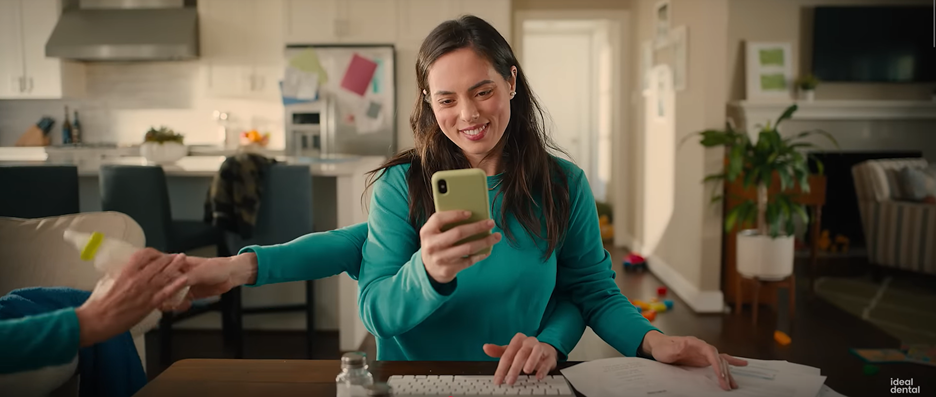
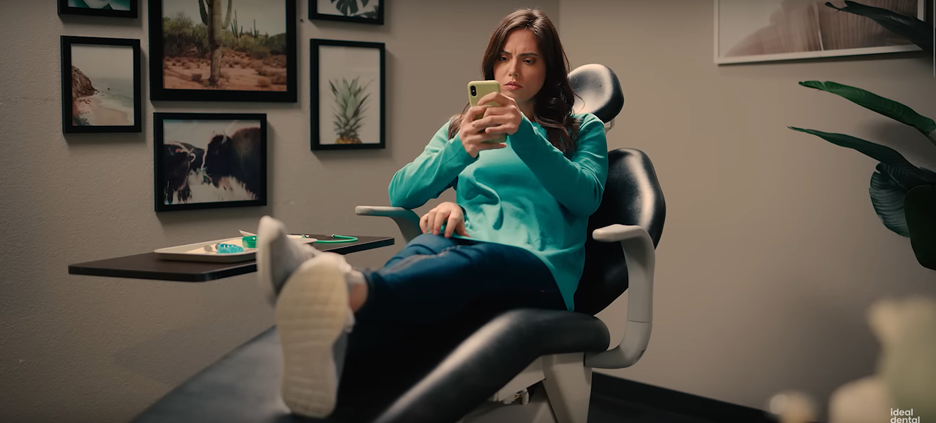
Title The Juggler, this 30 second dental advertisement sits squarely in a neoliberal America. The title’s namesake is seen with four arms attached and more off the frame doing many necessary tasks. She’s feeding a baby, cooking an American breakfast (eggs and bacon), folding laundry, doing paperwork, typing furiously on her mac-keyboard, and as the narrator tells us booking a dentist appointment. And throughout it all, she never expresses the slightest bit of discontent. In fact, the seems happy to do all these (mostly domestic) tasks – none of which seem to be done for her own sake.
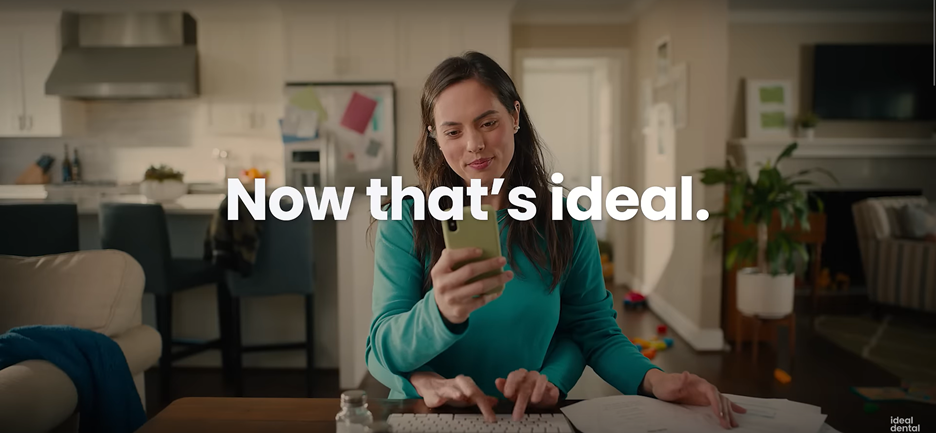
The main sell the advertisement is attempting to make is that Ideal Dental allows busy patients like Teal-shirt below to schedule their appointments on Saturdays. That’s it. No special mention of the quality of dentistry nor the kinds of services offered. Those parts are already coded in in the architype of the patient they present. Our unproblematic patient is (hyper)able-bodied, ostensibly middle/upper-class, and already dentally hygienic. That she’s white, young, a mother, and employed cannot go unmentioned.
We have spent a lot of time deconstructing, critiquing, and on occasion obliterating ideals. Confronting hegemonic ideologies such as heteronormativity and homonationalism are all about emptying out the signs of the “ideal.” Doing that meta ideologic work, the kind Sandoval includes as a methodology of the oppressed, means asking first what is ideal – so interrogating the image above – and then putting it into relation with other (equally arbitrary) ideals.
Being able to schedule dentist appointments on Saturdays is ideal only in the context where scheduling it on weekdays compromises one’s productivity. The connection between healthcare and work is, to the detriment of the unemployed and low-wage workers, the manufactured reality of America. The implicit ideological message then is that a good American would take advantage of the Saturday slots. And not only that, but we should also be grateful for that flexibility as it leaves us with more room to do other kinds of work. That Sunday is still not an option is curious as well. It looks like ideal dental observes the Christian Sabbath.
Framing dental health as a secondary necessity to work is also part of the ads messaging. Taking a look at their website, it is also clear that dental healthcare is seen not as healthcare in the traditional sense (that is caring about one’s wellbeing) but instead it is a professional service meant to ensure patient satisfaction. Convenience, comfort, and modernity are all stressed in both the ad and website. The chatbot prompt is friendly in a servile kind of way. The end goal is to have the patient smile, which while certainly a goal for dentistry, does away with all the other reasons someone might be going to a dentist unrelated to cosmetics.
The appearance of a third arm comes out again in the final seconds of the ad. It is, in this case wholly unnecessary to have more limbs as the actress is no longer multi-tasking. Yet it reappears just to take her phone out of her pocket and then lingers for no apparent reason. A hyper compulsory able-bodiedness is unabating.
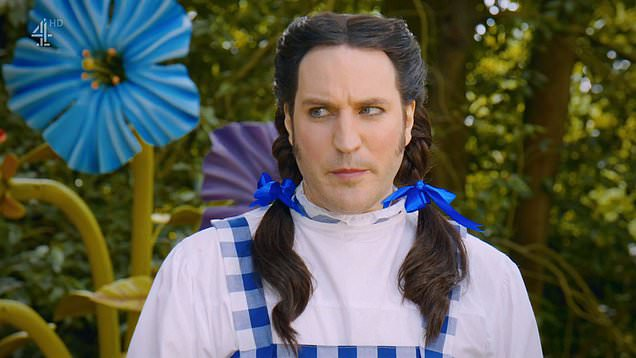
As one host yells to the bakers that they have half an hour left to complete their technical challenge, his coworker leaps down from out of frame. Wearing high-heels boots and a black, flowy, graphic button-up that reads “PHENOMENA” and has intricate illustrations on it, he apologizes for the surprise entrance, explaining that he had been on the ceiling eating bugs. During the time call before his leap from the ceiling, Noel and his co-host, Matt, had been pretending to lean in for an intimate kiss. Earlier this year, my housemate introduced me to The Great British Baking Show, which immediately charmed me with its whimsical challenges and shockingly positive competitive environment. One of the longstanding hosts of the show, Noel Fielding, particularly contributed to the show’s allure and delight. This entrance of Noel’s from the season 10 finale serves as a typical example of his eccentric style and surreal humor, which bring a key element of absurdity and comedy to the show. After watching several episodes, it becomes clear that his ability to comfort competitors, ease the anxieties of the competition, poke fun at and joke with the judges, and generally form relationships and connections with all personalities on the show makes him a crucial part of keeping the quintessential loveliness and lighthearted atmosphere of the Bake Off alive.
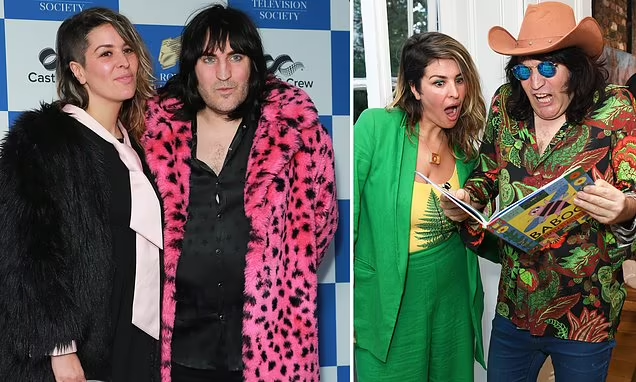
Noel immediately reads as queer, both in his eclectic fashion sense and in his general transgression of gender norms. His style often seems to take inspiration from 70s or punk style, with brightly colored sweaters and leather pants. Often donning heeled boots, eye makeup, a flowing hairstyle, and graphic shirts and sweaters that appear feminine or relatively gender-neutral, he moves across and between gender lines with his clothing choices. In his interactions with contestants and judges, he not only shows an ability to switch between humorous teasing and comforting sensitivity, but also jokingly alludes to sexual or romantic attraction to or relationships with a variety of his coworkers, from the overtly and traditionally masculine Paul Hollywood to his more recent co-host Alison Hammond.
Since being introduced by my housemate, I have become an avid watcher of the show. While Noel never alludes to anything specific about his identity (either gender identity or sexuality), I had always assumed a kind of queerness and fluidity to him. A few weeks ago, when watching the show in my kitchen while fittingly feeding my sourdough starter, the same housemate who had introduced me to the show saw me watching it, remarking, “can you believe that Noel is 50 and straight with kids??” A quick google search confirmed—Noel has been in a long term relationship with a woman (DJ Lliana Bird) for over a decade and has several children with her.
This revelation, and why Noel’s apparent heterosexuality might have come as such a shock to my housemate, illustrates a key argument in Cathy Cohen’s “Punks, Bulldaggars, and Welfare Queens”: heteronormativity does not necessarily equate to heterosexuality. Cohen explains, “The inability of queer politics to effectively challenge heteronormativity rests, in part, on the fact that despite a surrounding discourse which highlights the destabilization and even deconstruction of sexual categories, queer politics has often been built around a simple dichotomy between those deemed queer and those deemed heterosexual” (440). Given this dichotomy between queerness and heterosexuality, the reality that Noel often does challenge heteronormativity through both his presentation and his relation to others on the show positions him as queer and therefore not heterosexual. However, he provides an example of how one’s sexuality does not necessarily reflect the queerness of their politics or interactions. As Cohen further notes, “Queer means to fuck with gender. There are straight queers, bi queers, tranny queers, lez queers, fag queers, SM queers, fisting queers in every single street in this apathetic country of ours” (452). Noel, in his transgressive performance of gender, becomes an example of someone Cohen might dub a “straight queer” and helps reconstruct notions of the relationship between queerness and sexuality.
Solange’s “Cranes in the Sky” music video opens with a shot of Solange wearing a pale pink dress made of a trash bag and holding a bag filled with boxes over her shoulder. She stares into the camera, lips slightly parted, and her hand making soft caressing motions in the space in front of her pelvis. The scene then shifts between shots of Solange in various minimalistic outdoor landscapes. In each, she shifts her body positioning, and makes slow, deliberate, and subtle motions with her body. Later, we see shots of Solange in groups of other black women. In each shot, they lean on each other, creating a connected and intertwined mass of bodies. The rest of the video is interspersed with solo shots of Solange and group shots of her and the other women, painting an interesting contrast between solitude and community.
The “Cranes in the Sky” music video is absolutely packed with gestures in the way Rodriguez conceptualizes them in “Sexual Futures, Queer Gestures, and Other Latina Longings.” For one, the video features multitudes of “specific corporeal articulations of fingers, thighs, and tongues, the movement of the living body and her parts.” Several of the shots in the video depict these bodily gestures: a flick of the wrist, a flutter of fingers, a slow blink. As Rodiguez highlights, “gestures are “always relational; they form connections between different parts of our bodies; they cite other gestures; they extend the reach of the self into the space between us; they bring into being the possibility of a ‘we.’” The scenes in this video both demonstrate a corporeal relationality, one that exists between parts of the body, but also an interpersonal relationality, one that forms a collective. In the group shots emerges a physical relationality in the intertwinement of bodies that also conveys a greater sense of communal relationality stemming from a shared female and black identity. In the gesture of a head resting on another shoulder, a hand enveloping another’s elbow, a chin resting atop another’s head, we can see the way they “extend the reach of the self into the space between” to form a collective.
Similarly to the physical act of diminishing space between bodies, Rodriguez notes how “the political gestures we undertake—shouting back in defiance, marching in protest, even the passing of a digital petition from one person to another—enact the process of forging collectives.” In this way, we can read their physical relationality as indicative of greater political community building. Moreover, the interplay between solitude and collectivity in the video gestures toward the possibilities of communal healing. The solo shots reflect moments of introspection and alienation, while the group formations invoke a sense of mutual care and support. In these group formations, we see what Rodriguez might call a “queer gesture,” one that is “non-hierarchical, and centered in healing.” Altogether, this video paints a picture of the potentiality of gesture, both on an individual level and in the process of building collectives.
Zootopia is a hit children’s animated film produced in 2016, and is also a social commentary. It follows the perspective of Judy Hobbs, a young bunny who comes from a family of rural carrot farmers. Judy dreamed of being a police officer her whole life, yet she was always told that she was too small and cute to fulfill such a role. She proved those cynical of her wrong by becoming the first bunny to graduate from the police academy.
The story accompanies Judy as she begins her first day of work at the police station in Zootopia. Things do not go as she expects when she is assigned to parking ticket duty. She is disillusioned, realizing that her dream of becoming the first bunny police office and fighting bad guys and crime is unattainable. She meets Nick Wilde, a fox, later that day when she sees him scamming the elephants working at an ice cream shop. Intrigued, she later blackmails Nick into helping her solve the missing mammal case, which she got assigned by promising Mrs. Otterton to find her husband Emmitt. Judy and Nick go on a 48 hour manhunt for the missing mammals, all predators that have “gone savage”.
Judy and Nick hold harmful assumptions about one another when they first meet. Judy believes that Nick is a sly fox, and immediately mistrusts him. Nick believes Judy is a dumb bunny, and unfit to be a police officer. The stereotypes that they believe about one another’s species is symbolic of harmful stereotypes and assumptions that groups in society, such as racial or ethnic groups, hold about one another. Judy and Nick come to learn that those stereotypes are untrue during their journey, causing the audience to question the prejudices that they hold about others.
Moreover, Zootopia is represented as a diverse, cosmopolitan city, which is intended to represent cities such as New York, London, or Paris. Although Zootopia is diverse, species of animals tend to live near those similar to them like how neighborhoods in diverse cities are stratified based on racial, ethnic, and class identities in the real world. Moreover, there is division between social groups in Zootopia. The prey increasingly fear the predators of the city due to their belief that the predators are “going savage” because of their biology. This fear is representative of moral panic, which is defined as widespread fear by a group of people of others who they believe threaten the community’s morals or well-being. Moral panic is common in diverse cities where the majority group, such as Whites or heterosexuals, begins to fear a marginalized population, such as Black or lgbtq individuals.
Judy unintentionally fuels the moral panic of the city in a press conference, which creates tension between her and Nick who is a predator. Early in the film, Nick had confided to Judy about how his “sly fox” persona had come to be. He was excited to join the Junior Ranger Scouts as a young fox, even wearing a custom made uniform. When he arrived at the meeting for the group, the other scouts, all prey, muzzled and bullied him, saying that they would never trust a predator. He ran out crying, throwing the muzzle off his face, and declaring that if the world was only going to see him as a sly, sneaky fox then he would live up to that stereotype. Judy’s public statement hurt Nick who thought that Judy had seen him as more than a sly fox. Nick’s sadness at Judy’s actions is symbolic of the damage done in relationships between people of different groups when one makes it clear that they don’t see the other as anything more than their race, class, gender, etc.
Moreover, her statement created greater division between predators and prey. Predators became the victims of microaggressions, hate speech, and discrimination. On a train car, a mother sheep pulls her child closer to her, and stares nervously at the tiger sitting next to her, which represents the common experience of minority and marginalized groups facing subtle acts of hostility from the majority group. More direct acts of hostility are directed against the predators of Zootopia as well. A pig and a leopard are arguing outside a grocery store, and the pig yells, “Go back to the forest predator!”. The leopard retorts, “I’m from the savannah!”. This argument represents the common experience of xenophobia that immigrants and racial and ethnic minorities face. Furthermore, the predators of Zootopia face outright discrimination. The friendly, enthusiastic Benjamin Clawhauser, the cheetah who works at the front desk of the police station, gets moved to the back because they didn’t think visitors would feel comfortable being greeted by a predator. This kind of discrimination, although illegal in most countries in the Global North, is common. Racial and ethnic minorities are often placed in back roles with Whites or others in the dominant group being moved to the front. It is played off not as an issue of discrimination, but of the minority looking unfriendly or aggressive.
Overall, Zootopia is a useful educational tool to teach children about identity categories, prejudice, and discrimination. It ends optimistically with Judy and Nick saving the city, and restoring their friendship, alluding to hope for a world where everyone can overcome their differences. This messaging is reinforced by Zootopia’s slogan: “In Zootopia, anyone can be anything”.