JoJo Siwa has consistently been a point of conversation in queer spaces online, which is typical for the former child celebrity who has been a loud and proud lesbian. However, her recent controversy stems from disowning her previous lesbian identity in favor of identifying as queer. This shift followed her guest appearance on Celebrity Big Brother UK and her coupling with another star, Chris Hughes. The news came as a shock to many who admired her outspoken queerness. The controversy surrounding her new relationship and identification has affected many fans, particularly lesbians, who feel she has both disregarded lesbian identity and betrayed her partner – compounded by the fact that Hughes is significantly older.
This whole situation is complicated to unpack due to a multitude of factors, which must be approached with an intersectional lens. Many lesbians online have expressed feeling hurt and abandoned by JoJo’s shift, as they once felt seen in her earlier claim of lesbianism. Yet, when considering Nash’s Rethinking Intersectionality, we are reminded that intersectionality must travel as a theory of complexity. That is, there are many methodological ways to assess JoJo’s changed identity: anti, intra, or intercategorical complexity (5). With anticategorical complexity, JoJo’s change in identities could be seen as a simple rejection of all notions of categorization. For her, identifying as queer could dismiss the idea that once you claim a label, you must adhere to it. When analyzing this decision with intracategorical complexity, her identities as both a lesbian and queer would be critiqued to help find tensions within her lived experiences as both. This could show her unique hardships as a lesbian that might’ve led to her to believe queer to be a better fit. Intercategorical complexity might zoom out and not just focus on her self-identification, but how sexuality interacts with other categories like age, race, and gender. With this method, JoJo dating an older man while moving from a lesbian to a queer identity raises questions about how gendered power dynamics might’ve played into both her personal choices and the public’s response.
As a whole, this situation is messy and layered. Because of this, it’s best to approach the situation while remembering the real lived experience JoJo has as a queer public figure. Intercategorical analysis seems to be the best methodology, in my opinion, as JoJo’s race and socio-economic status play a large part in her identity shift. I’m curious to see the long-term implications of her decision and how it might affect lesbian public figures in the future.
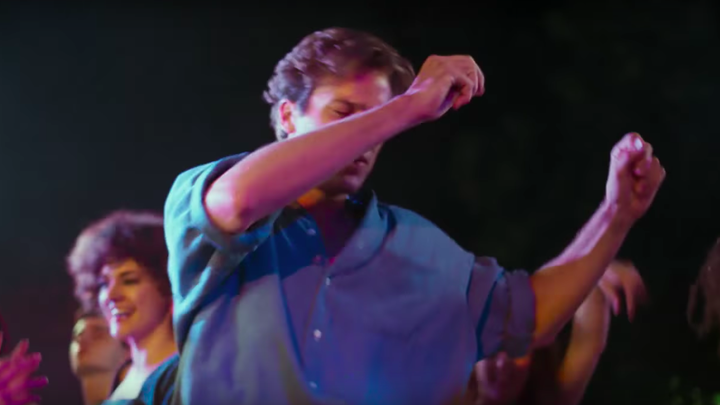
Within the emotion picture Dirty Computer, we watch as the main character Jane undergoes a process of having all of her memories erased as part of a cleaning process for being a dirty computer. The various memories are alluded to be dreams, making it ambiguous as to whether or not they were real memories. In one such memory, we watch as Jane and her partner, Zen, walk into a club and meet up with someone who appears to also be Jane’s partner, Ché, as they dance and enjoy their time together in the club.
The memory ends with one of the two white men viewing the memories of Jane deleting the memory and moving onto the next one.
Following the deleted memory, we see Jane dressed in white, wearing golden bracelets, seated on what looks like a medical bed, while Zen, who is in a similar attire, along with a golden cage around her head, looks over her tattoo of a naked woman on a cross. Jane mentions how she can’t discern whether her memories of them together were real or not, but wishes not to lose them regardless, and to continue remembering her time with Zen. Zen comments that she does not remember how they met, that thinking about it will make the process harder, and that it’s better to enjoy the cleaning process and forget.
Within the memories, while Jane is in constant need of avoiding the police while ultimately getting captured, she’s happy and gets to act freely. In her memories, Jane can love who she wants to love, dress as flamboyant as she likes, and dance with no restrictions. In contrast, while on the medical table, she is put into a modest white outfit with her hair tied in a ponytail, has no feeling in her legs, and is subjected to a removal of her memories and any individuality she once possessed to have the privilege to live within the facility. Therefore, for Jane to be accepted into their society, she would have to first conform to the norms and accept the cleaning process, just as Zen suggested. This struggle between maintaining independence and personality versus being socially accepted becomes more apparent when considering Jane’s queer relationship between Zen and Ché, and the fact that they are all black while those in power are all white. Throughout the emotion picture, the state of the memories is repeatedly questioned between being real or a dream, which can be interpreted as a potential utopia. This notion of a utopia then ties in with the reading Feeling Utopia by Munoz, about the idea of queerness being an ideality, a future that is to be longed for, yet out of reach. So, when Jane decides to break out of the facility along with her partners, it is because of this hope for utopia and their unwillingness to settle for the present that pushes them to move toward the future, to reach utopia.
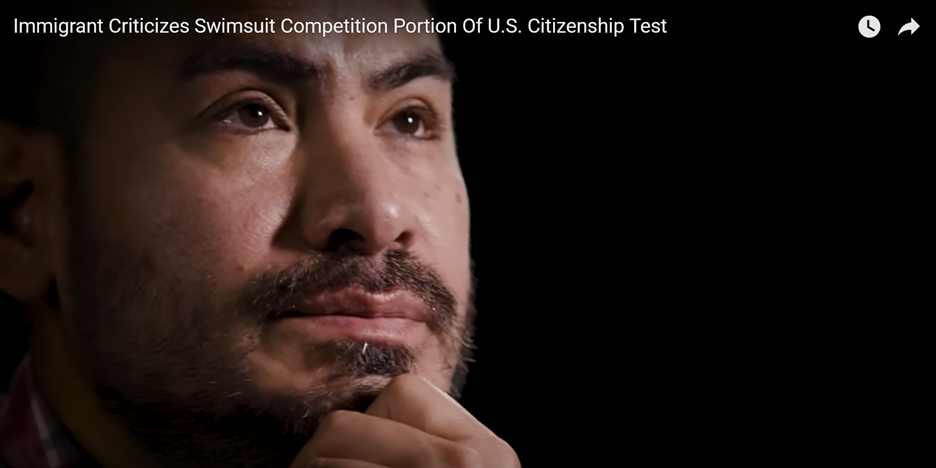
To be clear, there is no swimsuit competition component to the U.S citizenship naturalization process. This is a surrealist insert by the otherwise serious The Onion News Network. The goal here is clear, through a formal interview format, replete with sad violins, The Onion seeks to criticize the naturalization process by hyperbolizing its anti-immigrant bias.
The first fifteen seconds of the 90 second clip are sensible as Steven Gimenez, the video’s sole speaker, makes valid critiques about the many requirements and roadblocks that make it clear to [certain] immigrants that “this country doesn’t want you here.” These lamentations about the legal process are, of course, fully merited. Since the 1965 Hart-Cellar act the number of visas given has been severely capped for countries in Latin America (of whom Gimenez, an Argentinian is meant to represent). Pathways to citizenship for undocumented immigrants is practically non-existent and since the 1996 Illegal Immigration Reform and Immigrant Responsibility Act necessitates self-deportation for 10 years before being able to apply (even if sponsored on the grounds of family reunification). 1996 also saw the Personal Responsibility and Work Act that restructured the welfare system of the US and initially made even legal immigrants unable to access any social safety net. Although that provision was reversed, accessing social welfare programs (like SNAP, WIC, TANF, Medicaid, or whatever else) makes one liable to be a public charge which severely damages anyone’s case for naturalization. And all that’s not even touching the xenophobic rhetoric that is pervasive across the airwaves and visible in many parts of the nation.
But obviously a satirical piece of media can’t serve all that drudgery and still stay funny. So instead they make swimsuit competitions a stand-in for the reasons immigrants get rejected from citizenship. They make Gimenez say with full sincerity and gravity, “you can spend your time studying the constitution, declaration of independence, know the names of all nine Supreme Court Justices, and you can still be rejected because your suit has left unsightly tan lines.” This he continues is an unfair double standard and that he hopes such a requirement is removed so that “even less sexy immigrants can become citizens too.”
Although Steven Gimenez’s character ostensibly qualifies as an Avatar in the sense McMillan describes, there is a source pause in folding something from The Onion and something perhaps more intentional like the avatars arising in Beyonce’s Lemonade into the same space. For McMillan, he took his avatar production analytic to examine how avatars “comment[ed] back on identity, to subvert the taken-for-granted rules for properly embodying a black female body” (McMillan, 12). My hesitation to ascribe avatar status to Gimenez is not to do with fear of expanding McMillan’s ideas of avatars to performances outside Black performance art. McMillan already does this in allowing the “fraudulent identities in faux biographies, video art, printed newsletters, and … digital media like Tumblr and YouTube” (McMillan, 13). Instead the hesitation is in seeing Gimenez’s character as perhaps a reduced form of performing objecthood. The intent to subvert taken-for-granted rules is certainly there; the whole point of the video is to critique the idea of a valid American (naturalized citizen). But the method is wholly unserious, and perhaps this makes the avatars feel attenuated – more objets d’art than embodied subject.
All that is not to diminish the video’s power to focus the viewer’s oppositional gaze. Quoting and expanding on Manthia Diawara, bell hooks argues: “‘Every narration places the spectator in a position of agency….’ Of particular concern for [them] are moments of ‘rupture’ when the spectator resists ‘complete identification with the film’s discourse’” (bell hook, 209). In this case, the moment of rupture is fairly immediate. Saying with temerity and seriousness the pain caused by the swimsuit competition portion of the naturalization process necessarily pulls the viewer into a fictional plane of reality. But the viewer knows this (unless they are immensely gullible). From this perspective, the viewer is forced to interrogate not the avatar before them (Steven Gimenez is a perfectly normal person) but the systems of immigration, citizenship, and belonging. Obviously, we know that there is on swimsuit competition in any legal procedure, but invoking the imagery sends the viewer into a constant state of criticism in search of what the swimsuit competition is a stand-in for.
On its own, the video does not provide the wrap-around context needed to make full sense of the systems it is criticizing. But the oppositional gaze it conjures remains active long after its completion.
In Beyonce’s “Pray You Catch Me” music video, she employs what McMillan describes as “temporal ambiguity.” The video weaves together clips in black and white and in color. The 19th-century fashion, tunnel shot, and southern setting all suggest a reference to slavery, but these are all meshed in with contemporary elements, blurring the temporal boundaries of the narrative.
By blurring past and present, Beyonce is able to capture how, as McMillan writes, “what has come before is not contained in the past, but is continually erupting.” Beyonce’s video highlights how Black history and Black grief inform present-day experiences of Black womanhood. In the poetry voice-over, Beyonce says, “you remind me of my father… in the tradition of men in my blood you come home at 3am and lie to me. What are you hiding? The past and the future merge to meet us here. What luck, what a fucking curse.” She draws parallels between her experience of adultery and generations of Black trauma. The emotional affect of both experiences comes through in the way the subjects in the video are depicted.
Read through McMillan’s framework, the women in the video can be seen as both objects and agents. Their white formal attire contrasts with the setting which could have once been a plantation with Black slaves. In this sense, it is a reclamation of space and power. Yet, the women appear stuck, they don’t speak or move, and their expressions are solemn. In their statue-like nature, they are objects. This intentional performance of objecthood (in McMillan’s terms) draws attention to the tension between oppression and subjectivity, trauma and reclamation/redemption. Like Beyonce, stuck between love and deceit, hurt and forgiveness, the women in the video occupy a liminal space. In one striking clip, a woman rocks on the porch, her face obscured by a leaf. Her pose is comfortable and powerful, yet her gaze is blocked. Is she hidden or hiding? I’d argue both – or maybe neither.
It is in this elusive portrayal that I really understand the application of McMillan’s avatar. She is abstract and atemporal, but her affect is palpable, almost tangible. Like the rest of Lemonade, she offers a beautiful exploration of the messiness of pain, pleasure, power, love, and oppression.
In The Afro-Surreal Manifesto, D. Scot Miller declares that “Afro-Surrealism is about the present,” insisting that the unreal, the uncanny, and the absurd are not speculative or deferred—they are the lived reality of Black people now. Afro-Surrealism is not an escape from reality but a confrontation with its layered textures: the bizarre, the disjointed, etc. What appears fantastical to the dominant gaze is often, for Black communities, the ordinary experience of navigating a world shaped by historical violence, systemic oppression, and cultural erasure.
The Afro-Surrealist seeks “to uncover the unconscious in the now,” illuminating how trauma, joy, resistance, and magic coexist in the everyday. This practice reclaims the strange not as deviation but as a necessary expressive language for lives too often misrepresented or rendered invisible by dominant narratives. Afro-Surrealism bends time, warps realism, and recovers histories not through linear causality, but through emotion, haunting, and rupture.
This sensibility finds a powerful echo in the concept of the avatar as theorized by hooks and McMillan. hooks often writes about how Black bodies—especially Black women’s—have been hyper-visible, surveilled, and stereotyped in ways that flatten their complexity and humanity. For hooks, reclaiming representation is a form of resistance: the creation of self-defined images and narratives becomes a project of liberation. She calls for a visual politics that rejects imposed avatars—those externally constructed and often dehumanizing representations—and instead insists on avatars that are generated from within: avatars of self-determination.
McMillan extends this line of thought by reconceptualizing the avatar not merely as a tool of representation but as a tactic of performance, exploring how Black women artists strategically inhabit “simulated” roles—digital, artificial, exaggerated, objectified—in order to expose and subvert the historical framing of Black bodies as ornamental, non-human, or consumable. These avatars do not seek to humanize in conventional terms; rather, they disorient and destabilize the viewer. The performance of objecthood becomes a paradoxical assertion of agency.
These two frameworks—Afro-Surrealism and avatarhood—intersect in Janelle Monáe’s Dirty Computer: An Emotion Picture (2018), a visual album that stages the story of Jane 57821, a queer Black android whose memories and desires are being forcibly deleted by a sterile, authoritarian regime. In this dystopian yet familiar world, Jane is an avatar in every sense: a digital projection, a performative persona, a vessel of marginalized embodiment. Her Blackness, queerness, and erotic imagination are reclassified as “dirty data”—dangerous, deviant, deletable. But these very attributes become sources of resistance.
In line with Miller’s manifesto, Monáe makes use of rococo aesthetics (Tenet #5): her vision is lush, hyper-stylized, and emotionally potent. As Jane undergoes state-mandated cleansing, her inner life resists obliteration. Her suppressed memories erupt in a series of kaleidoscopic musical sequences—nonlinear, sensuous, saturated with color and desire. These interludes operate as ruptures in the visual narrative, rejecting chronology and coherence. The music videos double as flashbacks, fantasies, counter-histories—each one refusing the logic of erasure. Here, Monáe deploys Afro-Surrealism to literalize what it means to survive as data, body, and memory in a world that seeks to overwrite you.
Jane does not remain a fixed subject. She disperses herself across screens, voices, roles, and genders. She multiplies, glitches, refuses stability. Her shifting identities reflect not incoherence, but an intentional refusal of the regime’s rigid taxonomies. These moments of surplus disrupt the regime’s narrative control and embody Miller’s claim that “excess is the only legitimate means of subversion” (Tenet #6). In doing so, Dirty Computer becomes more than a speculative dystopia—it becomes an Afro-Surrealist project that foregrounds nonlinear time, affective truth, and the magic within oppressed realities.
Jane herself exemplifies Afro-Surreal fluidity. Her identity cannot be reduced to a single name, body, or desire. She moves through roles, screen personas, and affective registers. She is simultaneously lover, fugitive, prophet, and glitch. In this way, she inhabits what Miller calls “the Afro-Surrealist life”—a life of aliases, defiant in its refusal to conform to census or state (Tenet #4). She performs multiplicity not as fragmentation but as power.
Crucially, the Afro-Surrealist elements of Dirty Computer cannot be separated from its avatar logic. Jane’s memories are not simply plot devices—they are insurgent archives. Even when her body is confined in the cleansing facility, her mind overflows with vivid fragments of connection, intimacy, and defiance. These scenes constitute Afro-Surrealist ruptures in the systemic grid: moments when community and pleasure cut through surveillance and control.
Ultimately, Dirty Computer exemplifies the convergence of Afro-Surrealism and avatarhood in a shared politics of refusal, multiplicity, and speculative presence. Monáe offers a vision in which the strange is not escapist, but emancipatory. Through Jane, her glitching, shifting avatar, she shows how performance, memory, and desire can short-circuit regimes of domination—and how the Afro-Surreal can make visible the truths buried beneath imposed realities.
“Portrait of a Lady on Fire,” directed by Céline Sciamma, offers a profound exploration of gesture as both artistic technique and political commentary. Set in France in 1770, the film follows Marianne, a painter commissioned to create a wedding portrait of Héloïse, a young woman recently removed from a convent to be married to a man she has never met. Since Héloïse refuses to pose, Marianne must observe her secretly during daily walks, memorizing her features to paint her portrait in private.
The film’s central dynamic of observation and being observed creates a visual language that challenges the patriarchal structures of 18th century France. As Rodríguez suggests in her work, gestures can “highlight the everyday labor of political, social, and sexual energies” that exist within oppressive systems. The act of looking becomes a gesture of resistance in a society where women were objects to be viewed rather than subjects with agency.
When Héloïse returns Marianne’s gaze, it disrupts the traditional power dynamics of portraiture and the male gaze. This mutual looking transforms into a form of intimate communication that exists outside patriarchal language. Their exchanged glances, cautious touches, and subtle movements create what Rodríguez calls “a stream of gestures [that] occasions the possibility of thinking about discourse as constituting a corporeal practice.”
Gesture as Political Resistance
The relationship between Marianne and Héloïse functions as a form of rebellion against the social constraints of their time. Héloïse’s resistance to her arranged marriage is reflected in her initial refusal to pose for her portrait, which is intended to be sent to her prospective husband. Meanwhile, Marianne must sign her father’s name to her paintings because women were excluded from the artistic establishment.
Their gestures of intimacy—hands briefly touching, bodies gradually moving closer, stolen glances—become political acts that challenge the heteronormative structures that govern their lives. These moments embody Rodríguez’s observation that “gestures reveal the inscription of social and cultural laws, transforming our individual movements into an archive of received social behaviors and norms.” By creating their own gestural language, Marianne and Héloïse temporarily escape these inscriptions while simultaneously highlighting them.
Embodied Memory in the Final Scene
The film’s remarkable final scene demonstrates how “memory and feeling are enacted and transformed through bodily practices.” In a four-minute unbroken shot, we watch Héloïse at a concert as she listens to Vivaldi’s “Four Seasons”—specifically the piece Marianne once played for her on the harpsichord. The camera remains fixed on Héloïse’s face as she experiences a profound emotional response to the music.
Her breathing, facial expressions, and eventual tears communicate what words cannot: the embodied memory of her relationship with Marianne living on in her body long after their separation. This scene powerfully illustrates Rodríguez’s concept that gestures can “signal a futurity, even if it refuses its arrival.” Though their love cannot continue, the memory persists through the body’s gestures, creating a form of resistance to the temporary nature of their relationship.
Through its meticulous attention to gesture, “Portrait of a Lady on Fire” offers a visual meditation on how bodies communicate beyond language, particularly when operating within restrictive social structures that seek to limit autonomy and desire.
In this episode of Black Mirror we follow the actor Brandy Friday (Issa Rae) as she’s looking for her next big role, not one where she’s playing the sidekick or love interest, but the main lead. She finally finds the opportunity in the role of Dr. Alex Palmer from the in universe 1940’s classic “Hotel Reverie” by Keyworth Studios. Utilizing “Redream” technology, Brandy Friday is transported into the movie. “Redream” uses technology to build an entire simulated universe based on the final copy of the movie. Then actor(s) are able to upload their likeness(es) and consciousness(es) into the simulated movie universe as already present in-movie characters and play the role. Everyone in the movie only understands themselves as really being the characters they portray and everything they do and experience feels real and authentic to them. To remaster this classic film, Friday’s full likeness and consciousness is put into a simulated movie universe, and even though the original Dr. Alex Palmer was played by a white man—Ralph Redwell—while Brandy Friday is a black woman, everyone in the simulated movie knows her as Dr. Palmer. That is to say the simulated characters do not discriminate against her based on her race or gender, they treat her like Dr. Alex Palmer, but one simulated character does take notice of this difference in gender especially. Clara Ryce-Lechere—in universe played by Dorthy Chambers (Emma Corrin)—is the unhappily wedded heiress to the Ryce-Lechere fortune, target of her husband’s multiple murder plots (to inherit her fortune), and the love interest of Dr. Alex Palmer. Dr. Palmer is meant to fall in love with Clara and save her, but the boundaries between Brandy Friday – Dr. Palmer and Clara Ryce-Lechere – Dorthy Chambers begin to blur, complicating their relationship and possibly raising ethical questions about the use of “Redream” technology within the film industry.
“Seduction Scene”
“Seduction Scene – Hotel Reverie.” Black Mirror, created by Charlie Brooker, season 7, episode 3, Brooke & Bones, 10 Apr. 2025. Netflix, https://www.netflix.com/watch/81716299?trackId=14170286
The scene starts at about 34 minutes into the episode. After Clara sprains her ankle on the stairs outside of the hotel, Dr. Palmer brings her up to her room. Clara sits in a chair and takes her heels off while Dr. Palmer kneels and asks to check her swollen ankle. Clara raises her foot to Dr. Palmer’s chest as she holds her foot in one hand. Soft and gentle orchestral music begins to play in the background. As Clara goes to pull down her stocking, she looks up to see Dr. Palmer looking down with an empty stare. As Dr. Palmer looks up at her with glittering eyes Clara stops for a moment. She looks off to the side with a contemplative look on her face before blinking herself back into reality. Once her stocking is completely off of her leg, Dr. Palmer begins to conduct the examination. Clara says that Dr. Palmer’s touch “doesn’t hurt at all”. At her ankle they joke about her being able to join the Bolshoi (a prestigious ballet academy in Moscow Russia). Still she asks Dr. Palmer to “try a little bit higher” to “make certain” of the diagnosis. Friday moves further up. Now at her calf, Friday asks if she’s in the correct spot. With a small gasp Clara tells Friday, “that’s good”. Friday moves further up and asks again. Finally at her knee, Clara gasps again, repositioning herself in her chair. Friday asks “Is that tender?” Clara quickly responds, almost sighing “Ever so tender.” In the real world the license holder/script supervisor, Judith Keyworth (Harriet Walter) comments. . .
“. . .a bit fruiter than the original.”
There is a knock on the door. The tune changes to something more sinister and suspenseful. It’s the ice that Dr. Palmer requested for the swelling, but it came with champagne that wasn’t ordered. While the second murder plot is set into motion—a scorpion is released from underneath the bedskirt—Clara invites Dr.Palmer to stay for a drink. Friday knows of the scorpion and saves Clara by trapping it beneath a coup glass. Clara shoots up from her chair, placing her hand on Dr. Palmer’s chest and thanks her for saving her life. Once the danger is thwarted their eyes lock and they passionately kiss, pulling each other closer, as romantic music swells in the background. Keyworth comments again. . .
“She wasn’t like this with Ralphy.”
Analysis
Dr. Alex Palmer/Brandy Friday (Issa Rae) on the left, Clara Ryce-Lechere/Dorothy Chambers (Emma Corrin) on the right.
I think it’s in this scene that Clara’s character moves from object to subject, especially as she begins to embody more of Dorthy Chambers’ characteristics. She gains a greater sense of agency in her gestures that express a desire for more contact with Brandy Friday’s Palmer. Brandy has already entered this role with agency and self-consciousness that surpass Clara’s digitally generated consciousness, i.e. Brandy knows she’s in a movie and Clara doesn’t. Yet Brandy is still in love with both the real life Dorthy Chambers and the character of Clara who embodies her. Gesture is used throughout the scene to indicate an attraction between Clara/Dorthy and Brandy/Dr. Palmer that goes beyond the characters that they are playing. In this scene Brandy’s eyes are glittering as she looks at Clara with a mesmerized look on her face. Throughout the entire episode Brandy’s eyes linger on Clara even past the moments where the original movie scene would’ve ended. When Clara takes a little bit longer—looking off to the side, thinking about whether or not to pull her stocking further down for Brandy to check for swelling before eventually doing so; every one of Clara’s gasps and Brandy moved her hand further up Clara’s leg are evidence of their mutual understanding and attraction between them. These gestures allow them to speak in this language of potentialities, “out of sound’s reach” (Rodriguez, Queer Futures).
Brandy and Clara looking out of her hotel door. Occurs shortly after the scene I talk about, “Seduction Scene”.
There is so much more that I could talk about when it comes to “Hotel Reverie”, but I’ll stick with gestures because I’d be writing too much and it’s my birthday. Here’s the link to the rest of the episode on Netflix, so you can watch it for yourself. <3
Beyonce first introduced her alter-ego, Sasha Fierce, in 2008 when she released her album, “I Am… Sasha Fierce.” According to Beyonce, she created this alter-ego to express a different side of herself, one that was bold and glamorous, and confident being on stage. In her early career, she felt nervous performing and the persona of Sasha Fierce helped her gain confidence as a performer.
In the album cover, we can see Sasha Fierce in all her glory. She stares straight into the camera, which gives the impression that she is making direct eye contact with the viewer. Her chin is slightly raised and her lips parted which, when put all together, conveys an expression of daring self-assuredness and sensuality. She does not appear to be wearing anything (or at least not on the part of her body we can see) and holds her hair straight back from her face, meaning nothing obstructs the viewer from having a clear view of her face and body. Additionally, her elbows extend outward, so she takes up more space in the frame.
Not only is Sasha Fierce totally badass, she also gives a real-world example of the power and complexities of avatar production. We can consider Sasha Fierce to be an avatar Beyonce uses/used to access confidence agency as a black female performer. Beyonce’s deployment of Sasha fierce can be thought of as avatar production in that it is a “cogent and brave performance of alterity,” as is the way McMillan defines avatar production in “Performing Objects.” In this way, Beyonce crafted an alter-ego and presented and performed this “other” to the public. Further, Mcmillan, borrowing the words of Sianne Ngai, asserts that avatars are “particulary unique ‘ways of inhabiting a social role that actually distorts its boundaries.’” In her performance of Sasha Fierce, Beyonce pulls on tropes and stereotypes of black women, specifically that they are sexual, bold, and commanding. In her construction of Sasha Fierce, Beyonce amplifies these qualities: in the album cover, she appears to not be wearing clothes, her lips are parted, and she’s staring directly into the viewer’s eyes. Through embodying these characteristics, Beyonce isn’t enacting “mere mimesis,” but rather bringing light to these tropes and taking agency over how she is enacting them. In thinking about avatars, and specifically the way Beynce uses the avatar of Sasha Fierce, we can also consider the ways that avatars provide “new possibilities for human agency.” The act of crafting an avatar is one imbued with agency and potential, an act that involves using oneself as a base but then actively building upon oneself or shifting oneself to create an alternate persona or self. Similarly, in Beyonce’s production of Sasha Fierce, she is able to amplify parts of herself and pull on external inspriation to intentionally craft an alter-ego. In taking agency in the process of producing Sasha Fierce, she subverts the power dynamics that created these harmful stereotypes of black women in that she herself employs them.
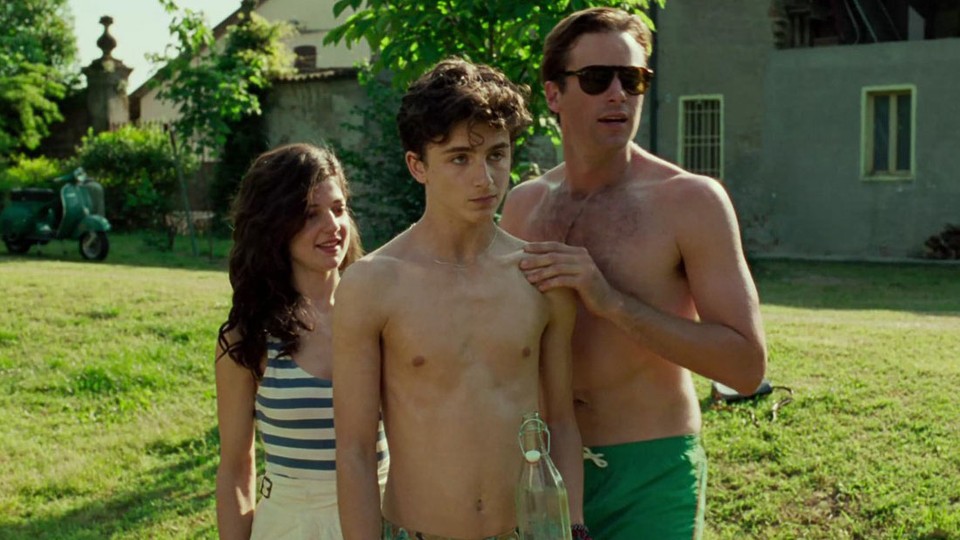
Around the one-hour and 20-minute mark of Call Me By Your Name, we finally see the beginnings of a moment between Elio and Oliver, the two protagonists and love interests. It is midnight after a party, and the two of them are standing side-by-side on a balcony. All you can hear is their breathing, a ruffling of shirts, and the high-pitched chirping of crickets. Oliver says, “I’m glad you came,” and lightly brushes his hand (holding a cigarette) over Elio’s before the two of them amble back inside the room. It’s summer in 1980s Italy, and both characters are wearing loose-fitting clothes, Oliver in a green rolled-up button-down and Elio in a white t-shirt and jeans. The camera lingers on their bodies as they slowly learn to get closer, Elio starting to lean more on Oliver and eventually, fully embracing him, hands in hair as they kiss and become more comfortable with each other. The intimacy increases as they get into bed, the camera spending a long time on their feet and then moving up to their bodies, and start to climb on top of each other, their breathing getting heavy and movements becoming more frantic. As Oliver strips off his belt, the camera pans away to look outside the window at the trees, only the sound of their breathing and faint crickets audible.
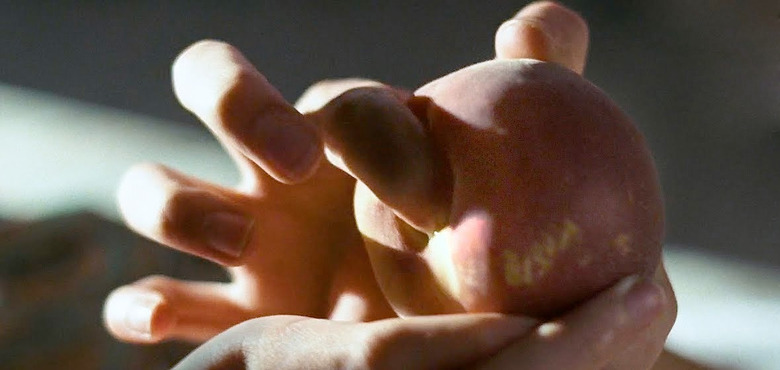
I found this scene a really interesting illustration of both Rodriguez’s “queer gestures” and Muñoz’s concept of a queer utopia. Although this scene represents a fulfillment of the potential for queer love (i.e. sex, or the implication of sex), this is not the first time that we sense queer undertones. Because they rarely speak to each other, some viewers may read Elio and Oliver’s budding relationship as platonic and far from the realm of sexual. And yet, what I think makes the film so powerful is its emphasis on queer gestures, that “socially legible and highly codified form of kinetic communication” that brings the two subtly and slowly together into a “we,” even if they don’t directly interact in ways customarily read as romantic (Rodriguez 6). So much of the film is predicated on those relational movements— the squeeze of a shoulder, the touching of a peach, a glance at a party—that by the time this specific scene rolls around, viewers already feel like the two have been involved in a kind of sensual, erotic play (and that this is the final, ultimate climax of those gestures). But even in this scene, gestures play a large role. When Elio moves his foot over Olivers, when they cling to each other, wrestling almost, they “counteract demands for corporeal conformity” and leave open space for a queer interpretation of the motions of their bodies (6).
Moving to Muñoz, part of this film’s appeal (and maybe also what makes it problematic) is its general tone of “not yet here” or “almost,” sharing the sentiment that “we may never touch queerness, but we can feel it as the warm illumination of a horizon imbued with potentiality” (Muñoz 1). A lot of this film just feels like waiting, but it is a waiting that is “laden with potentiality” (Rodriguez 5). Occuring at midnight, in that liminal space and time between the past and the future, this scene is situated perfectly in a moment that is “primarily about futurity and hope” (Muñoz 11). Its dark, isolated setting and limited diagetic sound also help create a spatially recognizable “queer horizon,” away from the oppressive gaze of others. This scene is also ripe with a sense of awkward hesitation and nervousness as the two characters fumble around each other, learning to touch each other in new ways and be together. This aligns with what Muñoz seems to be arguing for, that instead of being concerned fully with the here and now, there is a collapse in boundaries of what is and what could be; the trepidation of their actions—and the panning away of the camera— embodies his concept for queer utopia as “subjects can act in the present in the service of a new futurity,” a future that is excitable, but not fully in reach (16).
A scene that stood out to be in English television was the Bridgerton rendition of Indian wedding rituals. The show is set in old England, and it pleasantly surprised me that they have characters from India in their show. Particularly because of colonisation, a lot of people did move to England and beyond, so it would make sense to have this be part of the diversity in the show. It seemed natural and expected, rather than diversity being forced into a storyline where it doesn’t belong.
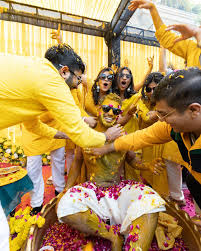
This part of the show has an Indian character engaged to the son of an old English family. This character, her sister and an older woman are taking part in a traditional Indian wedding ritual, called the Haldi ceremony. The background score is an instrumental version of a 90s bollywood song. The scene begins with traditional looking dishes in which someone is mixing turmeric and other ingredients for the ceremony. The background song has been remastered by using English instruments (like violins) for the Hindi song. There is a lot of yellow in the scene — from the clothes, to the marigolds, which are accurate for the traditional ceremony. Instead of Indian wear, the characters are wearing English-style dresses, and speak in a British accent. The ceremony only has three people, and seems to be taking place in the evening — which is unusual for this tradition. As are the candles that are lit in the back. The characters are discussing the upcoming nuptials. Apparently, the groom has pushed the wedding up, and the bride is nervous for it. She says that it is a clear sign of affection, but it has unnerved her. The women around her try to calm her down, as they apply turmeric on her arms. Their chats involve discussion about who the haldi is applied to and its significance — that the recipient finds a groom worthy of her — and the little sister (the bride) applies the paste to her older sister’s arms as well.
Instead of sunlight, bright outdoors, and a family-centred event, this one seems to be directed from a western perspective. It touches the values of the community briefly, but doesn’t take the time to delve deeper into why those customs are in place. While the storyline explains that the sisters are estranged from their grandparents, it seems strange to see no family at the wedding. Especially because Indian families are large, and everyone is invited to weddings — where the customs are primarily centred around bringing the family and friends together. Additionally, this ceremony would not take place in candlelight, but in the outdoors under the sun, or at least on a terrace and around tons of festivity. Showing Indian customs without the traditional outfits seems like an odd choice as well — if the sisters are tied to their roots enough to partake in this ceremony, why would the costume department not take more time and effort to give them appropriate traditional wear, especially for the time period they are in? Rather than traditional folk songs, the background is also an instrumental version of a popular song from 90s bollywood cinema. While the show does a good job of introducing these fleshed out characters and backstories, I wish more effort had been put into integrating their culture in this time period as well. The elements are superficially there, but not enough to make the ceremony believable or accurate for the population that resonates with this culture. There is a sense of exoticism of the characters’ backgrounds, but not an understanding. They are diverse at first glance, but their conversations, interpersonal dynamics, and even the visual elements of the scene are a westernised version of their culture.
Coming to gender dynamics, I am not surprised by the over representation of women in the scene. Especially in older times, there might be a difference in which gender attends which ceremony, and at times there might be a strict gender binary present. As the main characters, the women are depicted as beautiful, thoughtful and caring. I presume that the intended audience for this scene is the people in the Indian subcontinent, so I do wish there was more care taken to make the ceremony as accurate as possible, rather than a western product that only serves an exotic idea of the custom. As someone who is of the subcontinent, I am glad that there is an organic representation of this community in English media. However, I think we have a long way to go before the characters are shown as products of their time with appropriate depth, and the customs seem accurate to the time period and beliefs.